







Question: For Chemical Engineering Separations: 2. A defective RO membrane provides 6.5gal/ft2-day of drinking water with a little more salt than is preferred; only 97% of
For Chemical Engineering Separations:
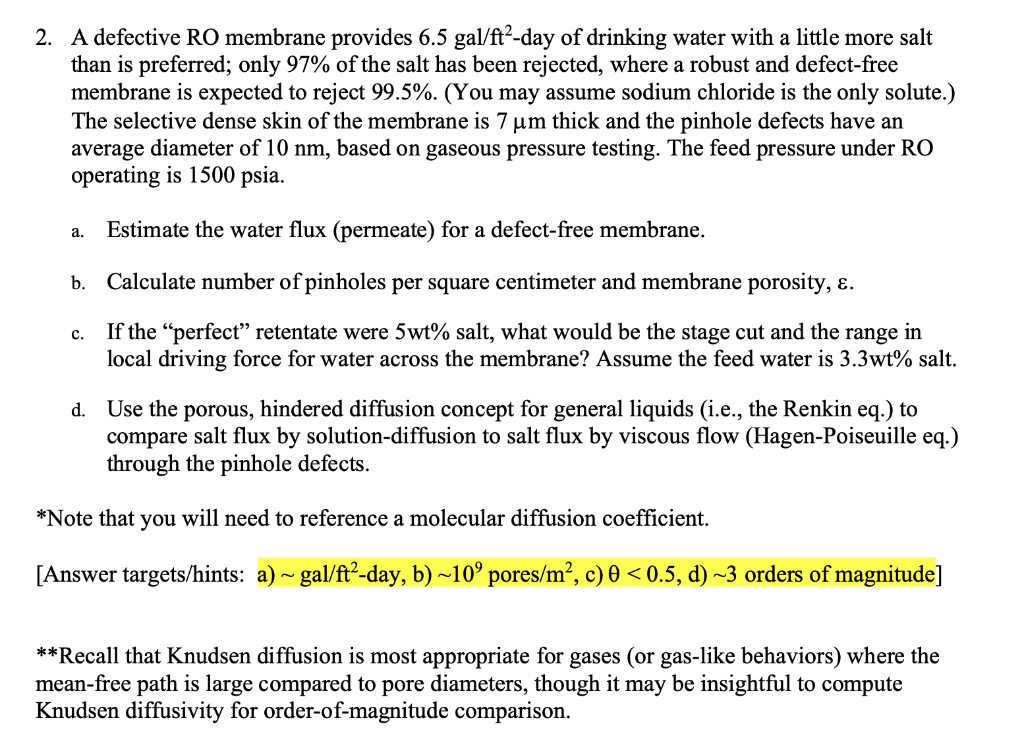
2. A defective RO membrane provides 6.5gal/ft2-day of drinking water with a little more salt than is preferred; only 97% of the salt has been rejected, where a robust and defect-free membrane is expected to reject 99.5%. (You may assume sodium chloride is the only solute.) The selective dense skin of the membrane is 7m thick and the pinhole defects have an average diameter of 10nm, based on gaseous pressure testing. The feed pressure under RO operating is 1500 psia. a. Estimate the water flux (permeate) for a defect-free membrane. b. Calculate number of pinholes per square centimeter and membrane porosity, . c. If the "perfect" retentate were 5wt% salt, what would be the stage cut and the range in local driving force for water across the membrane? Assume the feed water is 3.3wt% salt. d. Use the porous, hindered diffusion concept for general liquids (i.e., the Renkin eq.) to compare salt flux by solution-diffusion to salt flux by viscous flow (Hagen-Poiseuille eq.) through the pinhole defects. *Note that you will need to reference a molecular diffusion coefficient. [Answer targets/hints: a) gal /ft2-day, b) 109 pores /m2, c)
Step by Step Solution
There are 3 Steps involved in it

Get step-by-step solutions from verified subject matter experts
 Study Help