







Question: For discreet math, please answer ALL questions or none at all. Select the argument that is invalid. pqpqq pqpq pqppq Question 2 The domain for
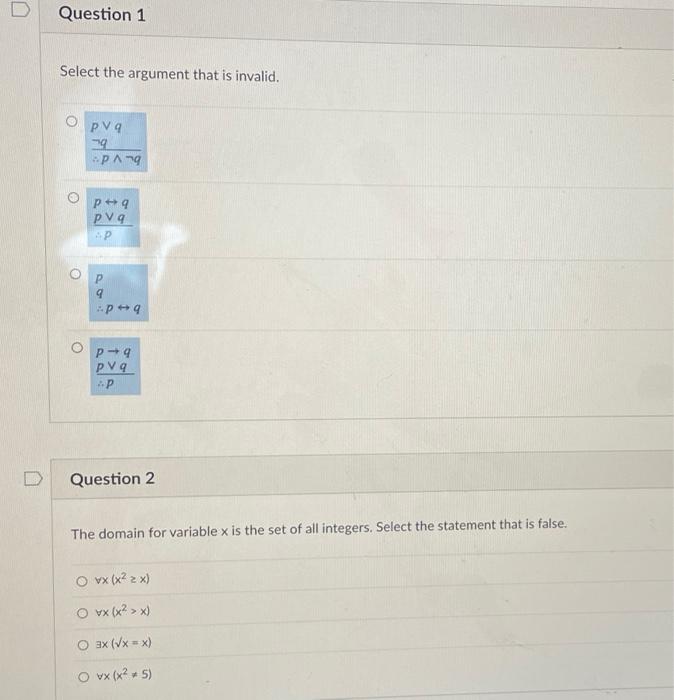
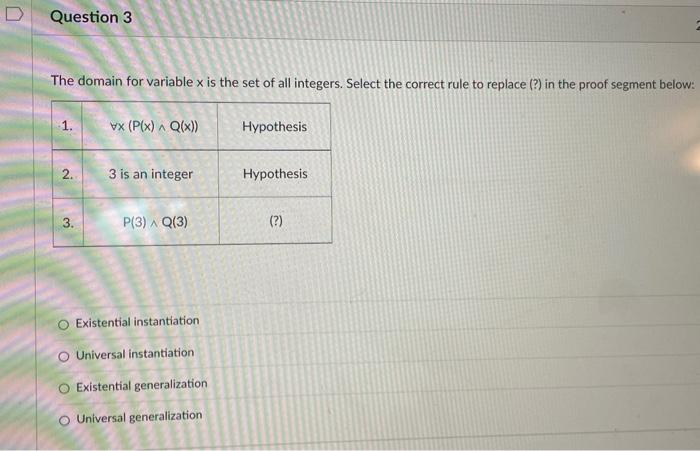
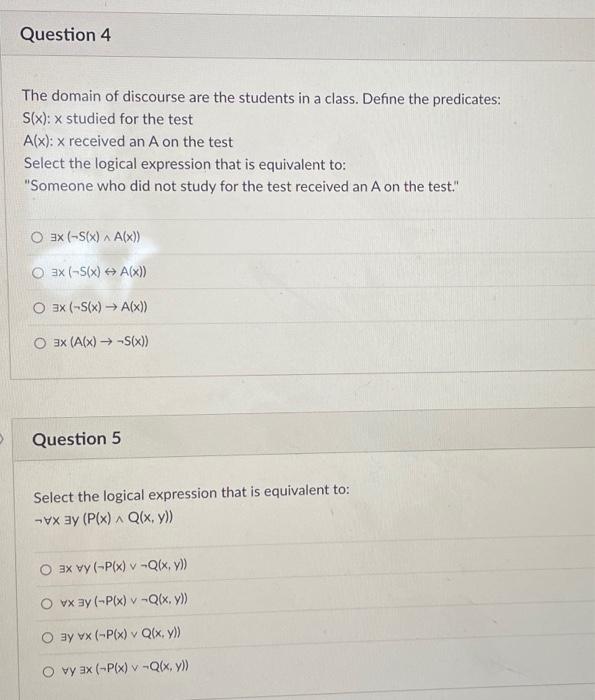
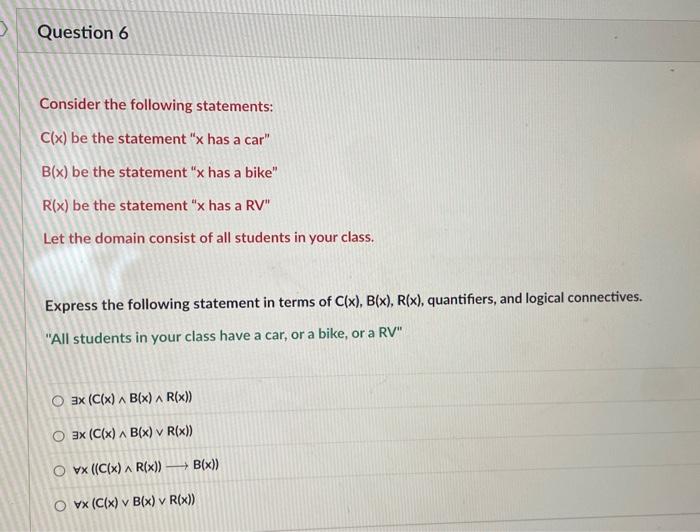
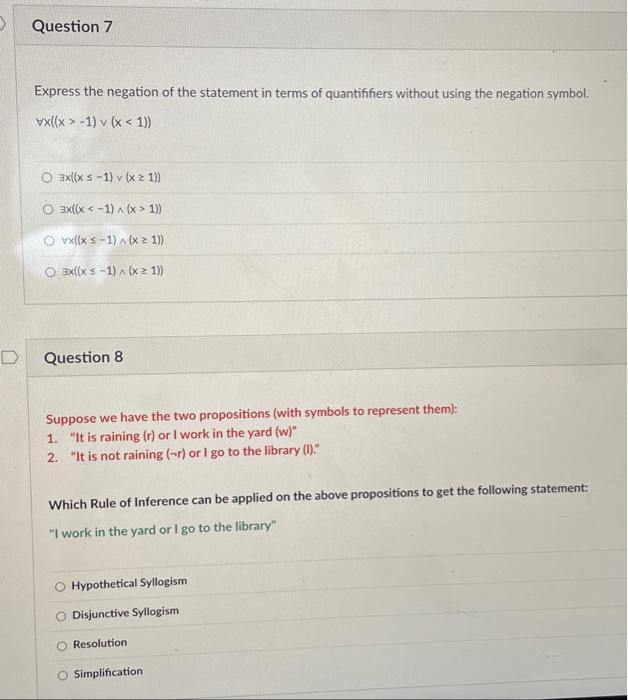
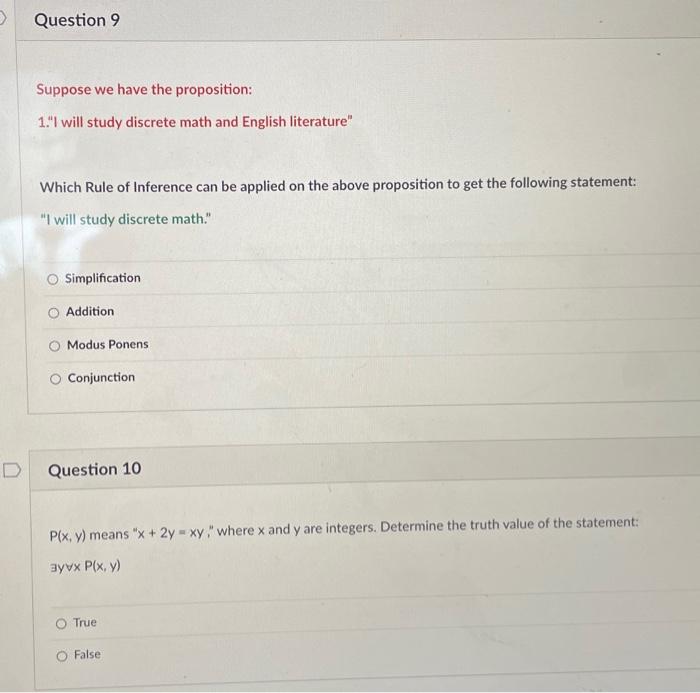
Select the argument that is invalid. pqpqq pqpq pqppq Question 2 The domain for variable x is the set of all integers. Select the statement that is false. x(x2x)x(x2>x)zx(x=x)x(x2=5) The domain for variable x is the set of all integers. Select the correct rule to replace (?) in the proof segment below: Existential instantiation Universal instantiation Existential generalization Universal generalization The domain of discourse are the students in a class. Define the predicates: S(x):x studied for the test A(x):x received an A on the test Select the logical expression that is equivalent to: "Someone who did not study for the test received an A on the test." x(S(x)A(x))x(S(x)A(x))x(S(x)A(x))x(A(x)S(x)) Question 5 Select the logical expression that is equivalent to: xy(P(x)Q(x,y)) 3xy(P(x)Q(x,y)) xy(P(x)Q(x,y)) y x(P(x)Q(x,y)) y=x(P(x)Q(x,y)) Let the domain consist of all students in your class. Express the following statement in terms of C(x),B(x),R(x), quantifiers, and logical connectives. "All students in your class have a car, or a bike, or a RV" x(C(x)B(x)R(x)) x(C(x)B(x)R(x)) x((C(x)R(x))B(x)) x(C(x)B(x)R(x)) Express the negation of the statement in terms of quantififiers without using the negation symbol. x((x>1)(x1))x((x1)(x1))x((x1)(x1)) Question 8 Suppose we have the two propositions (with symbols to represent them): 1. "It is raining (r) or I work in the yard (w)" 2. "It is not raining ( r) or I go to the library (l)." Which Rule of Inference can be applied on the above propositions to get the following statement: "I work in the yard or I go to the library" Hypothetical Syllogism Disjunctive Syllogism Resolution Simplification Suppose we have the proposition: 1."I will study discrete math and English literature" Which Rule of Inference can be applied on the above proposition to get the following statement: "I will study discrete math." Simplification Addition Modus Ponens Conjunction Question 10 P(x,y) means " x+2y=xy," where x and y are integers. Determine the truth value of the statement: y xP(x,y) True False
Step by Step Solution
There are 3 Steps involved in it

Get step-by-step solutions from verified subject matter experts
 Study Help