







Question: For discussion #1, due June 7th, you will answer the following prompts: How would you use the information obtained in a genogram and biopsychosocial assessment
For discussion #1, due June 7th, you will answer the following prompts:
- How would you use the information obtained in a genogram and biopsychosocial assessment with a client?
- Select a social issue that a client is dealing with that may cause a client discomfort when you are completing a genogram with them and explain how you would approach this conversation with the client.
For discussion #2, due June 9th, you will continue to analyze Maria from Topic 4 DQ 2 again.
Maria, a 34-year-old single mother of two children, ages 8 and 10, was referred to a social worker at a local community agency for assistance with housing and employment. Recently laid off from her part-time job, Maria is struggling to make ends meet and has received an eviction notice. During the initial meeting, Maria expressed feelings of stress and anxiety about her financial instability but was hesitant to go into detail about her personal circumstances.
As the social worker begins the assessment phase, Maria reveals that she has limited extended family support and has experienced periods of depression in the past, particularly after her divorce three years ago. She also expresses concerns about how the instability is affecting her children, especially her 10-year-old, who has been acting out in school.
The social worker must assess Maria's immediate needs while also considering the longer-term issues that may require attention, such as her mental health, family functioning, and access to community resources.
In the case of Maria, what is the role of the social worker during the assessment phase, and how does a comprehensive assessment contribute to both the immediate and long-term support of Maria? Additionally, what strategies should the social worker use to build trust with Maria, especially given her hesitancy to share personal information?
The assignment for this week is Biopsychosocial Assessment and Genogram Assignment.
Learning to complete biopsychosocial assessments and genograms is essential for social workers during the assessment stage of the Planned Change Process, helping them gain a comprehensive understanding of the client's life and the factors influencing their wellbeing. These tools allow social workers to assess biological, psychological, social, and spiritual dimensions while identifying family patterns and dynamics that impact clients. This assignment provides students the opportunity to practice and demonstrate their ability to use these tools effectively, which is critical for creating informed intervention plans. By mastering these skills, social workers enhance their ability to engage clients and address complex, interconnected challenges.
For this assignment, you are a social worker tasked with completing a biopsychosocial assessment on a mock client. You may use the mock client from Topic 4 assignment if you would like. Review theAppendix A: An Outline for a Biopsychosocial Assessment and Intervention Planlocated in the Topic Resources.
in a Word document using sections I-V headers for your biopsychosocial assessment. Written biopsychosocial assessments are narrative documents and not question and answer.
Genogram: Using the same mock client from the Biopsychosocial assessment, create a detailed three-generation genogram. You may use free websites such as Genopro, Creately, or Venngage, or software like Word or PowerPoint. No purchases or software downloads are required. Include the following in your Genogram:
Three Generations:
- Include the client, their parents' generation, and their grandparents' generation or their children. If relevant, you may add additional family members (e.g., extended family).
Five Descriptive Details per Family Member:
- In addition to name and gender, each family member must include at least four additional pieces of information. These could include:
- Date of birth/age
- Occupation or education level
- Marital status or significant relationships
- Health conditions (physical or mental)
- Substance use or abuse history
- Significant life events (e.g., divorce, death, trauma)
- Cultural background or religious affiliations
Family Dynamics:
- Use standardized genogram symbols to depict relationships (e.g., close, distant, conflicted, abusive, etc.).
- Show key family patterns such as divorces, separations, cohabitations, or remarriages.
Legend/Key:
- Provide a legend that clearly explains all symbols and relationship lines used (e.g., solid line for close relationships, dashed line for distant relationships).
include in text citations and refernces
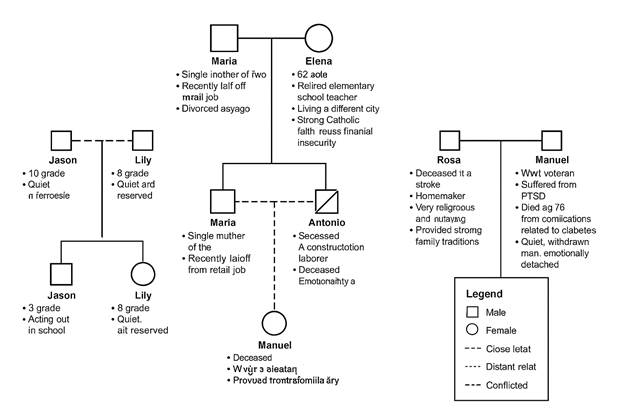 Maria Elena . Single inother of Two - 62 sole . Recently lalif off Relired elementary mrail job school teacher * Divorced asyago . Living a different city . Strong Catholic falth reuss finanial insecurity Jason Lily Rosa Manuel . 10 grade . B grade . Deceased it a . Wwt voteran . Quiet . Quiet ard stroke . Suffered from n ferrousic reserved . Homemaker PTSD . Very religroous . Died ag 76 Antonio and nutaymg from comications Maria . Provided stromg related to clabeles . Single muther . Secessed family traditions . Quiet, withdrawn of the A constructotion man, emotionally . Recently laioff laborer detached from retail job . Deceased Emotionally a Jason Lily Legend . 3 grade . 8 grade Male . Acting out . Quiet. in school ait reserved O Female Manuel =- - Close letat * Deceased . Wvor a aleatan -... Distant relat . Proved frontrafomiila ary me= Conflicted
Step by Step Solution
There are 3 Steps involved in it

Get step-by-step solutions from verified subject matter experts
 Study Help