







Question: For each case that you studied, (1) Compute the resonant natural frequency and the damping ratio. (2) Compare the resonant frequency you calculated to
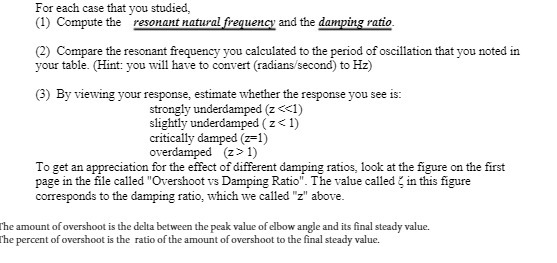
For each case that you studied, (1) Compute the resonant natural frequency and the damping ratio. (2) Compare the resonant frequency you calculated to the period of oscillation that you noted in your table. (Hint: you will have to convert (radians/second) to Hz) (3) By viewing your response, estimate whether the response you see is: strongly underdamped (z < 1) To get an appreciation for the effect of different damping ratios, look at the figure on the first page in the file called "Overshoot vs Damping Ratio". The value called in this figure corresponds to the damping ratio, which we called "z" above. The amount of overshoot is the delta between the peak value of elbow angle and its final steady value. The percent of overshoot is the ratio of the amount of overshoot to the final steady value.
Step by Step Solution
There are 3 Steps involved in it

Get step-by-step solutions from verified subject matter experts
 Study Help