







Question: For each initial value problem... 2. For each initialvalue problem, determine Whether Theorem 1 applies to show the existence of a unique solution in an
For each initial value problem...
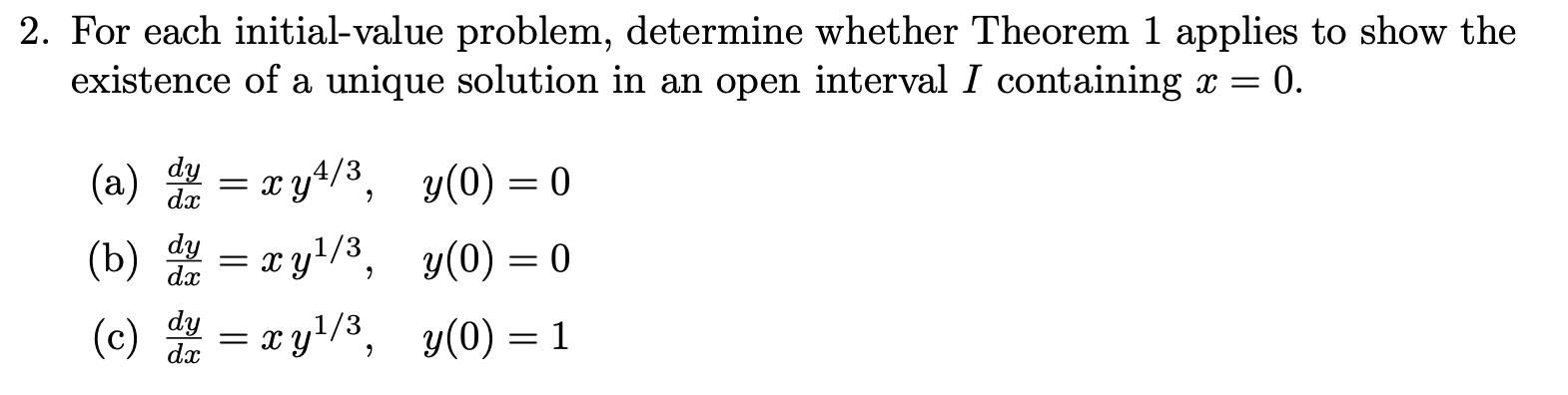
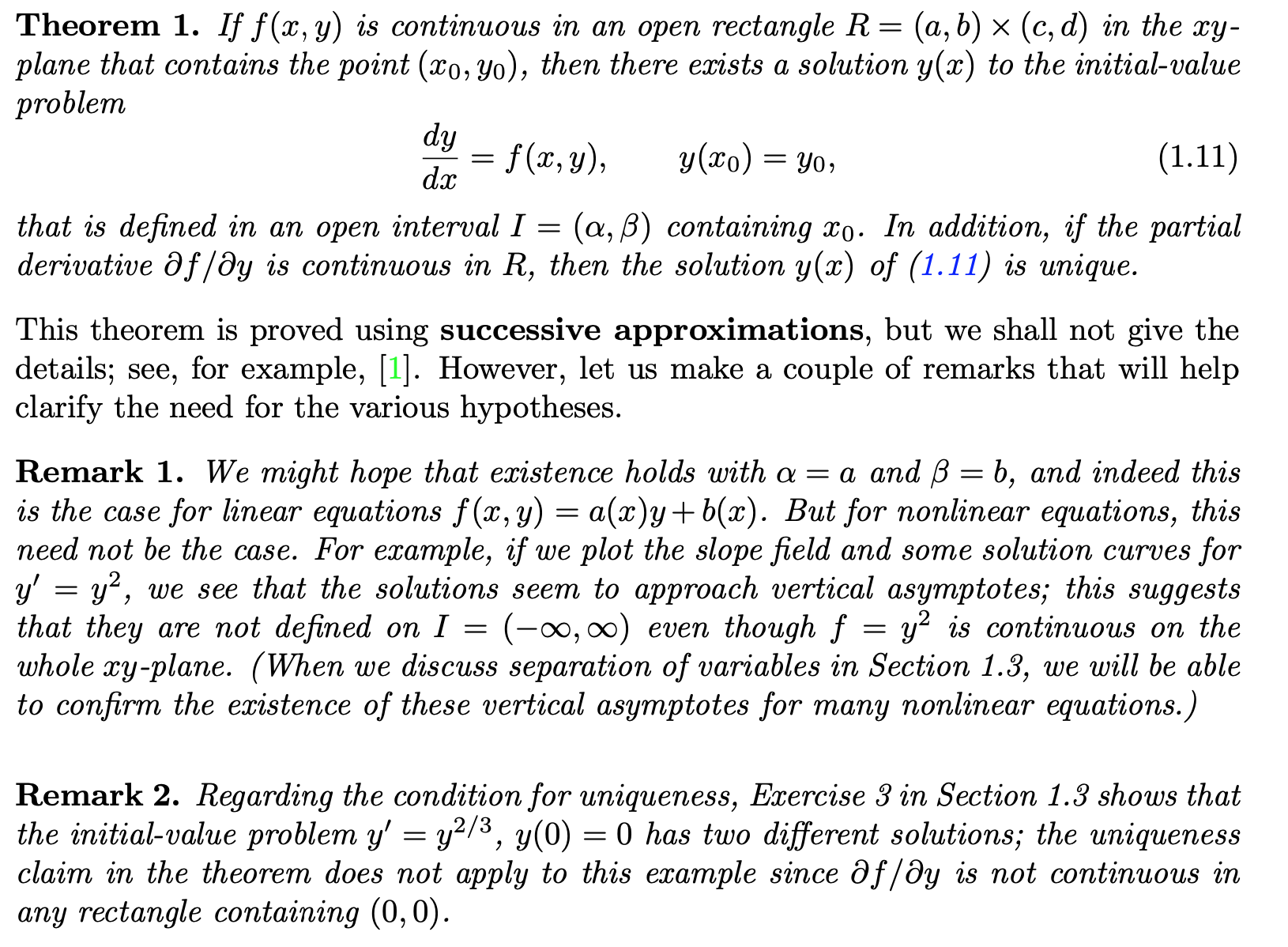
2. For each initialvalue problem, determine Whether Theorem 1 applies to show the existence of a unique solution in an open interval I containing a: = 0. (a) %=wy'\"3, y(0)=0 (b) 23,. = 3291/3, y(0) = 0 (C) 23 = 9391/3, 9(0) = 1 Theorem 1. If f (x, y) is continuous in an open rectangle R = (a, b) X (c, d) in the xy- plane that contains the point (x0, yo), then there exists a solution y(x) to the initial-value problem d g = ay). you = m. (1.11) that is dened in an open interval I = (01,3) containing x0. In addition, if the partial derivative 6 f /6y is continuous in R, then the solution y(x) of (1.11) is unique. This theorem is proved using successive approximations, but we shall not give the details; see, for example, [ ]. However, let us make a couple of remarks that will help clarify the need for the various hypotheses. Remark 1. We might hope that existence holds with a = a and ,8 = b, and indeed this is the case for linear equations f (x,y) = a(x)y+ b(x). But for nonlinear equations, this need not be the case. For example, if we plot the slope eld and some solution curves for y' = y2, we see that the solutions seem to approach vertical asymptotes; this suggests that they are not dened on I = (00,00) even though f = y2 is continuous on the whole xy-plane. ( When we discuss separation of variables in Section 1.3, we will be able to conrm the existence of these vertical asymptotes for many nonlinear equations.) Remark 2. Regarding the condition for uniqueness, Exercise 3 in Section 1.3 shows that the initial-value problem y' = y2/3, y(0) = 0 has two dierent solutions; the uniqueness claim in the theorem does not apply to this example since 6 f / y is not continuous in any rectangle containing (0,0)
Step by Step Solution
There are 3 Steps involved in it

Get step-by-step solutions from verified subject matter experts
 Study Help