







Question: For each of the code fragments below, determine: a. Which of the 8 simple branches (BPL, BMI, BNE, BEQ, BVC, BVS, BCC, BCS) are taken
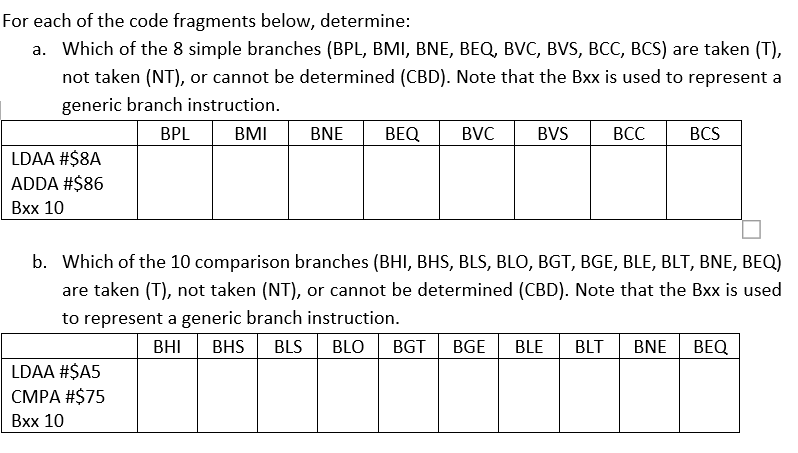
For each of the code fragments below, determine: a. Which of the 8 simple branches (BPL, BMI, BNE, BEQ, BVC, BVS, BCC, BCS) are taken (T), not taken (NT), or cannot be determined (CBD). Note that the Bxx is used to represent a generic branch instruction. BPL BMI BNE BEQ BVC BVS BCC BCS LDAA #$8A ADDA #$86 Bxx 10 b. Which of the 10 comparison branches (BHI, BHS, BLS, BLO, BGT, BGE, BLE, BLT, BNE, BEQ) are taken (T), not taken (NT), or cannot be determined (CBD). Note that the Bxx is used to represent a generic branch instruction. BHI BHS BLS BLO BGT BGE BLE BLT BNE BEQ LDAA #SA5 CMPA #$75 Bxx 10 For each of the code fragments below, determine: a. Which of the 8 simple branches (BPL, BMI, BNE, BEQ, BVC, BVS, BCC, BCS) are taken (T), not taken (NT), or cannot be determined (CBD). Note that the Bxx is used to represent a generic branch instruction. BPL BMI BNE BEQ BVC BVS BCC BCS LDAA #$8A ADDA #$86 Bxx 10 b. Which of the 10 comparison branches (BHI, BHS, BLS, BLO, BGT, BGE, BLE, BLT, BNE, BEQ) are taken (T), not taken (NT), or cannot be determined (CBD). Note that the Bxx is used to represent a generic branch instruction. BHI BHS BLS BLO BGT BGE BLE BLT BNE BEQ LDAA #SA5 CMPA #$75 Bxx 10
Step by Step Solution
There are 3 Steps involved in it

Get step-by-step solutions from verified subject matter experts
 Study Help