







Question: For fiber - reinforced two - phase composite materials with volume fraction c 1 for the fibers and c 2 for the matrix ) =
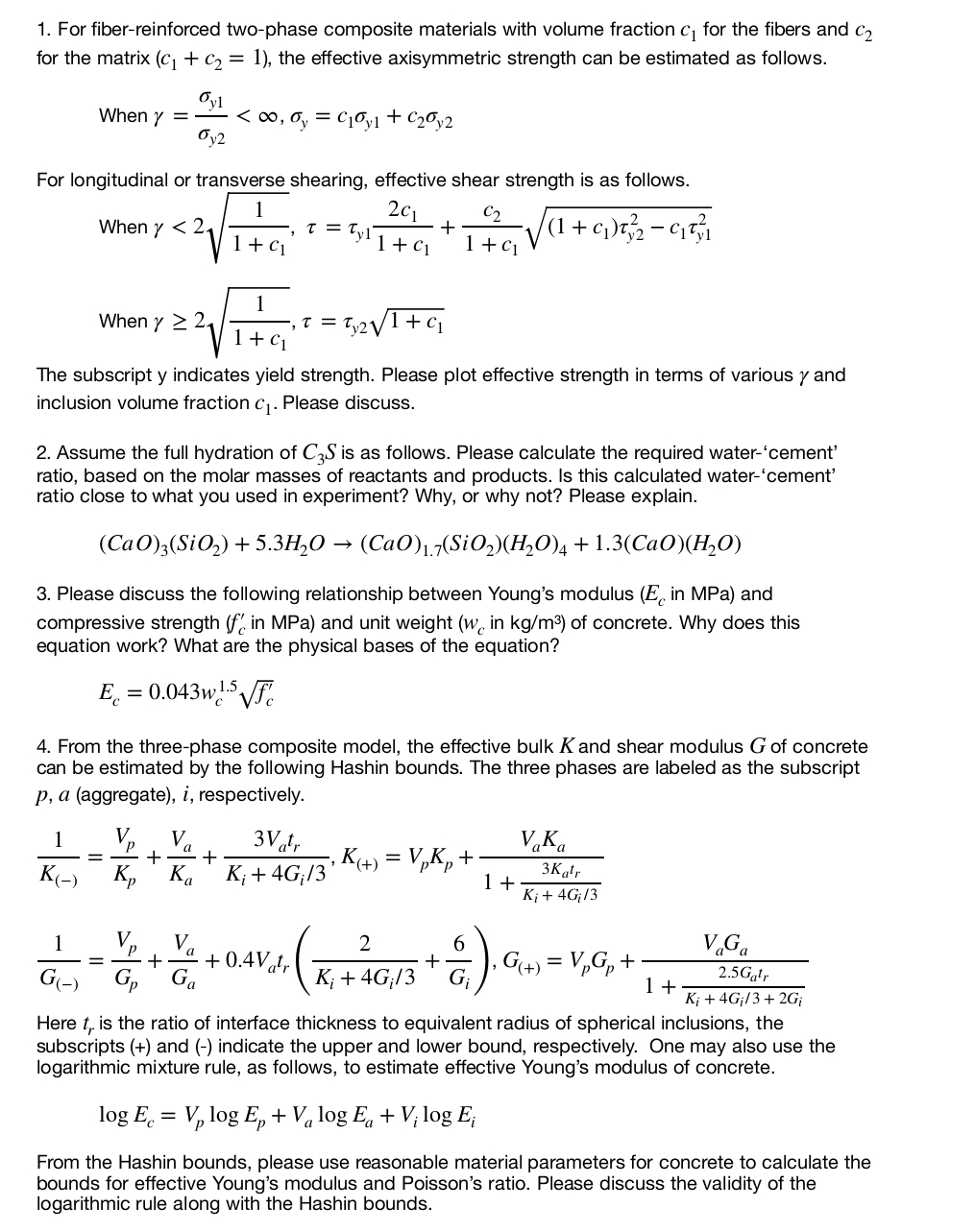
For fiberreinforced twophase composite materials with volume fraction for the fibers and for the matrix the effective axisymmetric strength can be estimated as follows.
When
For longitudinal or transverse shearing, effective shear strength is as follows.
When
When
The subscript indicates yield strength. Please plot effective strength in terms of various and inclusion volume fraction Please discuss.
Assume the full hydration of is as follows. Please calculate the required water'cement' ratio, based on the molar masses of reactants and products. Is this calculated water'cement' ratio close to what you used in experiment? Why, or why not? Please explain.
Please discuss the following relationship between Young's modulus in :MPa and compressive strength in MPa and unit weight in : of concrete. Why does this equation work? What are the physical bases of the equation?
From the threephase composite model, the effective bulk and shear modulus of concrete can be estimated by the following Hashin bounds. The three phases are labeled as the subscript aggregate respectively.
Here is the ratio of interface thickness to equivalent radius of spherical inclusions, the subscripts and indicate the upper and lower bound, respectively. One may also use the logarithmic mixture rule, as follows, to estimate effective Young's modulus of concrete.
From the Hashin bounds, please use reasonable material parameters for concrete to calculate the bounds for effective Young's modulus and Poisson's ratio. Please discuss the validity of the logarithmic rule along with the Hashin bounds.
Step by Step Solution
There are 3 Steps involved in it
1 Expert Approved Answer
Step: 1 Unlock

Question Has Been Solved by an Expert!
Get step-by-step solutions from verified subject matter experts
Step: 2 Unlock
Step: 3 Unlock
 Study Help