







Question: For fractions with repeating parts in binary representation, floating point must be approximate and the more bits used, the closer the approximation. For the following
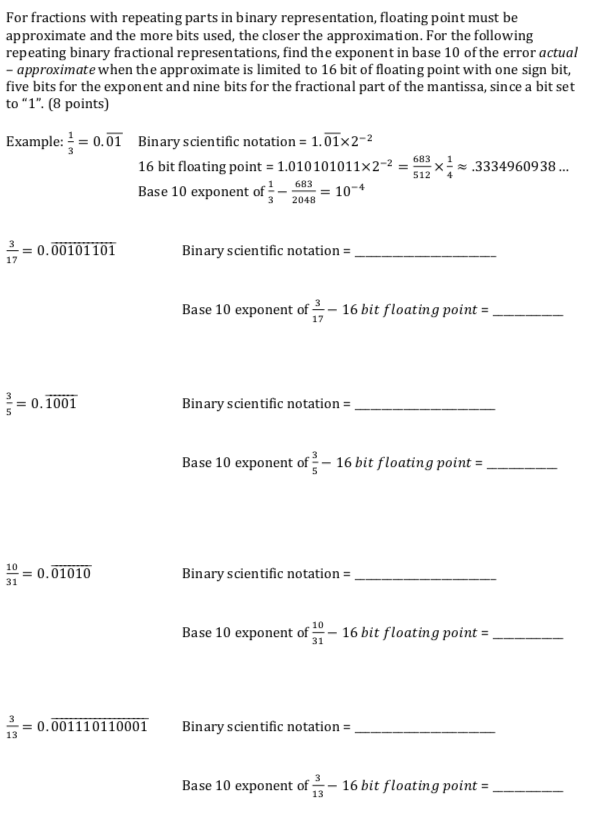
For fractions with repeating parts in binary representation, floating point must be approximate and the more bits used, the closer the approximation. For the following repeating binary fractional representations, find the exponent in base 10 of the error actual approximate when the approximate is limited to 16 bit of floating point with one sign bit, five bits for the exponent and nine bits for the fractional part of the mantissa, since a bit set to "1". (8 points) Example: 1=0.01 Binary scientific notation =1.012-2 16 bit floating point - 1.010101011x2-2 Base 10 exponent of 3 2048 685 x1 .3334960938.. 512 4 1 683 0.00101101 Binary scientific notation- 17 Base 10 exponent of 16 bit floating point = 0, 1001 Binary scientific notation = Base 10 exponent of- 16 bit floating point- 10 0.01010 Binary scientific notation = 31 10 Base 10 exponent of -16 bit floating point = 31 -=0.00 1 1 1 0110001 Binary scientific notation = 13 Base 10 exponent of 16 bit floating point = 13
Step by Step Solution
There are 3 Steps involved in it

Get step-by-step solutions from verified subject matter experts
 Study Help