



Question: For major league baseball teams, do higher player payrolls mean more gate money? Here are data for each of the American League teams in the
For major league baseball teams, do higher player payrolls mean more gate money? Here are data for each of the American League teams in the year2001. The variablexdenotes the player payroll (in millions of dollars) for the year2001, and the variableydenotes the mean attendance (in thousands of fans) for the81home games that year. The data are plotted in the scatter plot below, as is the least-squares regression line. The equation for this line is=^y=13.82+0.23x.
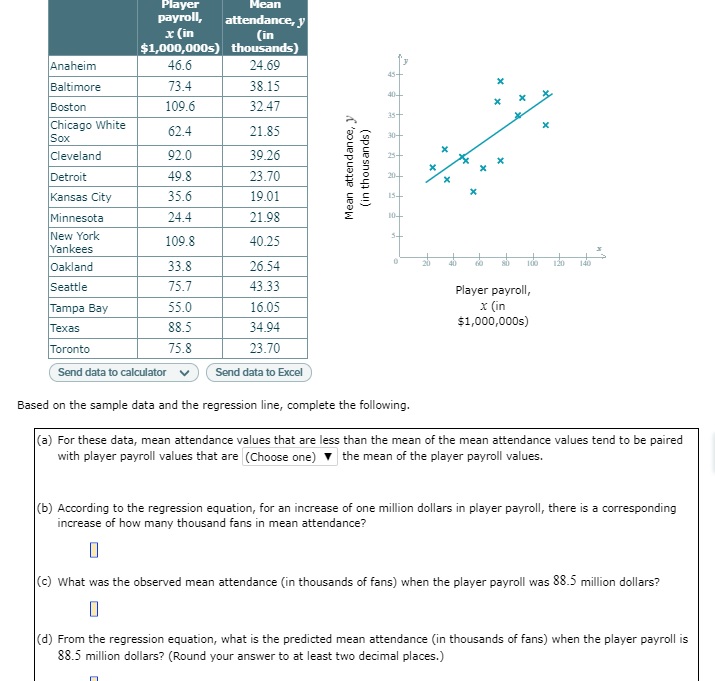
Player Mean payroll, attendance, y x (in (in $1,000,000s) thousands Anaheim 46.6 24.69 45- Baltimore 73.4 38.15 40- Boston 109.6 32.47 Chicago White 62.4 Sox 21.85 Cleveland 92.0 39.26 Mean attendance, y (in thousands) Detroit 49.8 23.70 Kansas City 35.6 19.01 Minnesota 24.4 21.98 10 New York 109.8 40.25 Yankees Oakland 33.8 26.54 120 140 Seattle 75.7 13.33 Player payroll, Tampa Bay 55.0 16.05 x (in Texas 88.5 34.94 $1,000,000s) Toronto 75.8 23.70 Send data to calculator Send data to Excel Based on the sample data and the regression line, complete the following. (a) For these data, mean attendance values that are less than the mean of the mean attendance values tend to be paired with player payroll values that are (Choose one) | the mean of the player payroll values. (b) According to the regression equation, for an increase of one million dollars in player payroll, there is a corresponding increase of how many thousand fans in mean attendance? 0 (c) What was the observed mean attendance (in thousands of fans) when the player payroll was 88.5 million dollars? 0 (d) From the regression equation, what is the predicted mean attendance (in thousands of fans) when the player payroll is 88.5 million dollars? (Round your answer to at least two decimal places.)
Step by Step Solution
There are 3 Steps involved in it

Get step-by-step solutions from verified subject matter experts