







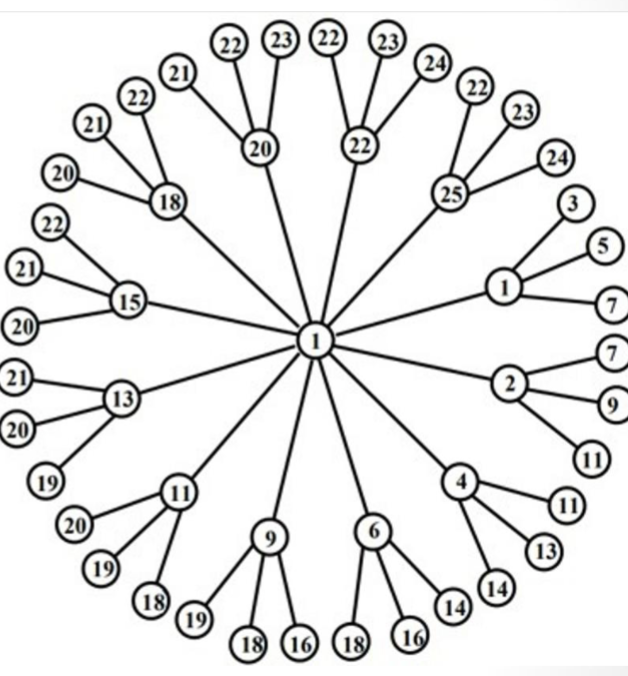
Question: For n > = 3 , homogenous amalgamated star Sn , m admits the edge irregular k - labeling. Order of Sn , m =
For n homogenous amalgamated
star Snm admits the edge irregular k
labeling.
Order of Snm m x n
Vertex label is at most k and the edge
weights are distinctive, thus Snm admits
the edge irregular klabeling.
kceilmn
Find out the best datastructure to represent store the graph in memory.
Devise an algorithm to assign the labels to the vertices using vertex k
labeling definition. Main Task
What design strategy you will apply, also give justifications that selected
strategy is most appropriate.
How traversing will be applied?
Store the labels of vertices and weights of the edges as an outcome.
Compare your results with mathematical property and tabulate the
outcomes for comparison.
Hardware resources supported until what maximum value of n m
Compute the Time Complexity of your algorithm TVE or Tn
conditions:
Output should be a graph
Edge weights should start from and They should be in sequence with all the edge weights
edge weights should be calculated such that sum of vertex labels
Vertex labels can be same or different
if the solution is with centroid vertex it will be easy
k is already mentioned in the problems
In Output graph, max vertex label value and k value should be same
Step by Step Solution
There are 3 Steps involved in it
1 Expert Approved Answer
Step: 1 Unlock

Question Has Been Solved by an Expert!
Get step-by-step solutions from verified subject matter experts
Step: 2 Unlock
Step: 3 Unlock
 Study Help