







Question: For numbers 17 to 18: Given the sequence 10, 7,3.4, -1 17 What is the next term? A 5 B C. 3 DO 18. What
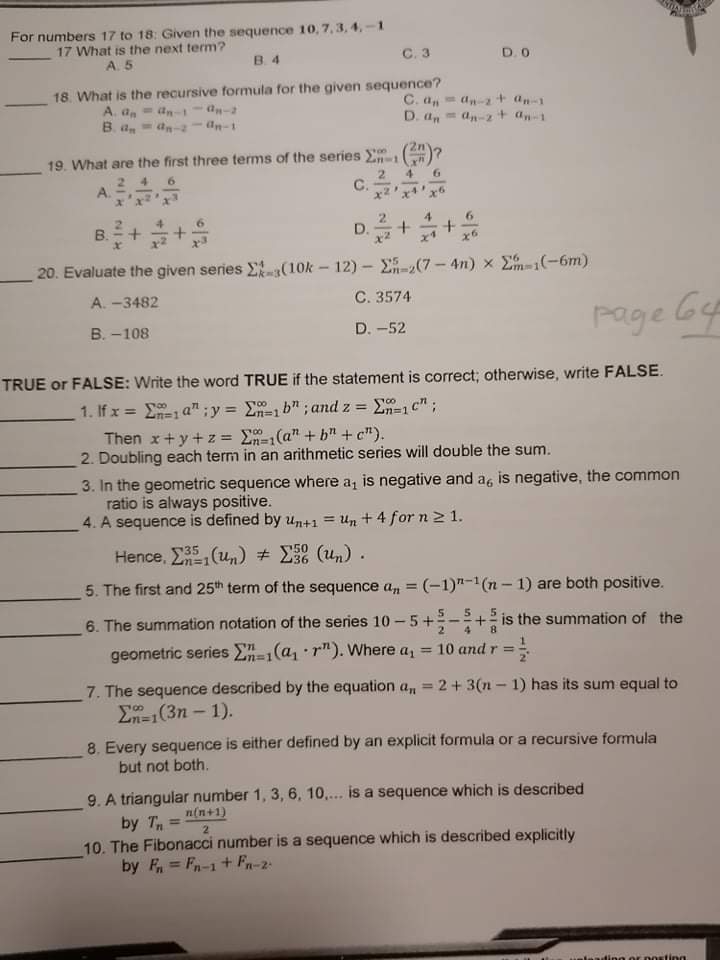
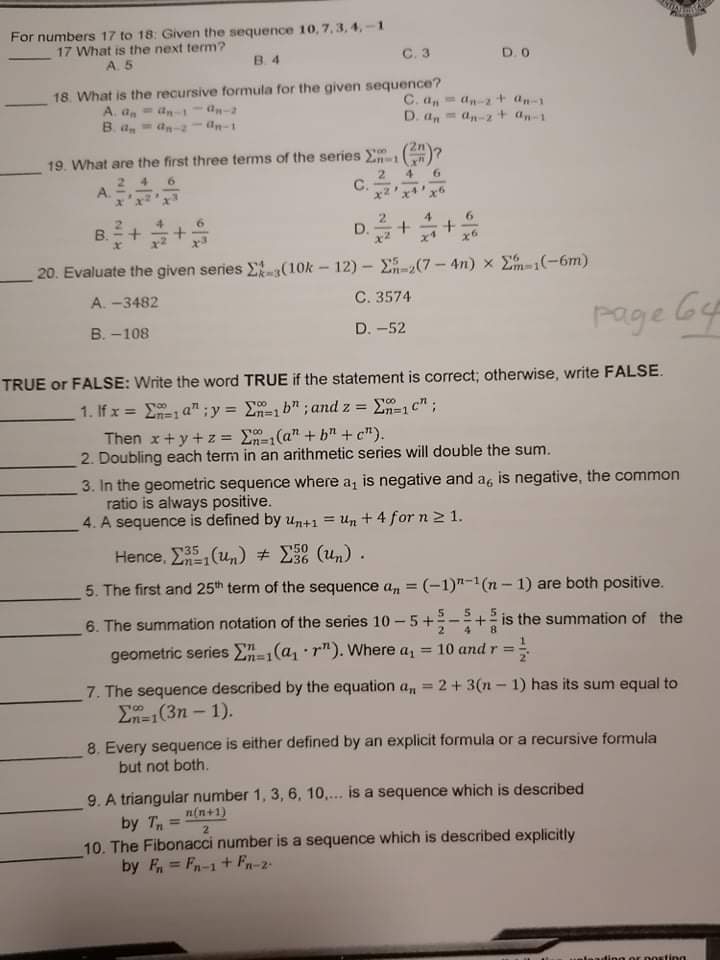
For numbers 17 to 18: Given the sequence 10, 7,3.4, -1 17 What is the next term? A 5 B C. 3 DO 18. What is the recursive formula for the given sequence? 19. What are the first three terms of the series ),, ( 24 2 46 A. C. B. D. 2 x2 + 6 2 6 20. Evaluate the given series _ (10k - 12) - ER (7 - 4n) x Em (-6m) A. -3482 C. 3574 B. -108 D. -52 page 64 TRUE or FALSE: Write the word TRUE if the statement is correct; otherwise, write FALSE. 1. If x = Enza" ;y = >=1b" ; and z = >n-, Then x + y + z = > 2n=(a" + b" + c"). 2. Doubling each term in an arithmetic series will double the sum. 3. In the geometric sequence where a, is negative and a, is negative, the common ratio is always positive. 4. A sequence is defined by un+1 = Un + 4 for n 2 1. Hence, En=1 235 (un) # Es8 (un) . 5. The first and 25th term of the sequence a, = (-1)"-1(n - 1) are both positive. 6. The summation notation of the series 10 - 5 + - - + is the summation of the geometric series _n=, (d, . r"). Where a, = 10 and r = 7. The sequence described by the equation a,, = 2 + 3(n - 1) has its sum equal to Zn=(3n -1). 8. Every sequence is either defined by an explicit formula or a recursive formula but not both. 9. A triangular number 1, 3, 6, 10.... is a sequence which is described by T, = "(n+1) 2 10. The Fibonacci number is a sequence which is described explicitly by En = Fa-1 + Fr-2
Step by Step Solution
There are 3 Steps involved in it

Get step-by-step solutions from verified subject matter experts
 Study Help