







Question: for OPERATING SYSTEMS Segmentation Q1. Consider a program consists of five segments: S0 = 600, S1 = 14 KB, S2= 100 KB, S3 =580 KB,
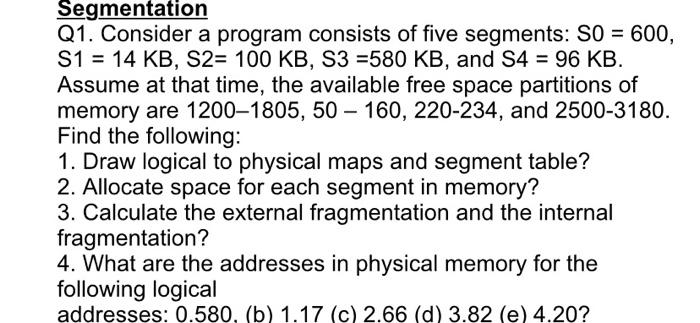
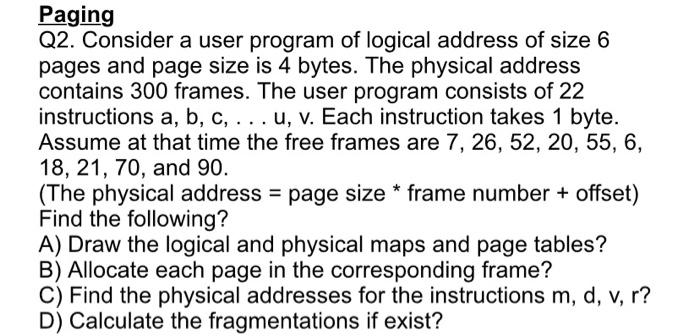
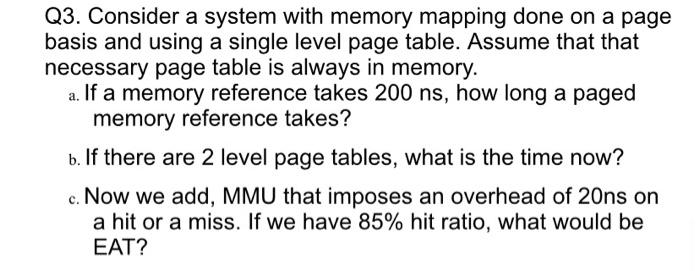
Segmentation Q1. Consider a program consists of five segments: S0 = 600, S1 = 14 KB, S2= 100 KB, S3 =580 KB, and S4 = 96 KB. Assume at that time, the available free space partitions of memory are 12001805, 50 160, 220-234, and 2500-3180. Find the following: 1. Draw logical to physical maps and segment table? 2. Allocate space for each segment in memory? 3. Calculate the external fragmentation and the internal fragmentation? 4. What are the addresses in physical memory for the following logical addresses: 0.580. (b) 1.17 (c) 2.66 (d) 3.82 (e) 4.20? Paging Q2. Consider a user program of logical address of size 6 pages and page size is 4 bytes. The physical address contains 300 frames. The user program consists of 22 instructions a, b, c, ... u, v. Each instruction takes 1 byte. Assume at that time the free frames are 7, 26, 52, 20, 55, 6, 18, 21, 70, and 90. (The physical address = page size * frame number + offset) Find the following? A) Draw the logical and physical maps and page tables? B) Allocate each page in the corresponding frame? C) Find the physical addresses for the instructions m, d, v, r? D) Calculate the fragmentations if exist? Q3. Consider a system with memory mapping done on a page basis and using a single level page table. Assume that that necessary page table is always in memory. a. If a memory reference takes 200 ns, how long a paged memory reference takes? b. If there are 2 level page tables, what is the time now? c. Now we add, MMU that imposes an overhead of 20ns on a hit or a miss. If we have 85% hit ratio, what would be EAT
Step by Step Solution
There are 3 Steps involved in it

Get step-by-step solutions from verified subject matter experts
 Study Help