Question: For problem 2, you will use the rules governing DFD which are summarized in Tables 7-2 and 7-3 and suggestions on correct and incorrect ways
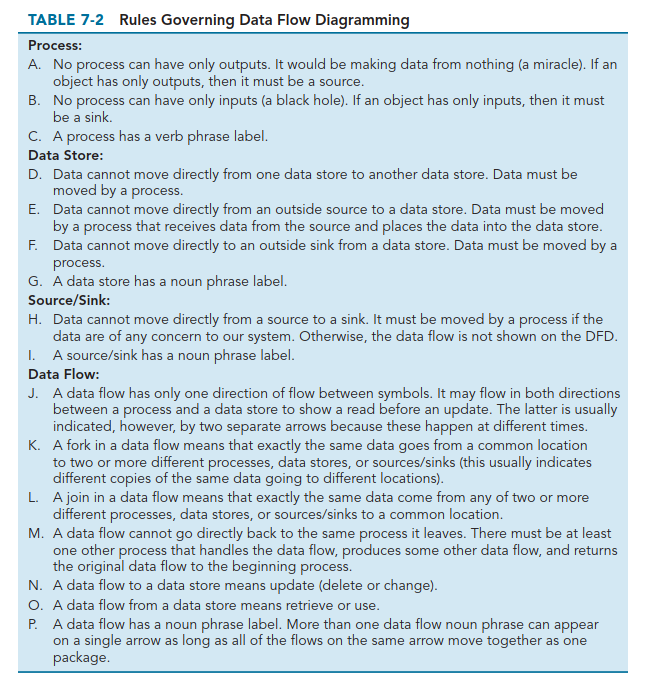
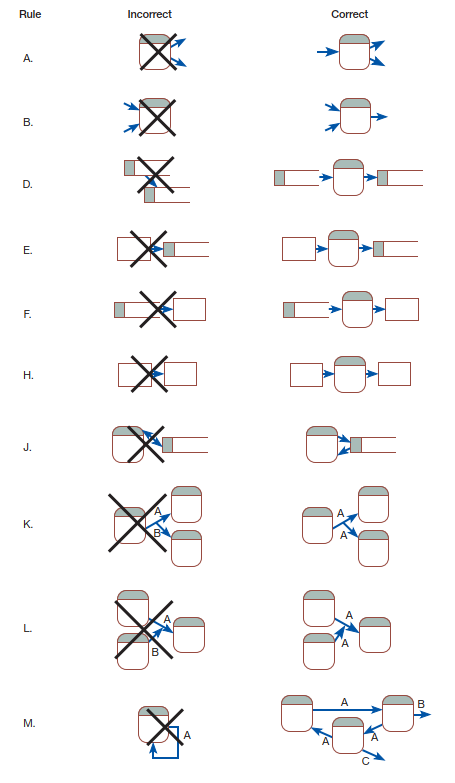
For problem 2, you will use the rules governing DFD which are summarized in Tables 7-2 and 7-3 and suggestions on correct and incorrect ways to draw a DFD.
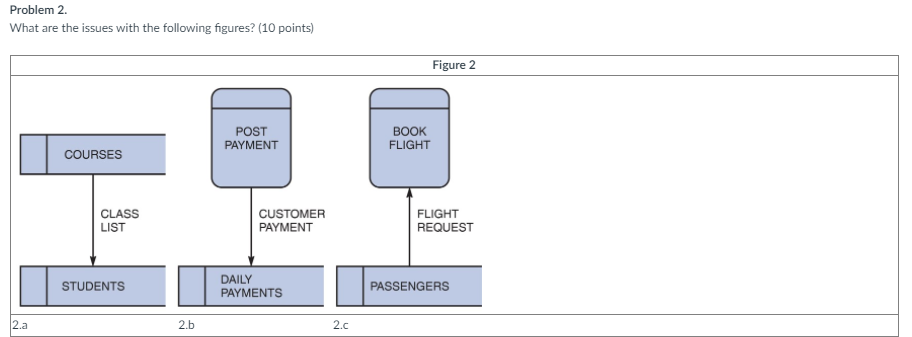
2A: The image in 2A breaks rule D which states that "data cannot move directly from one data store to another data store." It must be moved by a process
2B: The image in 2B breaks rule A which states that "no process can have only outputs. It would be making data from nothing. If an object has only outputs, then it must be a source."
2C: The image in 2C breaks rule B which states that "no process can have only inputs. If an object has only inputs, then it must be a sink."
State your answer in your own words.
Problem 2. What are the issues with the following figures? (10 points) Figure 2 POST PAYMENT BOOK FLIGHT COURSES CLASS LIST CUSTOMER PAYMENT FLIGHT REQUEST DAILY STUDENTS PAYMENTS PASSENGERS 2.a 2.b 2.c TABLE 7-2 Rules Governing Data Flow Diagramming Process: A. No process can have only outputs. It would be making data from nothing (a miracle). If an object has only outputs, then it must be a source. B. No process can have only inputs (a black hole). If an object has only inputs, then it must be a sink. C. A process has a verb phrase label. Data Store: D. Data cannot move directly from one data store to another data store. Data must be moved by a process. E. Data cannot move directly from an outside source to a data store. Data must be moved by a process that receives data from the source and places the data into the data store. F. Data cannot move directly to an outside sink from a data store. Data must be moved by a process. G. A data store has a noun phrase label. Source/Sink: H. Data cannot move directly from a source to a sink. It must be moved by a process if the data are of any concern to our system. Otherwise, the data flow is not shown on the DFD. I. A source/sink has a noun phrase label. Data Flow: J. A data flow has only one direction of flow between symbols. It may flow in both directions between a process and a data store to show a read before an update. The latter is usually indicated, however, by two separate arrows because these happen at different times. K. A fork in a data flow means that exactly the same data goes from a common location to two or more different processes, data stores, or sources/sinks (this usually indicates different copies of the same data going to different locations). L. A join in a data flow means that exactly the same data come from any of two or more different processes, data stores, or sources/sinks to a common location. M. A data flow cannot go directly back to the same process it leaves. There must be at least one other process that handles the data flow, produces some other data flow, and returns the original data flow to the beginning process. N. A data flow to a data store means update (delete or change). O. A data flow from a data store means retrieve or use. P. A data flow has a noun phrase label. More than one data flow noun phrase can appear on a single arrow as long as all of the flows on the same arrow move together as one package Rule Incorrect Correct A. 00 D. E F. H. J. K. OO L. B M. *









 Study Help