





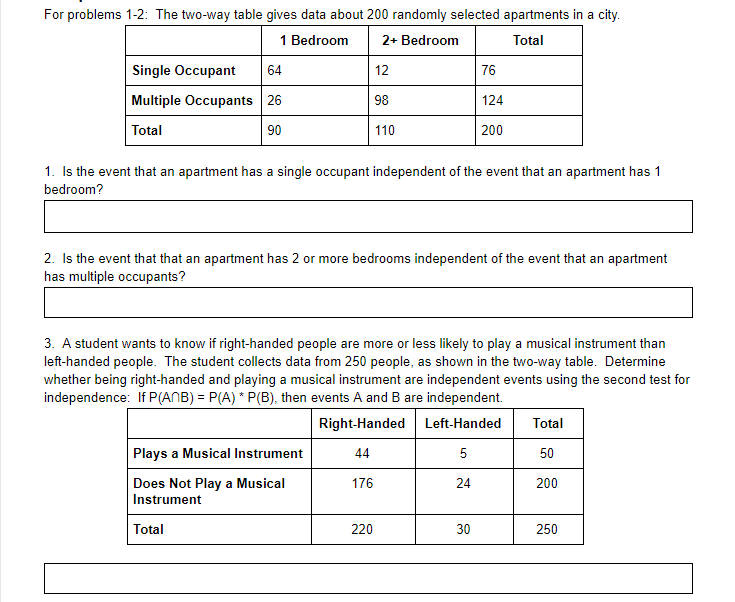
Question: For problems 1-2: The two-way table gives data about 200 randomly selected apartments in a city. 1 Bedroom 2+ Bedroom Total Single Occupant 64 12
For problems 1-2: The two-way table gives dataFor problems 1-2: The two-way table gives dataFor problems 1-2: The two-way table gives data
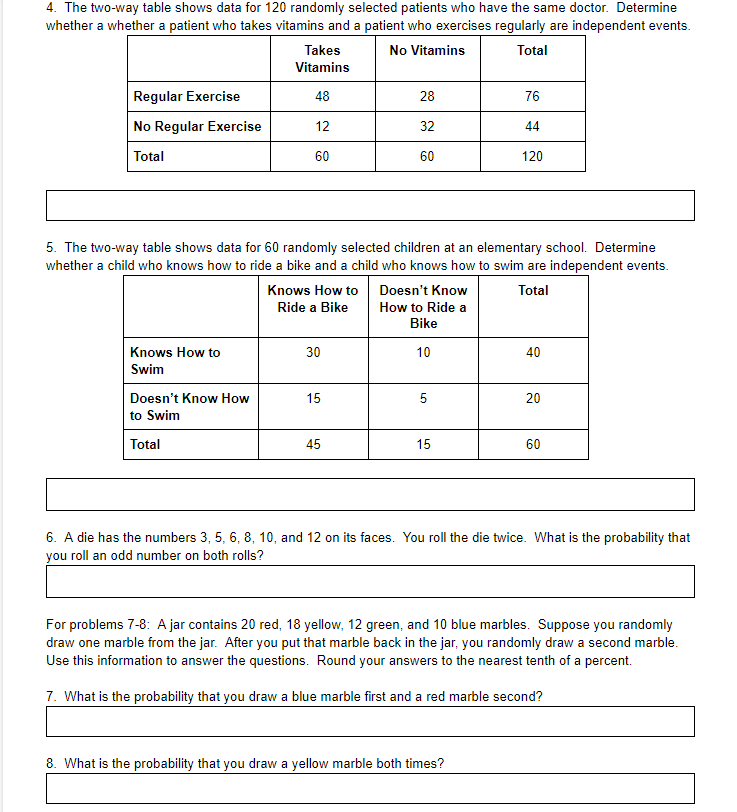
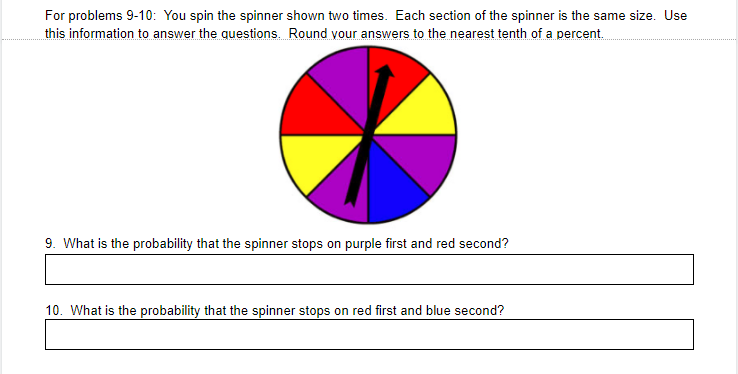
For problems 1-2: The two-way table gives data about 200 randomly selected apartments in a city. 1 Bedroom 2+ Bedroom Total Single Occupant 64 12 76 Multiple Occupants |26 98 124 Total 90 110 200 1. Is the event that an apartment has a single occupant independent of the event that an apartment has 1 bedroom? 2. Is the event that that an apartment has 2 or more bedrooms independent of the event that an apartment has multiple occupants? 3. A student wants to know if right-handed people are more or less likely to play a musical instrument than left-handed people. The student collects data from 250 people, as shown in the two-way table. Determine whether being right-handed and playing a musical instrument are independent events using the second test for independence: If P(AnB) = P(A) *P(B), then events A and B are independent. Right-Handed Left-Handed Total Plays a Musical Instrument 44 5 50 Does Not Play a Musical 176 24 200 Instrument Total 220 30 2504. The two-way table shows data for 120 randomly selected patients who have the same doctor. Determine whether a whether a patient who takes vitamins and a patient who exercises regularly are independent events. Takes No Vitamins Total Vitamins Regular Exercise 18 28 76 No Regular Exercise 12 32 44 Total 60 60 120 5. The two-way table shows data for 60 randomly selected children at an elementary school. Determine whether a child who knows how to ride a bike and a child who knows how to swim are independent events. Knows How to Doesn't Know Total Ride a Bike How to Ride a Bike Knows How to 30 10 40 Swim Doesn't Know How 15 5 20 to Swim Total 45 15 60 6. A die has the numbers 3, 5, 6, 8, 10, and 12 on its faces. You roll the die twice. What is the probability that you roll an odd number on both rolls? For problems 7-8: A jar contains 20 red, 18 yellow, 12 green, and 10 blue marbles. Suppose you randomly draw one marble from the jar. After you put that marble back in the jar, you randomly draw a second marble. Use this information to answer the questions. Round your answers to the nearest tenth of a percent. 7. What is the probability that you draw a blue marble first and a red marble second? 8. What is the probability that you draw a yellow marble both times?For problems 9-10: You spin the spinner shown two times. Each section of the spinner is the same size. Use this information to answer the questions. Round your answers to the nearest tenth of a percent, 9. What is the probability that the spinner stops on purple first and red second? 10. What is the probability that the spinner stops on red first and blue second
Step by Step Solution

There are 3 Steps involved in it

1 Expert Approved Answer
Step: 1 Unlock blur-text-image

Question Has Been Solved by an Expert!

Get step-by-step solutions from verified subject matter experts

Step: 2 Unlock
Step: 3 Unlock

Students Have Also Explored These Related Mathematics Questions!