







Question: For problems 3 and 4, we want to define two new logical operators called nand and npand. Given two propositions p and q, we will
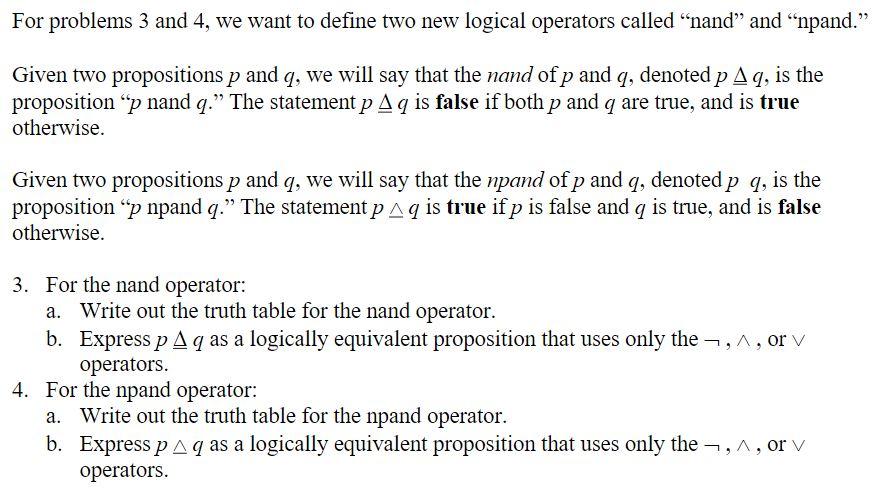
For problems 3 and 4, we want to define two new logical operators called "nand and npand." Given two propositions p and q, we will say that the nand of p and q, denoted p Aq, is the proposition p nand q." The statement p Aq is false if both p and q are true, and is true otherwise. Given two propositions p and q, we will say that the npand of p and q, denoted p q, is the proposition p npand q. The statement paq is true if p is false and q is true, and is false otherwise. 3. For the nand operator: a. Write out the truth table for the nand operator. b. Express p Aq as a logically equivalent proposition that uses only the-,, or v operators. 4. For the npand operator: a. Write out the truth table for the npand operator. b. Express Paq as a logically equivalent proposition that uses only the ~, 1, or v operators
Step by Step Solution
There are 3 Steps involved in it

Get step-by-step solutions from verified subject matter experts
 Study Help