







Question: For simplicity, we assume that there is no random delay when broadcasting control messages and all broadcast can be successfully received. We also ignore the
For simplicity, we assume that there is no random delay when broadcasting control messages and all broadcast can be successfully received. We also ignore the local repair mechanism.
The testing begins when nodes B and C begin to move, and it ends when nodes B and C arrive at their destinations (the point D and the point A respectively). What is the throughput (in bps) for this testing scenario? To obtain full mark, you need to illustrate the detailed operations of AODV in this test scenario and show your calculation step by step.
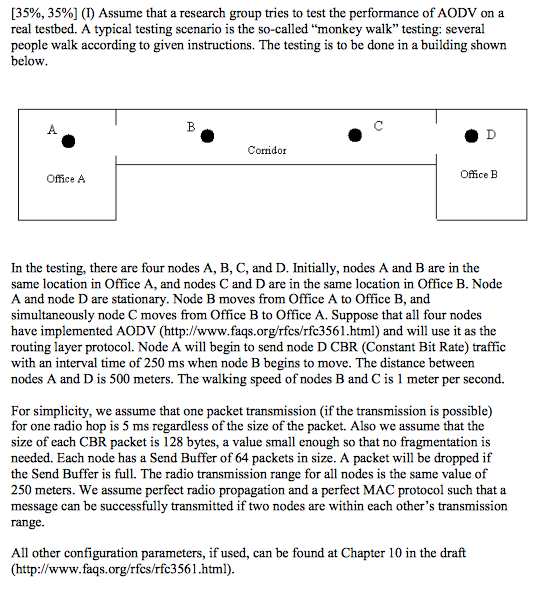
35%, 35%) (1) Assume that a research group tries to test the performance of AODV on a real testbed. A typical testing scenario is the so-called "monkey walk" testing: several people walk according to given instructions. The testing is to be done in a building shown below A. Corridor Office A Office B In the testing, there are four nodes A, B, C, and D. Initially, nodes A and B are in the same location in Office A, and nodes C and D are in the same location in Office B. Node A and node D are stationary. Node B moves from Office A to Office B, and simultaneously node C moves from Office B to Office A. Suppose that all four nodes have implemented AODV (http://www.faqs.org/rfcs/rfc3561.html) and will use it as the routing layer protocol. Node A will begin to send node D CBR (Constant Bit Rate) traffic with an interval time of 250 ms when node B begins to move. The distance between nodes A and D is 500 meters. The walking speed of nodes B and C is 1 meter per second. For simplicity, we assume that one packet transmission (if the transmission is possible) for one radio hop is 5 ms regardless of the size of the packet. Also we assume that the size of each CBR packet is 128 bytes, a value small enough so that no fragmentation is needed. Each node has a Send Buffer of 64 packets in size. A packet will be dropped if the Send Buffer is full. The radio transmission range for all nodes is the same value of 250 meters. We assume perfect radio propagation and a perfect MAC protocol such thata message can be successfully transmitted if two nodes are within each other's transmission range. All other configuration parameters, if used, can be found at Chapter 10 in the draft (http://www.faqs.org/rfcs/rfc3561.html). 35%, 35%) (1) Assume that a research group tries to test the performance of AODV on a real testbed. A typical testing scenario is the so-called "monkey walk" testing: several people walk according to given instructions. The testing is to be done in a building shown below A. Corridor Office A Office B In the testing, there are four nodes A, B, C, and D. Initially, nodes A and B are in the same location in Office A, and nodes C and D are in the same location in Office B. Node A and node D are stationary. Node B moves from Office A to Office B, and simultaneously node C moves from Office B to Office A. Suppose that all four nodes have implemented AODV (http://www.faqs.org/rfcs/rfc3561.html) and will use it as the routing layer protocol. Node A will begin to send node D CBR (Constant Bit Rate) traffic with an interval time of 250 ms when node B begins to move. The distance between nodes A and D is 500 meters. The walking speed of nodes B and C is 1 meter per second. For simplicity, we assume that one packet transmission (if the transmission is possible) for one radio hop is 5 ms regardless of the size of the packet. Also we assume that the size of each CBR packet is 128 bytes, a value small enough so that no fragmentation is needed. Each node has a Send Buffer of 64 packets in size. A packet will be dropped if the Send Buffer is full. The radio transmission range for all nodes is the same value of 250 meters. We assume perfect radio propagation and a perfect MAC protocol such thata message can be successfully transmitted if two nodes are within each other's transmission range. All other configuration parameters, if used, can be found at Chapter 10 in the draft (http://www.faqs.org/rfcs/rfc3561.html)
Step by Step Solution
There are 3 Steps involved in it

Get step-by-step solutions from verified subject matter experts
 Study Help