







Question: For Step 3 only, describe how your team will perform this exercise for this project, in order to achieve the step-by-step procedure suggested by the
For Step 3 only, describe how your team will perform this exercise for this project, in order to achieve the step-by-step procedure suggested by the author.
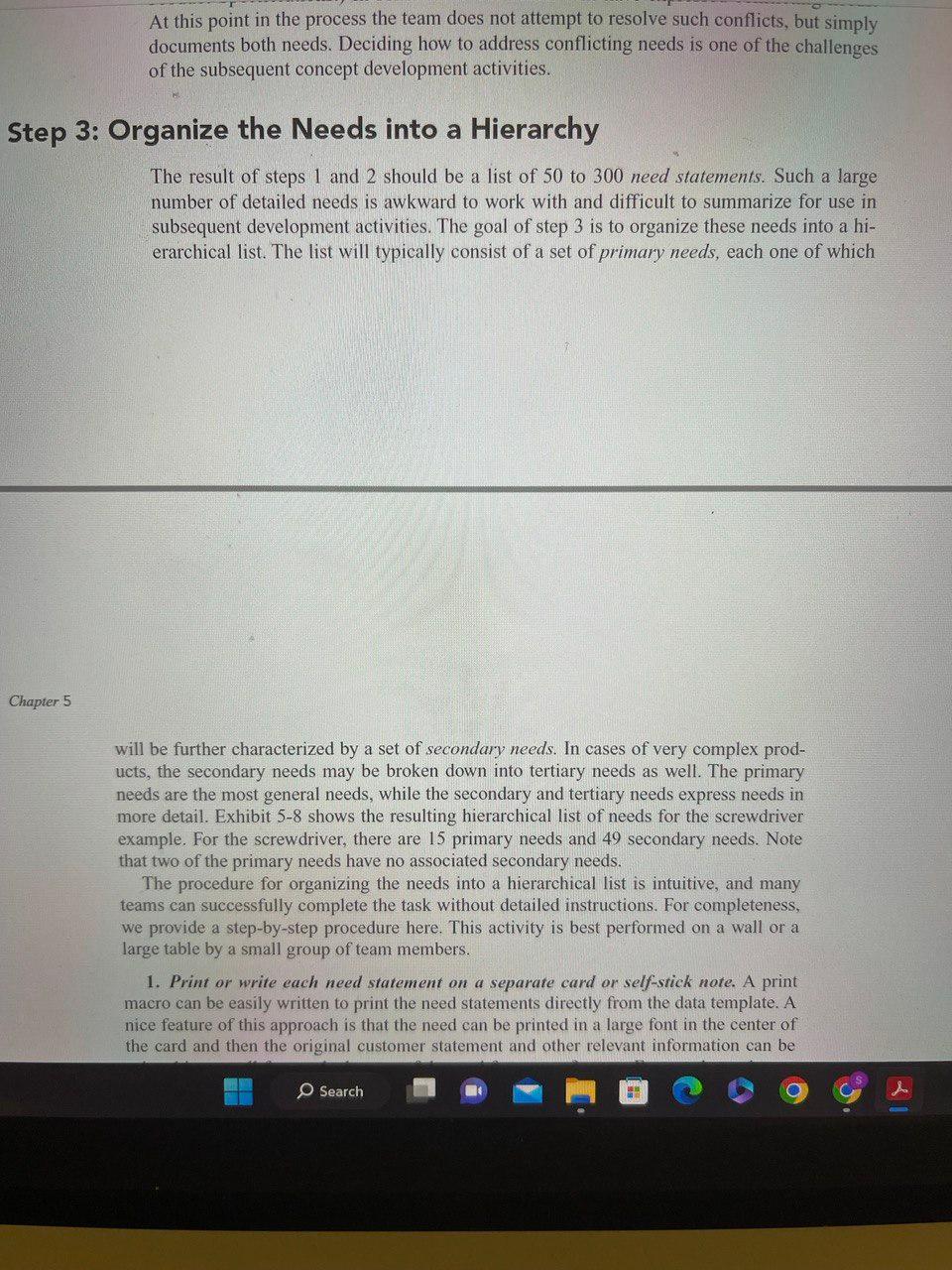
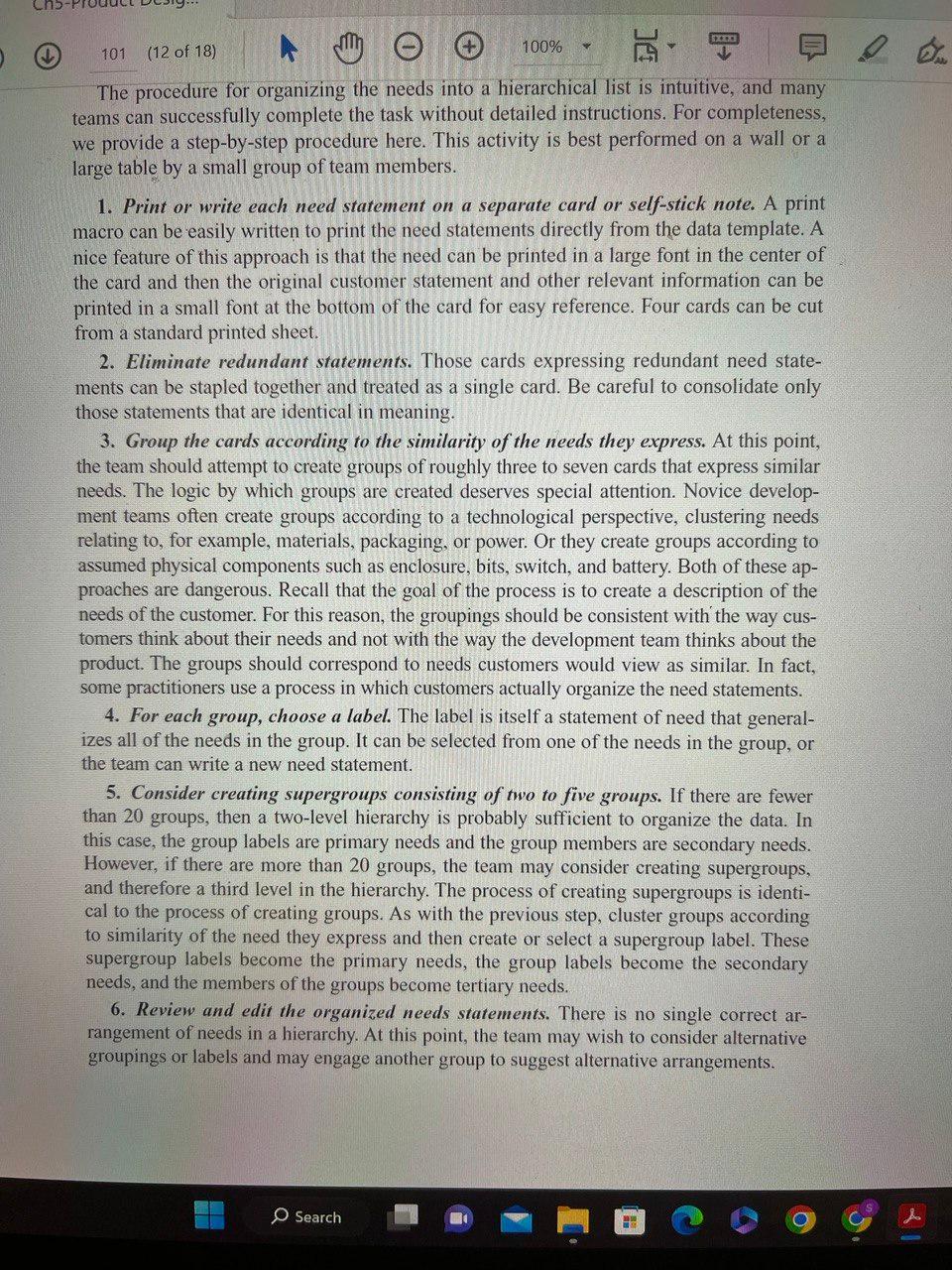
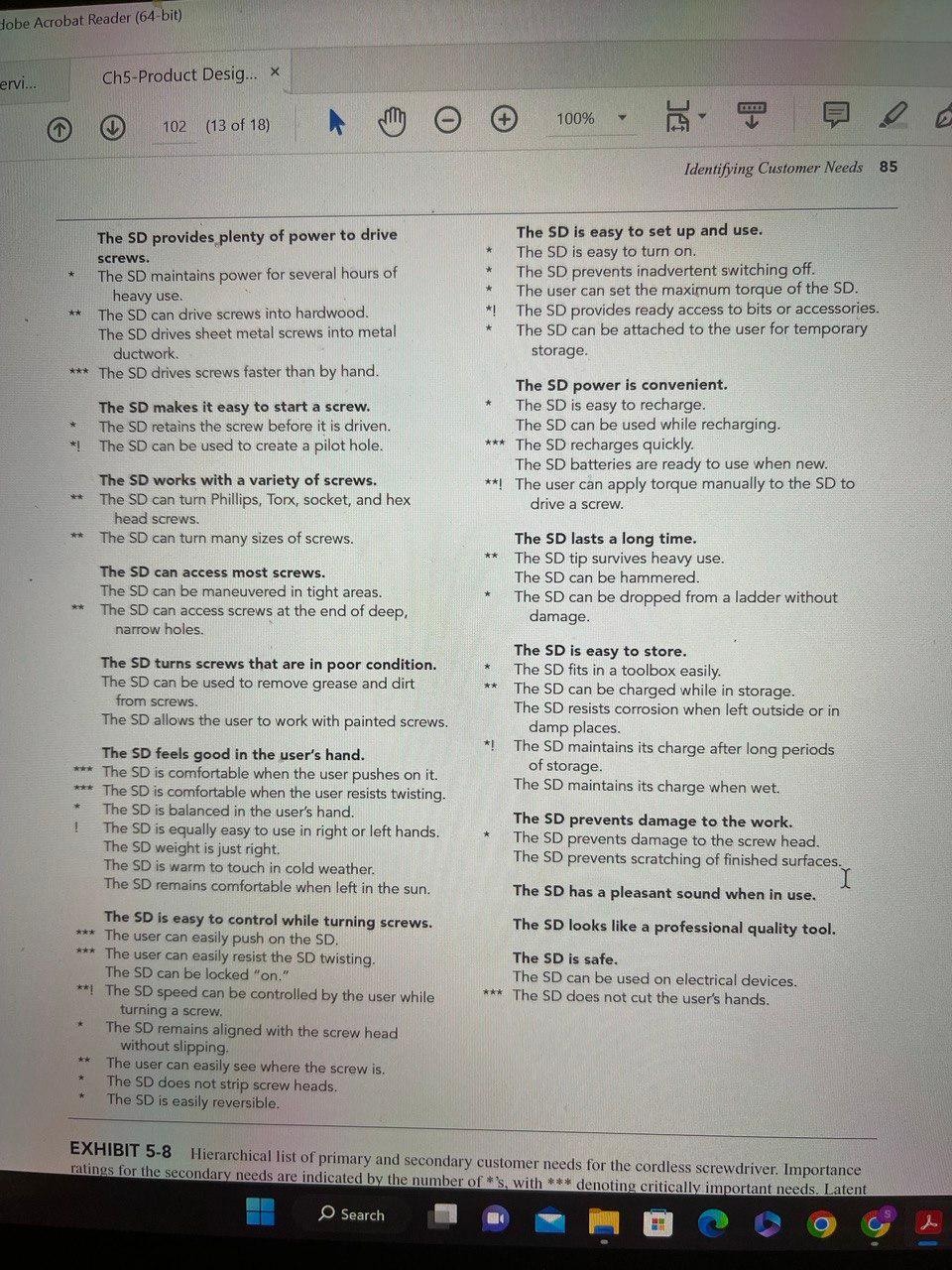
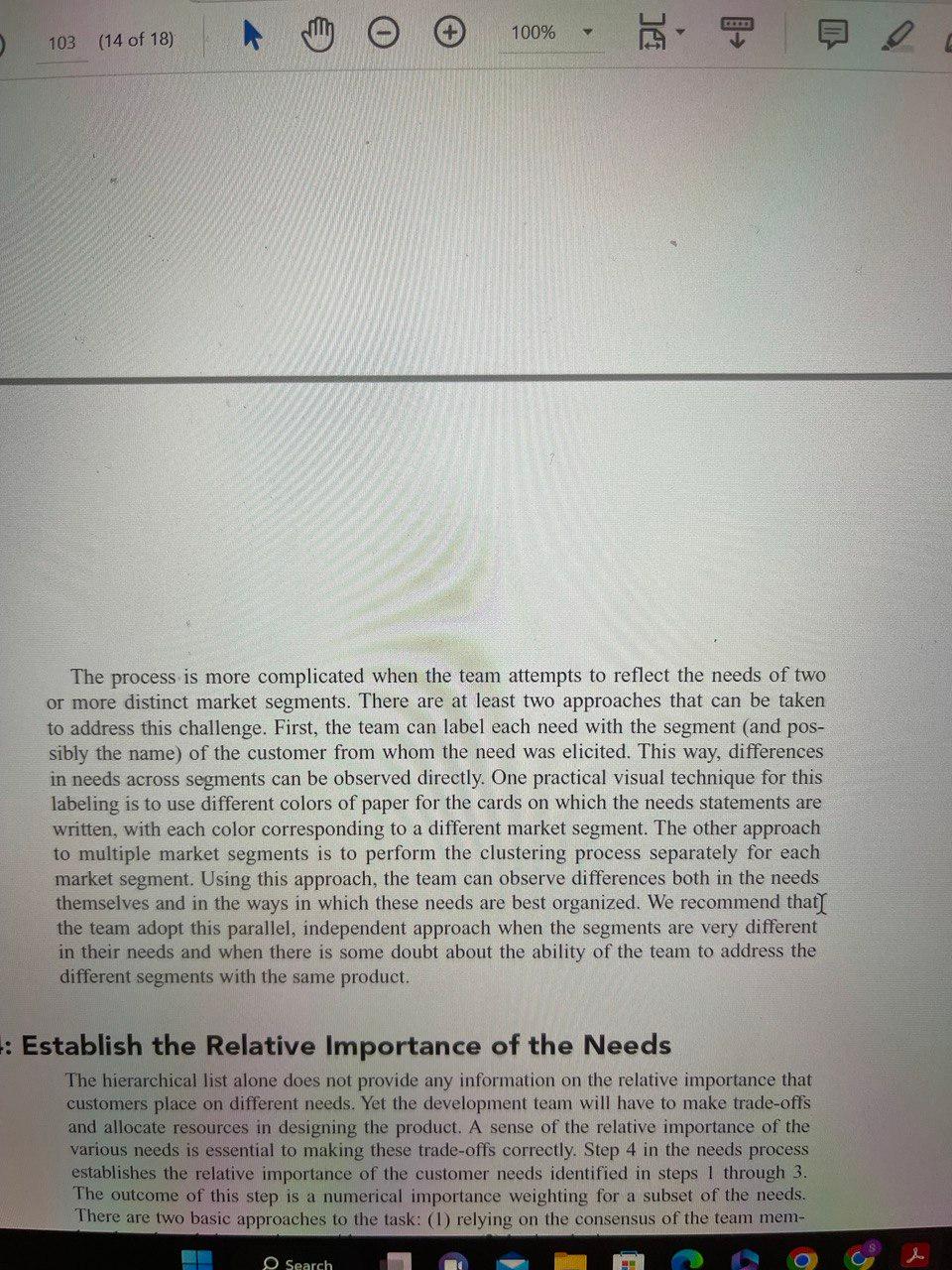
At this point in the process the team does not attempt to resolve such conflicts, but simply documents both needs. Deciding how to address conflicting needs is one of the challenges of the subsequent concept development activities. tep 3: Organize the Needs into a Hierarchy The result of steps 1 and 2 should be a list of 50 to 300 need statements. Such a large number of detailed needs is awkward to work with and difficult to summarize for use in subsequent development activities. The goal of step 3 is to organize these needs into a hierarchical list. The list will typically consist of a set of primary needs, each one of which will be further characterized by a set of secondary needs. In cases of very complex products, the secondary needs may be broken down into tertiary needs as well. The primary needs are the most general needs, while the secondary and tertiary needs express needs in more detail. Exhibit 5-8 shows the resulting hierarchical list of needs for the screwdriver example. For the screwdriver, there are 15 primary needs and 49 secondary needs. Note that two of the primary needs have no associated secondary needs. The procedure for organizing the needs into a hierarchical list is intuitive, and many teams can successfully complete the task without detailed instructions. For completeness, we provide a step-by-step procedure here. This activity is best performed on a wall or a large table by a small group of team members. 1. Print or write each need statement on a separate card or self-stick note. A print macro can be easily written to print the need statements directly from the data template. A nice feature of this approach is that the need can be printed in a large font in the center of the card and then the original customer statement and other relevant information can be teams can successfully complete the task without detailed instructions. For completeness, we provide a step-by-step procedure here. This activity is best performed on a wall or a large table by a small group of team members. 1. Print or write each need statement on a separate card or self-stick note. A print macro can be easily written to print the need statements directly from the data template. A nice feature of this approach is that the need can be printed in a large font in the center of the card and then the original customer statement and other relevant information can be printed in a small font at the bottom of the card for easy reference. Four cards can be cut from a standard printed sheet. 2. Eliminate redundant statements. Those cards expressing redundant need statements can be stapled together and treated as a single card. Be careful to consolidate only those statements that are identical in meaning. 3. Group the cards according to the similarity of the needs they express. At this point, the team should attempt to create groups of roughly three to seven cards that express similar needs. The logic by which groups are created deserves special attention. Novice development teams often create groups according to a technological perspective, clustering needs relating to, for example, materials, packaging, or power. Or they create groups according to assumed physical components such as enclosure, bits, switch, and battery. Both of these approaches are dangerous. Recall that the goal of the process is to create a description of the needs of the customer. For this reason, the groupings should be consistent with the way customers think about their needs and not with the way the development team thinks about the product. The groups should correspond to needs customers would view as similar. In fact, some practitioners use a process in which customers actually organize the need statements. 4. For each group, choose a label. The label is itself a statement of need that generalizes all of the needs in the group. It can be selected from one of the needs in the group, or the team can write a new need statement. 5. Consider creating supergroups consisting of two to five groups. If there are fewer than 20 groups, then a two-level hierarchy is probably sufficient to organize the data. In this case, the group labels are primary needs and the group members are secondary needs. However, if there are more than 20 groups, the team may consider creating supergroups, and therefore a third level in the hierarchy. The process of creating supergroups is identical to the process of creating groups. As with the previous step, cluster groups according to similarity of the need they express and then create or select a supergroup label. These supergroup labels become the primary needs, the group labels become the secondary needs, and the members of the groups become tertiary needs. 6. Review and edit the organized needs statements. There is no single correct arrangement of needs in a hierarchy. At this point, the team may wish to consider alternative groupings or labels and may engage another group to suggest alternative arrangements. The process is more complicated when the team attempts to reflect the needs of two or more distinct market segments. There are at least two approaches that can be taken to address this challenge. First, the team can label each need with the segment (and possibly the name) of the customer from whom the need was elicited. This way, differences in needs across segments can be observed directly. One practical visual technique for this labeling is to use different colors of paper for the cards on which the needs statements are written, with each color corresponding to a different market segment. The other approach to multiple market segments is to perform the clustering process separately for each market segment. Using this approach, the team can observe differences both in the needs themselves and in the ways in which these needs are best organized. We recommend that the team adopt this parallel, independent approach when the segments are very different in their needs and when there is some doubt about the ability of the team to address the different segments with the same product. Establish the Relative Importance of the Needs The hierarchical list alone does not provide any information on the relative importance that customers place on different needs. Yet the development team will have to make trade-offs and allocate resources in designing the product. A sense of the relative importance of the various needs is essential to making these trade-offs correctly. Step 4 in the needs process establishes the relative importance of the customer needs identified in steps 1 through 3 . The outcome of this step is a numerical importance weighting for a subset of the needs. There are two basic approaches to the task: (1) relying on the consensus of the team mem
Step by Step Solution
There are 3 Steps involved in it

Get step-by-step solutions from verified subject matter experts
 Study Help