







Question: For the data set shownbelow, complete parts (a) through (d) below. For the data set shown below, complete parts [a]: through {d} below. J: 2E]
For the data set shownbelow, complete parts (a) through (d) below.
![the data set shown below, complete parts [a]: through {d} below. J:](https://dsd5zvtm8ll6.cloudfront.net/si.experts.images/questions/2024/11/672f5d2adda41_290672f5d2aba876.jpg)
![2E] 3E] 40 5E] 60% 3t 1112 E3 89 33 63 [a]](https://dsd5zvtm8ll6.cloudfront.net/si.experts.images/questions/2024/11/672f5d2c675e7_292672f5d2c2782b.jpg)
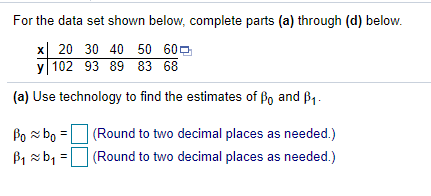
For the data set shown below, complete parts [a]: through {d} below. J: 2E] 3E] 40 5E] 60% 3t 1112 E3 89 33 63 [a] Use technologyr to nd the estimates of u and f5, . [3,] m on = D {Round to two decimal places as needed} [31 m o1 = D {Round to two decimal places as needed} (b) Use technology to compute the standard error, the point estimate for o. S (Round to four decimal places as needed.) (c) Assuming the residuals are normally distributed, use technology to determine s.. (Round to four decimal places as needed.)(d) Assuming the residuals are normally distributed, test Ho: P, =0 versus Hy : By #0 at the a= 0.05 level of significance. Use the P-value approach. Determine the P-value for this hypothesis test. P-value= (Round to three decimal places as needed.) Which of the following conclusions is correct? O A. Do not reject Ho and conclude that a linear relation does not exist between x and y. O B. Do not reject Ho and conclude that a linear relation exists between x and y. O C. Reject Ho and conclude that a linear relation exists between x and y. O D. Reject Ho and conclude that a linear relation does not exist between x and y
Step by Step Solution
There are 3 Steps involved in it

Get step-by-step solutions from verified subject matter experts
 Study Help