





Question: For the decision problem described in Question (1), the probability of a profit of $1 million if the company continues with the conference is 0.6.
For the decision problem described in Question

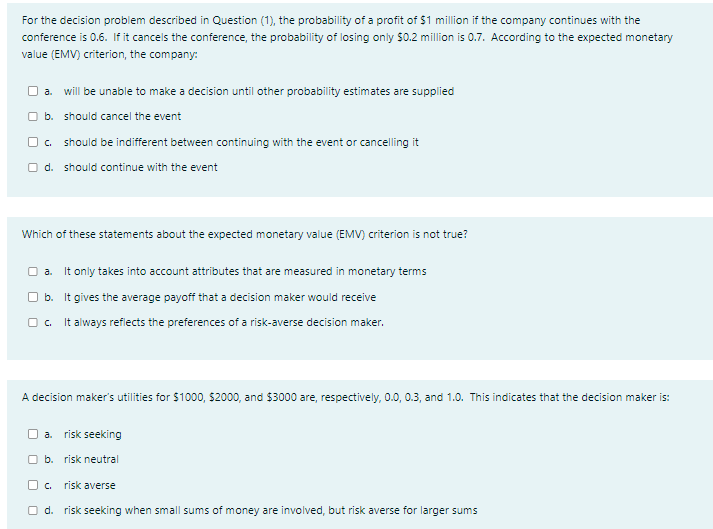
For the decision problem described in Question (1), the probability of a profit of $1 million if the company continues with the conference is 0.6. If it cancels the conference, the probability of losing only $0.2 million is 0.7. According to the expected monetary value (EMV) criterion, the company: a. Will be unable to make a decision until other probability estimates are supplied b. should cancel the event. c. should be indifferent between continuing with the event or cancelling it d. should continue with the event Which of these statements about the expected monetary value (EMV) criterion is not true? a. It only takes into account attributes that are measured in monetary terms b. It gives the average payoff that a decision maker would receive c. It always reflects the preferences of a risk-averse decision maker. A decision maker's utilities for $1000,$2000, and $3000 are, respectively, 0.0,0.3, and 1.0. This indicates that the decision maker is: a. risk seeking b. risk neutral c. risk averse d. risk seeking when small sums of money are involved, but risk averse for larger sums

Step by Step Solution

There are 3 Steps involved in it

1 Expert Approved Answer
Step: 1 Unlock blur-text-image

Question Has Been Solved by an Expert!

Get step-by-step solutions from verified subject matter experts

Step: 2 Unlock
Step: 3 Unlock

Students Have Also Explored These Related General Management Questions!