



Question: For the following questions, we will work with a Container ADT called an IntQueue. An IntQueue is a container of integers that allows elements to
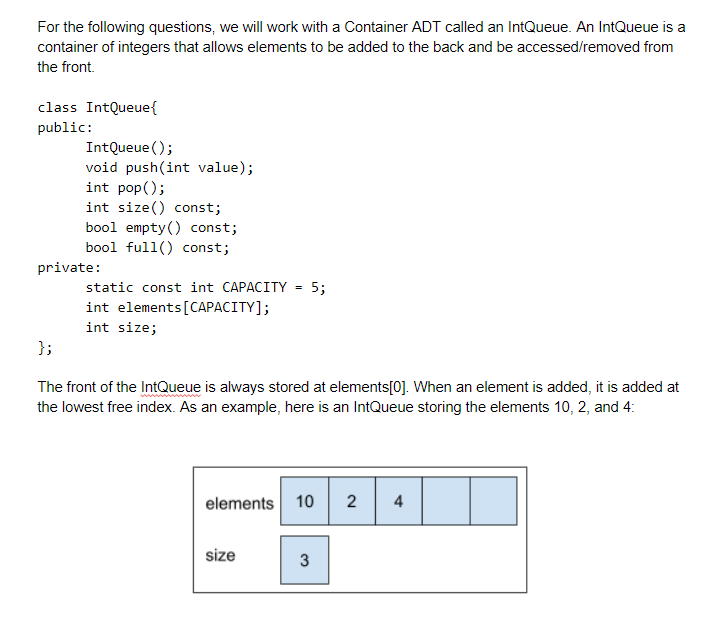
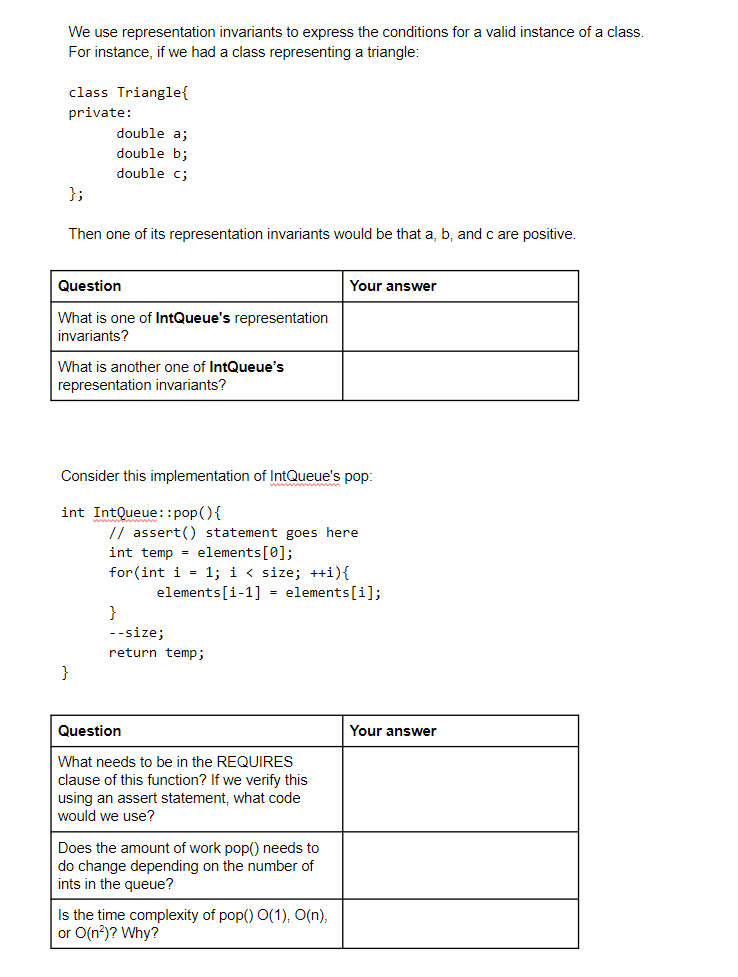
For the following questions, we will work with a Container ADT called an IntQueue. An IntQueue is a container of integers that allows elements to be added to the back and be accessed/removed from the front class IntQueue public: IntQueue(); void push(int value); int pop(); int size() const; bool empty() const; bool full() const; private: static const int CAPACITY int elements [CAPACITY]; int size; }; 5; The front of the IntQueue is always stored at elements[0]. When an element is added, it is added at the lowest free index. As an example, here is an IntQueue storing the elements 10, 2, and 4: elements 10 10 2 4 size 3 We use representation invariants to express the conditions for a valid instance of a class. For instance, if we had a class representing a triangle: class Triangle private: double a; double b; double c; }; Then one of its representation invariants would be that a, b, and c are positive. Question Your answer What is one of IntQueue's representation invariants? What is another one of IntQueue's representation invariants? Consider this implementation of IntQueue's pop: int IntQueue: :pop({ // assert() statement goes here int temp = elements[0]; for(int i = 1; i
Step by Step Solution
There are 3 Steps involved in it

Get step-by-step solutions from verified subject matter experts