Question: For the task network shown in the diagram below, perform the following: Task B 5 days Task C 2 days Task A 2 days Task
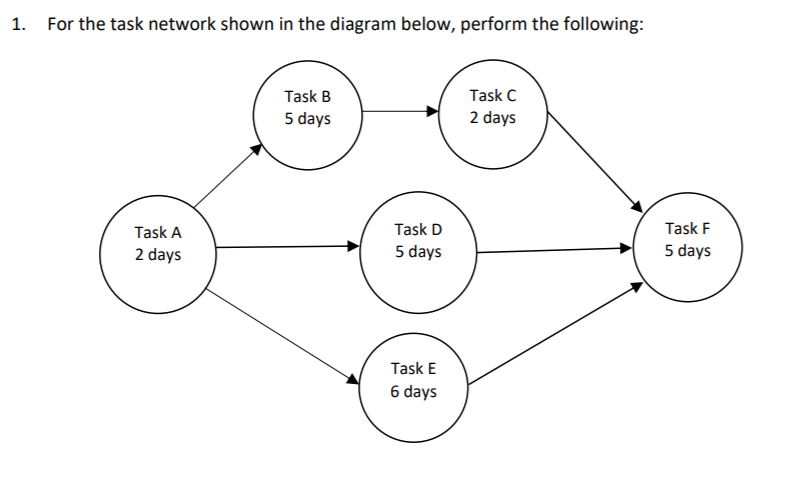
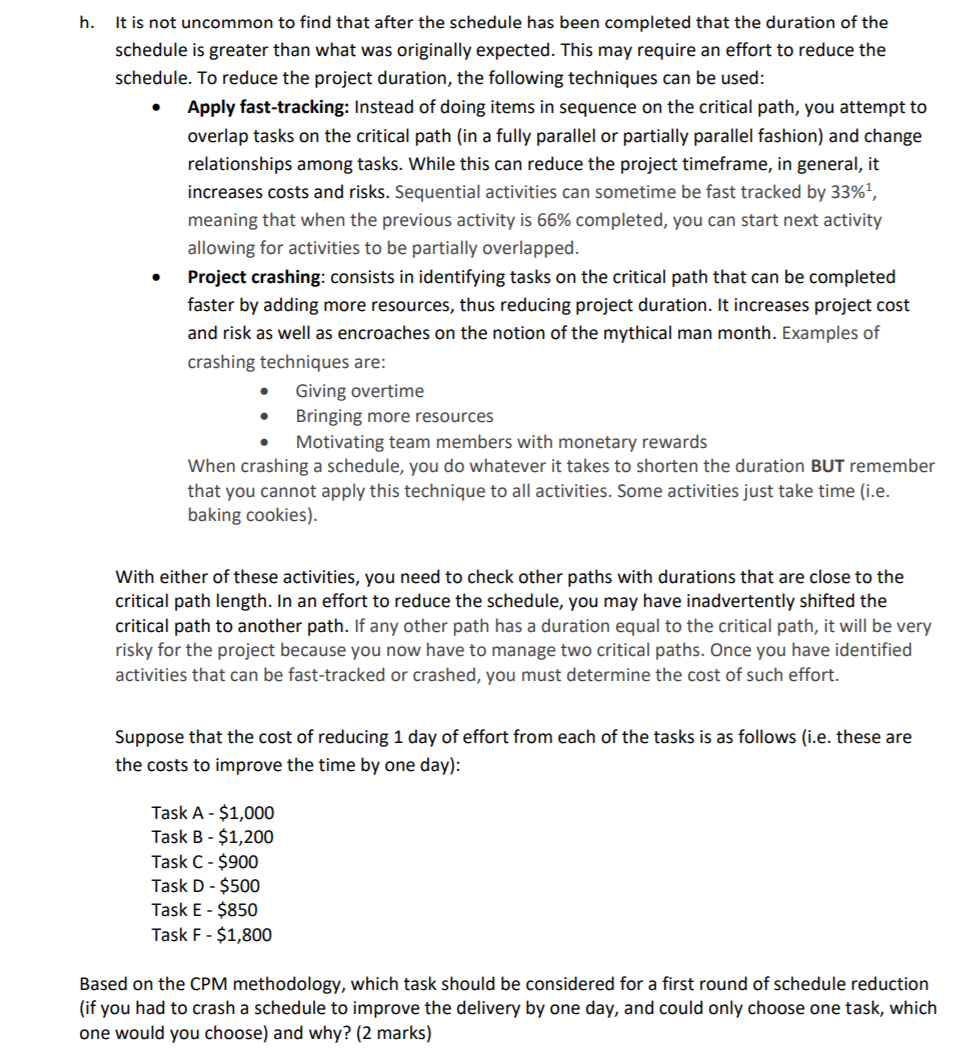
For the task network shown in the diagram below, perform the following: Task B 5 days Task C 2 days Task A 2 days Task D 5 days Task F 5 days Task E 6 days h. It is not uncommon to find that after the schedule has been completed that the duration of the schedule is greater than what was originally expected. This may require an effort to reduce the schedule. To reduce the project duration, the following techniques can be used: Apply fast-tracking: Instead of doing items in sequence on the critical path, you attempt to overlap tasks on the critical path (in a fully parallel or partially parallel fashion) and change relationships among tasks. While this can reduce the project timeframe, in general, it increases costs and risks. Sequential activities can sometime be fast tracked by 33%-, meaning that when the previous activity is 66% completed, you can start next activity allowing for activities to be partially overlapped. Project crashing: consists in identifying tasks on the critical path that can be completed faster by adding more resources, thus reducing project duration. It increases project cost and risk as well as encroaches on the notion of the mythical man month. Examples of crashing techniques are: Giving overtime Bringing more resources Motivating team members with monetary rewards When crashing a schedule, you do whatever it takes to shorten the duration BUT remember that you cannot apply this technique to all activities. Some activities just take time (i.e. baking cookies). With either of these activities, you need to check other paths with durations that are close to the critical path length. In an effort to reduce the schedule, you may have inadvertently shifted the critical path to another path. If any other path has a duration equal to the critical path, it will be very risky for the project because you now have to manage two critical paths. Once you have identified activities that can be fast-tracked or crashed, you must determine the cost of such effort. Suppose that the cost of reducing 1 day of effort from each of the tasks is as follows (i.e. these are the costs to improve the time by one day): Task A - $1,000 Task B - $1,200 Task C - $900 Task D - $500 Task E - $850 Task F - $1,800 Based on the CPM methodology, which task should be considered for a first round of schedule reduction (if you had to crash a schedule to improve the delivery by one day, and could only choose one task, which one would you choose) and why? (2 marks)









 Study Help