Question: For the writing journal assignment this week. you will begin practicing the essential skills of analyzing. interpreting, and evaluating information by completing five steps of
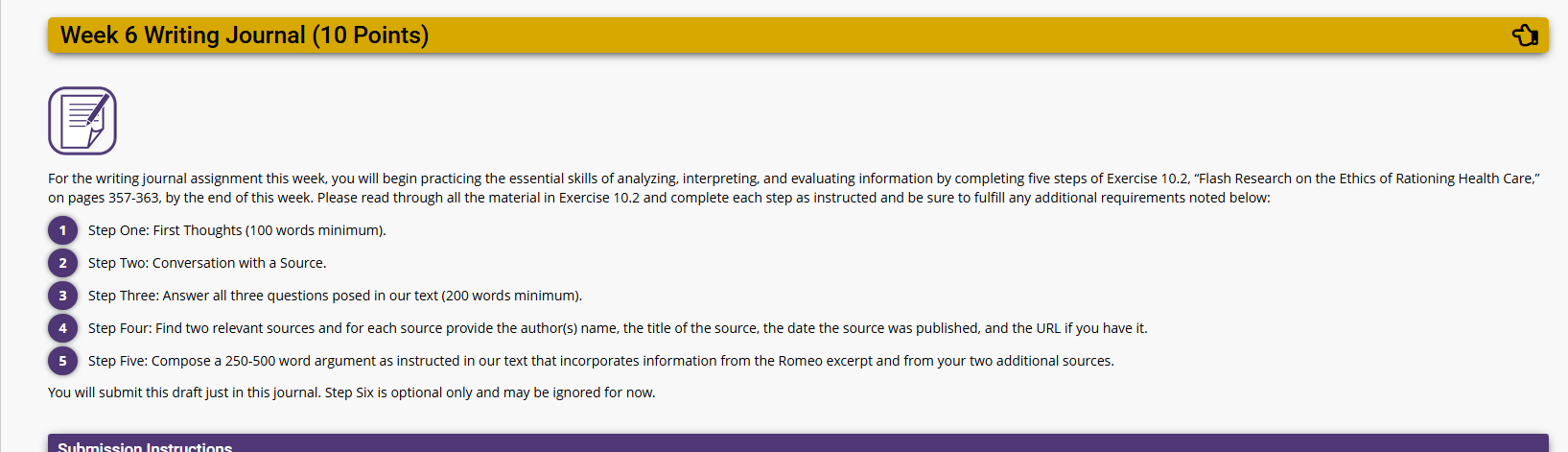
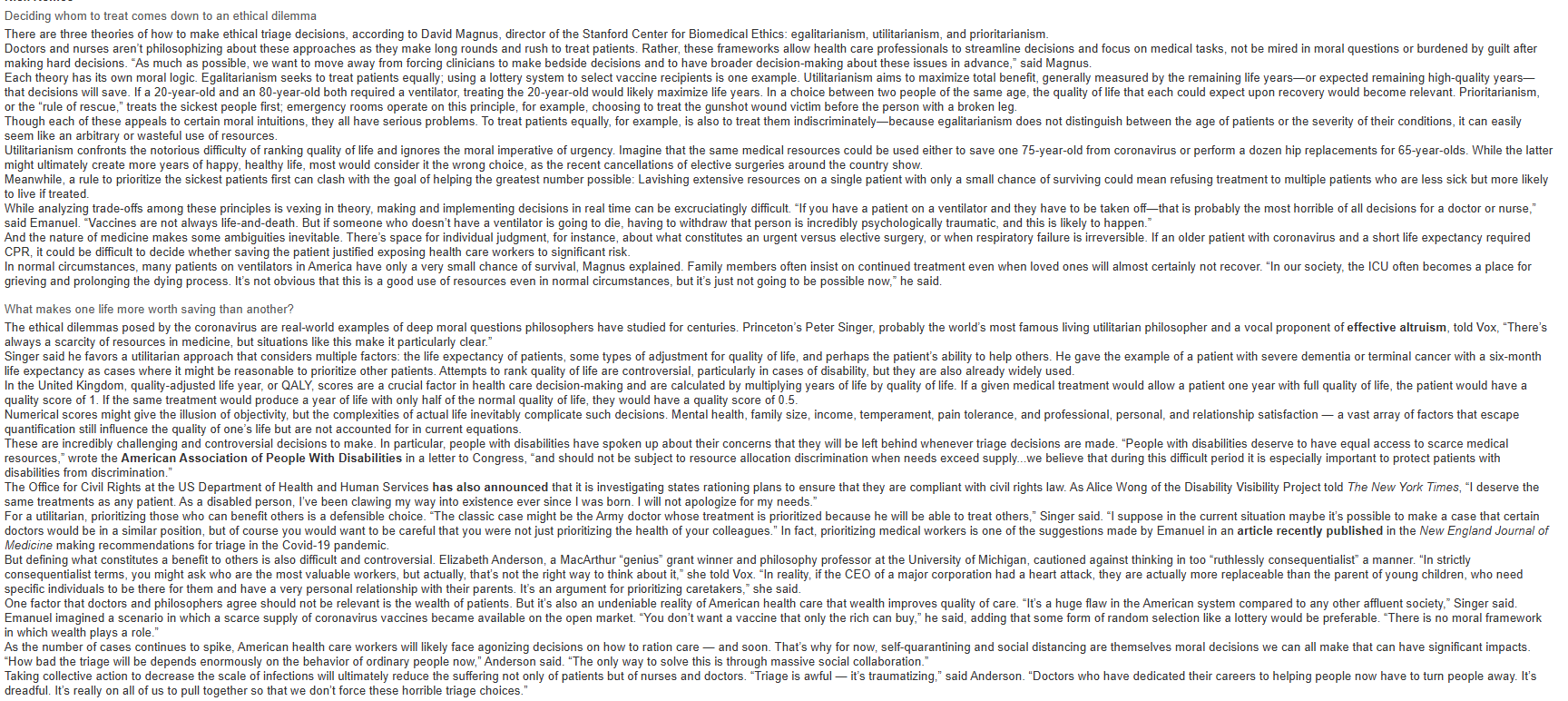
For the writing journal assignment this week. you will begin practicing the essential skills of analyzing. interpreting, and evaluating information by completing five steps of Exercise 10.2, \"Flash Research on the Ethics of Rationing Health Care.\" on pages 357-363, by the end of this week. Please read through all the material in Exercise 10.2 and complete each step as instructed and be sure to fulfill any additional requirements noted below: Step One: First Thoughts (100 words minimum). Step Two: Conversation with a Source. Step Three: Answer all three questions posed in our text (200 words minimum). Step Four: Find two relevant sources and for each source provide the author(s) name, the title of the source, the date the source was published, and the URL if you have it. Step Five: Compose a 250-500 word argument as instructed in our text that incorporates information from the Romeo excerpt and from your two additional sources. You will submit this draft just in this journal. Step Six is optional only and may be ignored for now. Flash Research on the Ethics of Rationing Health Care As we write, the coronoravirus pandemic rages around the world. Today, news reports tell us that 1.9 million people have died worldwide, and that by April 2021 nearly 600 thousand will die in the U.S. before the epidemic is controlled. When you read this, you'll know the current number. Older Americans are especially vulnerable. Because the health-care system is often overwhelmed, hospital staff face a profoundly difficult ethical decision: Should they let some people die to focus treatment on those more likely to survive? Might alder Americans be willing to sacrifice themselves to keep the economy afloat? That was what the Lt. Governor of Texas, Dan Palrick, argued during the crisis. He tweeted, *No one reached out to me and said, 'As a senior citizen, are you willing to take a chance on your survival in exchange for keeping the America that America loves for its children and grandchildren?' And if that is the exchange, I'm all in" One way to frame this dilemma is by asking this inquiry question: How do we decide frow to ration medical care in a public health crisis like Covid-192 \"If you have a 99-year-old male or female patient, that's a palient with a lot of diseases,\" an Italian doctor said in the midst of the crisis there \"And you have [a] young kid that needfs] to be intubated and you have one ventilator, | mean, you're not going to . . . toss a coin " It is a dilemma that had doctors there *weeping in the halls * This ethical and moral question of rationing care transcends the 2020 pandemic. Consider a case reported in the AMA Journal of Ethics.? \"Mr. J" is a 58-year-old, African-American man experiencing homelessness with kidney disease that requires regular dialysis. Medicare covers most of the expense. However, Mr. J has \"mental health issues,\" and despite frequent interventions by social services, he doesn't keep up with his dialysis appointments and continues to live on the streets, which aggravates his disease. When he inevitably gets sick, Mr. J then shows up at the ER as many as ten times a week, which is expensive and might divert care and resources from other patients. Should dactors refuse care for Mr. J or limit his access? Should they get him into hospice? Or should physicians simply accept that it is their moral and ethical responsibility to care for Mr. J, despite the expense? Deciding whom to treat comes down to an ethical dilemma There are three theories of how to make ethical triage decisions, according to David Magnus, directer of the Stanford Center for Biomedical Ethics: egalitarianism, utilitarianism, and prioritarianism Doctors and nurses arent philosophizing about these approaches as they make long rounds and rush to treat patients. Rather, these frameworks allow health care professionals to streamline decisions and focus on medical tasks, not be mired in moral questions or burdened by guilt after making hard decisions. \"As much as possible, we want to move away from forcing clinicians to make bedside decisions and to have broader decision-making about these issues in advance.\" said Magnus Each theory has its own moral logic. Egalitarianism seeks to treat patients equally; using a lottery system to select vaccine recipients is one example. Utilitarianism aims to maximize total benefit, generally measured by the remaining life yearsor expected remaining high-quality years that decisions will save. If a 20-year-old and an 80-year-old both required a ventilator, treating the 20-year-old would likely maximize life years. In a choice between twa people of the same age, the quality of life that each could expect upon recovery would become relevant. Prioritarianism, or the \"rule of rescue, " treats the sickest people first; emergency rosms operate on this principle, for example, choosing to treat the gunshat wound victim before the person with a broken leg Though each of these appeals to certain moral intuitions. they all have serious problems. To treat patients equally, for example, is also to treat them indiscriminatelybecause egalitarianism does not distinguish between the age of patients or the severity of their conditions, it can easily seem like an arbitrary or wasteful use of resources. Utilitarianism confronts the notorious difficulty of ranking quality of life and igneres the moral imperative of urgency. Imagine that the same medical resources could be used either to save one 75-year-old frem coronavirus or perform a dozen hip replacements for 65-year-olds. While the latter might ultimately create more years of happy, healthy life, most would consider it the wrong choice, as the recent cancellations of elective surgeries around the country show Meanwhile, a rule to prioritize the sickest patients first can clash with the goal of helping the greatest number possible: Lavishing extensive resources on a single patient with only a small chance of surviving could mean refusing treatment to multiple patients who are less sick but more likely to live if treated While analyzing trade-offs among these principles is vexing in theory, making and implementing decisions in real time can be excruciatingly difficult \"If you have a patient on a ventilator and they have to be taken offthat is probably the most horrible of all decisions for a doctor or nurse,\" said Emanuel. \"Vaccines are not always life-and-death. But if someone who doesn't have a ventilator is going to die, having to withdraw that persen is incredibly psychologically traumatic, and this is likely to happen.\" And the nature of medicine makes seme ambiguities inevitable. There's space for individual judgment, for instance, about what constitutes an urgent versus eleclive surgery, or when respiratory failure is irreversible_ If an older patient with corenavirus and a short life expectancy required CPR, it could be difficult to decide whether saving the patient justified exposing health care workers to significant risk. In normal circumstances, many patients on ventilators in America have only a very small chance of survival, Magnus explained. Family members often insist on continued treatment even when loved ones will almast certainly not recover. \"In our saciety, the ICU often becomes a place for grieving and prolonging the dying process. It's not obvious that this is a good use of resources even in normal circumstances, but it's just not going to be possible now,\" he said What makes one life more worth saving than another? The ethical dilemmas posed by the coronavirus are real-world examples of deep moral questions philosophers have studied for centuries. Princeton's Peter Singer, probably the world's most famous living utilitarian philosopher and a vocal proponent of effective altruism, told Vox, \"There's always a scarcity of resources in medicine, but situations like this make it particularly clear\" Singer said he favors a utilitarian approach that considers multiple factors: the life expectancy of patients, some types of adjustment for quality of life, and perhaps the patient's ability to help others. He gave the example of a patient with severe dementia or terminal cancer with a six-month life expectancy as cases where it might be reasonable to prioritize other patients. Attempts ta rank quality of life are controversial, particularly in cases of disability, but they are also already widely used In the United Kingdom, quality-adjusted life year, or QALY, scores are a crucial factor in health care decision-making and are calculated by multiplying years of life by quality of life_ If a given medical treatment would allow a patient one year with full quality of life, the patient would have a quality score of 1. If the same treatment would produce a year of life with only half of the normal quality of life, they would have a quality score of 0.5 Numerical scores might give the illusion of objectivity, but the complexities of actual life inevitably complicate such decisions. Mental health, family size, income, temperament, pain tolerance, and professional, persanal, and relationship satisfaction a vast array of factors that escape quantification still influence the quality of one's life but are not accounted for in current equations. These are incredibly challenging and contraversial decisions to make. In particular, people with disabilities have spoken up about their concerns that they will be left behind whenever triage decisions are made. \"People with disabilities deserve to have equal access to scarce medical resources,\" wrote the American Association of People With Disabilities in a letier to Cangress, \"and should not be subject to resource allocation discrimination when needs exceed supply.. we believe that during this difficult period it is especially important to protect patients with disabilities from discrimination.\" The Office for Civil Rights at the US Department of Health and Human Services has also announced that it is investigaling states rationing plans to ensure that they are compliant with civil rights law. As Alice Wong of the Disability Vi same treatments as any patient. As a disabled person, I've been clawing my way into existence ever since | was born. | will not apelogize for my needs.\" For a utilitarian, prioritizing thase who can benefit others is a defensible choice. \"The classic case might be the Army doctor whose treatment is prioritized bet doctors would be in a similar position, but of course you would want to be careful that you were not just prioritizing the health of your colleagues.\" In fact, prio Medicine making recommendations for triage in the Covid-19 pandemic But defining what constitutes a benefit to others is also difficult and controversial. Elizabeth Anderson, a MacArthur \"genius\" grant winner and philosaphy professor at the University of Michigan, cautioned against thinking in too \"ruthlessly consequentialist\" a manner. \"In strictly consequentialist terms, you might ask who are the most valuable workers, but actually, that's not the right way to think about it.\" she told Vox. \"In reality, if the CEO of a major corporation had a heart attack, they are actually more replaceable than the parent of young children, who need specific individuals to be there for them and have a very personal relationship with their parents. It's an argument for prioritizing caretakers, * she said One factor that doctors and philosophers agree should not be relevant is the wealth of patients. But it's also an undeniable reality of American health care that wealth improves quality of care. *It's a huge flaw in the American system compared to any other affluent society.\" Singer said Emanuel imagined a scenario in which a scarce supply of coronavirus vaccines became available on the open markst \"You don't want a vaccine that only the rich can buy,\" he said, adding that some form of randem selection Iike a lottery would be preferable. *There is na moral framework in which wealth plays a role " As the number of cases continues to spike, American health care workers will likely face agonizing decisions on how to ration care and soon. That's why for now, self-guarantining and social distancing are themselves moral decisions we can all make that can have significant impacts. \"How bad the triage will be depends enormously on the behavior of ordinary people now,\" Anderson said. \"The only way to solve this is through massive social collaboration * n Taking collective action to decrease the scale of infections will ultimately reduce the suffering not only of patients but of nurses and doctors. \"Triage is awful it's traumatizing,\" said Anderson. *Doctors who have dedicated their careers to helping people now have to turn people away. It's dreadful. It's really on all of us to pull together so that we don't force these herrible triage choices " lity Project told The New York Times, \"| deserve the & he will be able to treat others,\" Singer said. *I suppose in the current situation maybe it's possible to make a case that certain ing medical workers is one of the suggestions made by Emanuel in an article recently published in the New England Journal of STEP FIVE: Flash Research Now do something with all that writing that you generated in response to your flash research. Write a 250 to 500-word argument that somehow addresses the inquiry question: What's the best way to ration health care during a public health crisis like Covid-197 We recommend that you use "Mr. J\" as a case study. This flash research essay should = Make a claim (have a thesis) = Incorporate quotes, information, ideas, or facts from your reading on the topic. = For now, use a simplified citation. For example, put a parenthetical citation after borrowed material with the last name(s) of the excerpt's author(s) and the paragraph number of the relevant passage, such as (Kang, para. 3) Share the drafts of your flash research essays in class or online. Talk about the range of respanses people in class had to the excerpts, and which seemed most interesting or persuasive STEP SIX: Synthesizing Sources (Optional) The flash research step challenged you to make some moves that you'll need to make when you write a longer research essay, and one of the most important of these maves is incorporating sources inta your own writing. Analyze how you did this 1. Take two highlighterseach a different colorand use one to highlight every line, passage, or paragraph in your draft where you used an idea, phrase, or quotation from one of your published sources. Use the other color to highlight lines and passages that represent your own thinkinganalysis, commentary, evaluation, personal observation, and so on. 2. What do you netice about the pattemns of color? Typically, you want your own thinking to swarm around the sources you bring into your writing. Remember, you're the narrator and guide of your essays, and sources are in service to your explorations and arguments. 3. We join the wark of others with our own in several ways. a_ Support: evidence for a claim (e.g., illustration, example, idea, etc ) b. Explanation: clarification or summary of a concept or idea c Complication: detours into other ways of seeing things; ideas that make things more complicated and therefore more interesting d. Dramatization: establishing what's at stake (pathos)
Step by Step Solution
There are 3 Steps involved in it
1 Expert Approved Answer
Step: 1 Unlock
Question Has Been Solved by an Expert!
Get step-by-step solutions from verified subject matter experts
Step: 2 Unlock
Step: 3 Unlock
Students Have Also Explored These Related Business Writing Questions!











 Study Help