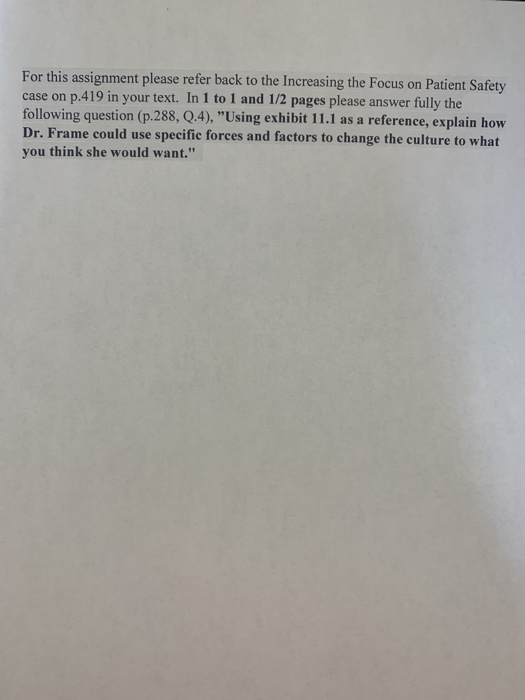
Question: For this assignment please refer back to the Increasing the Focus on Patient Safety case on p.419 in your text. In 1 to 1 and
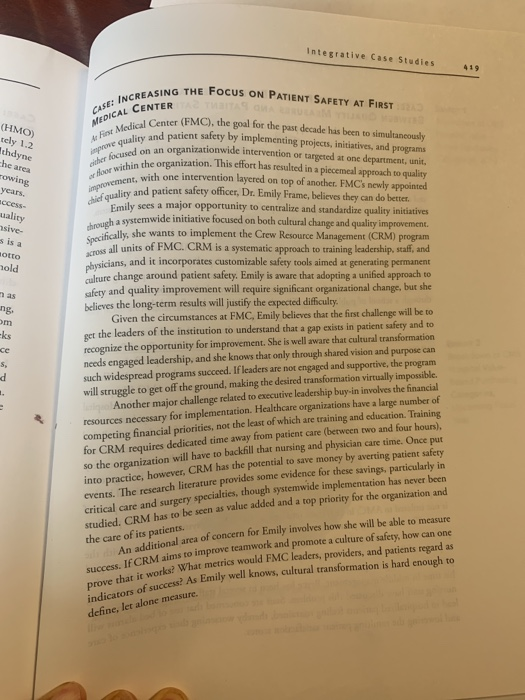
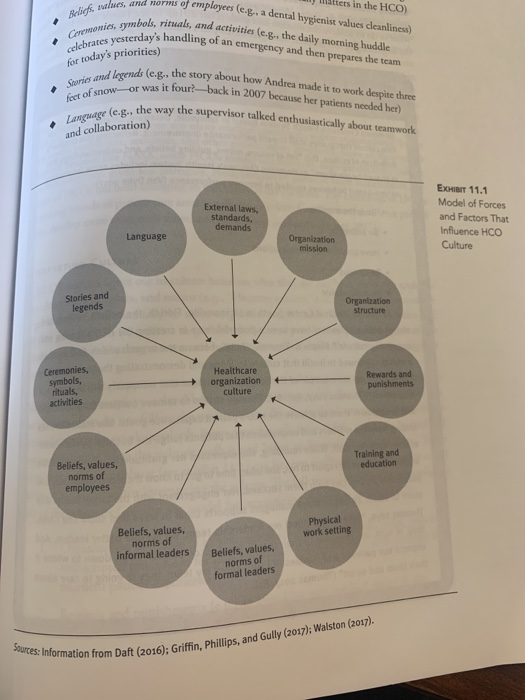
For this assignment please refer back to the Increasing the Focus on Patient Safety case on p.419 in your text. In 1 to 1 and 1/2 pages please answer fully the following question (p.288, Q.4), "Using exhibit 11.1 as a reference, explain how Dr. Frame could use specific forces and factors to change the culture to what you think she would want." Integrative Case Studies 419 CENTER MEDICAL (HMO) tely 1.2 Athdyne -hcarea rowing years. access uality CASE: INCREASING THE FOCUS ON PATIENT SAFETY AT FIRST Ar First Medical Center (FMC), the goal for the past decade has been to simultaneously improve quality and patient safety by implementing projects, initiatives, and programs cher focused on an organizationwide intervention of targeted at one department, unit. ar floor within the organization. This effort has resulted in a plecemeal approach to quality improvement, with one intervention layered on top of another. FMC's newly appointed chief quality and patient safety officer, Dr. Emily Frame, believes they can do better Specifically, she wants to implement the Crew Resource Management (CRM) prove that it works? What metrics would FMC leaders, providers, and patients regard as indicators of success? As Emily well knows, cultural transformation is hard enough to Emily sees a major opportunity to centralize and standardize quality initiatives program across all units of FMC. CRM is a systematic approach to training leadership, staff, and physicians, and it incorporates customizable safety tools aimed at generating permanent culture change around patient safety. Emily is aware that adopting a unified approach to safety and quality improvement will require significant organizational change, but she believes the long-term results will justify the expected difficulty. Given the circumstances at FMC, Emily believes that the first challenge will be to get the leaders of the institution to understand that a gap exists in patient safety and to ce recognize the opportunity for improvement. She is well aware that cultural transformation s, needs engaged leadership, and she knows that only through shared vision and purpose can d such widespread programs succeed. If leaders are not engaged and supportive, the program will struggle to get off the ground, making the desired transformation virtually impossible. Another major challenge related to executive leadership buy-in involves the financial resources necessary for implementation. Healthcare organizations have a large number of competing financial priorities, not the least of which are training and education. Training for CRM requires dedicated time away from patient care (between two and four hours), sive- s is a notto hold ng om eks so the organization will have to backfill that nursing and physician care time. Once put into practice, however, CRM has the potential to save money by averting patient safety events. The research literature provide some evidence for these savings, particularly in critical care and surgery specialties, though systemwide implementation has never been studied. CRM has to be seen as value added and a top priority for the organization and the care of its patients. An additional area of concern for Emily involves how she will be able to measure success. IF CRM aims to improve teamwork and promote a culture of safety, how can one define, let alone measure. celebrates yesterday's handling of an emergency and then prepares the team Ceremonies, symbols, rituals, and activities (eg the daily morning huddle Saries and legends (eg, the story about how Andrea made it to work despite three feet of snow or was it four-back in 2007 because her patients needed her) Langwage (c.g., the way the supervisor talked enthusiastically about teamwork Sources: Information from Daft (2016): Griffin, Phillips, and Gully (2017): Walston (2017). in the HCO) for today's priorities) and collaboration) External laws standards, demands EXHIBIT 11.1 Model of Forces and Factors That Influence HCO Culture Language Organization mission Stories and legends Organization structure Ceremonies, symbols. rituals, activities Healthcare organization culture Rewards and punishments Training and education Beliefs, values, norms of employees Physical work setting Beliefs, values, norms of informal leaders Beliefs, values, norms of formal leaders For this assignment please refer back to the Increasing the Focus on Patient Safety case on p.419 in your text. In 1 to 1 and 1/2 pages please answer fully the following question (p.288, Q.4), "Using exhibit 11.1 as a reference, explain how Dr. Frame could use specific forces and factors to change the culture to what you think she would want." Integrative Case Studies 419 CENTER MEDICAL (HMO) tely 1.2 Athdyne -hcarea rowing years. access uality CASE: INCREASING THE FOCUS ON PATIENT SAFETY AT FIRST Ar First Medical Center (FMC), the goal for the past decade has been to simultaneously improve quality and patient safety by implementing projects, initiatives, and programs cher focused on an organizationwide intervention of targeted at one department, unit. ar floor within the organization. This effort has resulted in a plecemeal approach to quality improvement, with one intervention layered on top of another. FMC's newly appointed chief quality and patient safety officer, Dr. Emily Frame, believes they can do better Specifically, she wants to implement the Crew Resource Management (CRM) prove that it works? What metrics would FMC leaders, providers, and patients regard as indicators of success? As Emily well knows, cultural transformation is hard enough to Emily sees a major opportunity to centralize and standardize quality initiatives program across all units of FMC. CRM is a systematic approach to training leadership, staff, and physicians, and it incorporates customizable safety tools aimed at generating permanent culture change around patient safety. Emily is aware that adopting a unified approach to safety and quality improvement will require significant organizational change, but she believes the long-term results will justify the expected difficulty. Given the circumstances at FMC, Emily believes that the first challenge will be to get the leaders of the institution to understand that a gap exists in patient safety and to ce recognize the opportunity for improvement. She is well aware that cultural transformation s, needs engaged leadership, and she knows that only through shared vision and purpose can d such widespread programs succeed. If leaders are not engaged and supportive, the program will struggle to get off the ground, making the desired transformation virtually impossible. Another major challenge related to executive leadership buy-in involves the financial resources necessary for implementation. Healthcare organizations have a large number of competing financial priorities, not the least of which are training and education. Training for CRM requires dedicated time away from patient care (between two and four hours), sive- s is a notto hold ng om eks so the organization will have to backfill that nursing and physician care time. Once put into practice, however, CRM has the potential to save money by averting patient safety events. The research literature provide some evidence for these savings, particularly in critical care and surgery specialties, though systemwide implementation has never been studied. CRM has to be seen as value added and a top priority for the organization and the care of its patients. An additional area of concern for Emily involves how she will be able to measure success. IF CRM aims to improve teamwork and promote a culture of safety, how can one define, let alone measure. celebrates yesterday's handling of an emergency and then prepares the team Ceremonies, symbols, rituals, and activities (eg the daily morning huddle Saries and legends (eg, the story about how Andrea made it to work despite three feet of snow or was it four-back in 2007 because her patients needed her) Langwage (c.g., the way the supervisor talked enthusiastically about teamwork Sources: Information from Daft (2016): Griffin, Phillips, and Gully (2017): Walston (2017). in the HCO) for today's priorities) and collaboration) External laws standards, demands EXHIBIT 11.1 Model of Forces and Factors That Influence HCO Culture Language Organization mission Stories and legends Organization structure Ceremonies, symbols. rituals, activities Healthcare organization culture Rewards and punishments Training and education Beliefs, values, norms of employees Physical work setting Beliefs, values, norms of informal leaders Beliefs, values, norms of formal leaders









 Study Help