





Question: For this homework you will need to read chapter 1 from Supply Chain Simulation and Optimization with anyLogistix posted in canvas watch the Chapter 1-part
For this homework you will need to read chapter 1
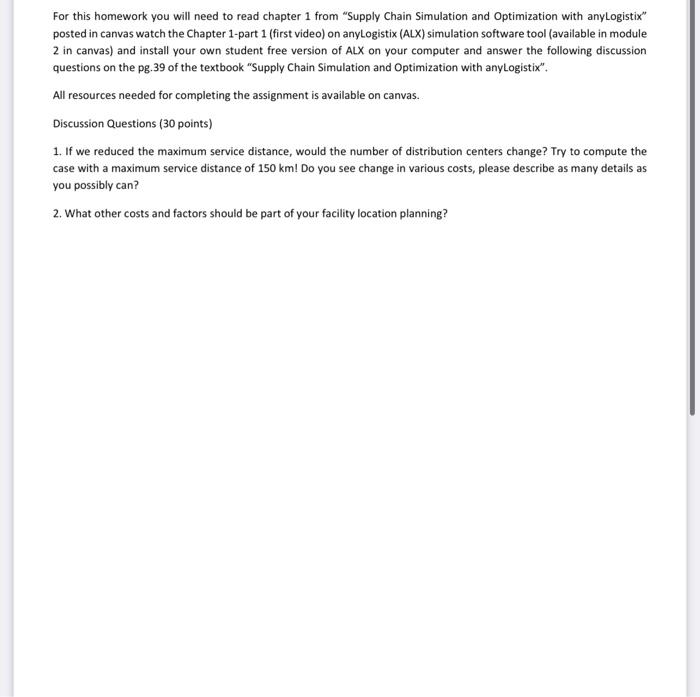
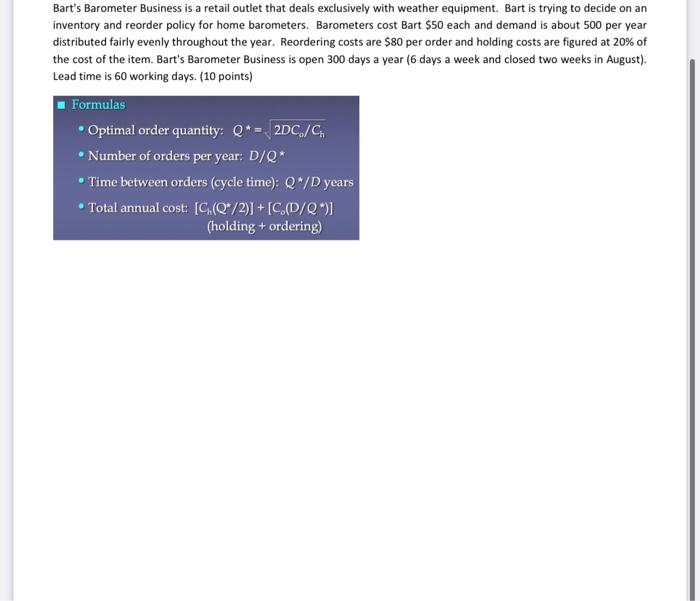
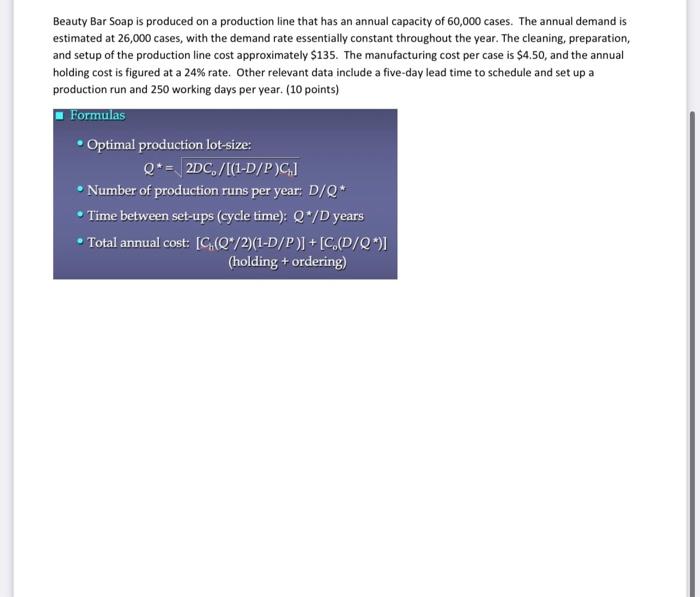
For this homework you will need to read chapter 1 from "Supply Chain Simulation and Optimization with anyLogistix" posted in canvas watch the Chapter 1-part 1 (first video) on anyLogistix (ALX) simulation software tool (available in module 2 in canvas) and install your own student free version of ALX on your computer and answer the following discussion questions on the pg.39 of the textbook "Supply Chain Simulation and Optimization with anyLogistix". All resources needed for completing the assignment is available on canvas. Discussion Questions ( 30 points) 1. If we reduced the maximum service distance, would the number of distribution centers change? Try to compute the case with a maximum service distance of 150km ! Do you see change in various costs, please describe as many details as you possibly can? 2. What other costs and factors should be part of your facility location planning? Bart's Barometer Business is a retail outlet that deals exclusively with weather equipment. Bart is trying to decide on an inventory and reorder policy for home barometers. Barometers cost Bart $50 each and demand is about 500 per year distributed fairly evenly throughout the year. Reordering costs are $80 per order and holding costs are figured at 20% of the cost of the item. Bart's Barometer Business is open 300 days a year ( 6 days a week and closed two weeks in August). Lead time is 60 working days. (10 points) Formulas - Optimal order quantity: Q=2DCo/Ch - Number of orders per year: D/Q* - Time between orders (cycle time): Q/ D years - Total annual cost. [Ch(Q/2)]+[C(D/Q)] (holding + ordering) Beauty Bar Soap is produced on a production line that has an annual capacity of 60,000 cases. The annual demand is estimated at 26,000 cases, with the demand rate essentially constant throughout the year. The cleaning, preparation, and setup of the production line cost approximately $135. The manufacturing cost per case is $4.50, and the annual holding cost is figured at a 24% rate. Other relevant data include a five-day lead time to schedule and set up a production run and 250 working days per year. (10 points) Formulas - Optimal production lot-size: Q=2DC0/[(1D/P)Ch] - Number of production runs per year: D/Q - Time between set-ups (cycle time): Q/D years - Total annual cost: [Ct(Q/2)(1D/P)]+[C0(D/Q)] (holding + ordering) For this homework you will need to read chapter 1 from "Supply Chain Simulation and Optimization with anyLogistix" posted in canvas watch the Chapter 1-part 1 (first video) on anyLogistix (ALX) simulation software tool (available in module 2 in canvas) and install your own student free version of ALX on your computer and answer the following discussion questions on the pg.39 of the textbook "Supply Chain Simulation and Optimization with anyLogistix". All resources needed for completing the assignment is available on canvas. Discussion Questions ( 30 points) 1. If we reduced the maximum service distance, would the number of distribution centers change? Try to compute the case with a maximum service distance of 150km ! Do you see change in various costs, please describe as many details as you possibly can? 2. What other costs and factors should be part of your facility location planning? Bart's Barometer Business is a retail outlet that deals exclusively with weather equipment. Bart is trying to decide on an inventory and reorder policy for home barometers. Barometers cost Bart $50 each and demand is about 500 per year distributed fairly evenly throughout the year. Reordering costs are $80 per order and holding costs are figured at 20% of the cost of the item. Bart's Barometer Business is open 300 days a year ( 6 days a week and closed two weeks in August). Lead time is 60 working days. (10 points) Formulas - Optimal order quantity: Q=2DCo/Ch - Number of orders per year: D/Q* - Time between orders (cycle time): Q/ D years - Total annual cost. [Ch(Q/2)]+[C(D/Q)] (holding + ordering) Beauty Bar Soap is produced on a production line that has an annual capacity of 60,000 cases. The annual demand is estimated at 26,000 cases, with the demand rate essentially constant throughout the year. The cleaning, preparation, and setup of the production line cost approximately $135. The manufacturing cost per case is $4.50, and the annual holding cost is figured at a 24% rate. Other relevant data include a five-day lead time to schedule and set up a production run and 250 working days per year. (10 points) Formulas - Optimal production lot-size: Q=2DC0/[(1D/P)Ch] - Number of production runs per year: D/Q - Time between set-ups (cycle time): Q/D years - Total annual cost: [Ct(Q/2)(1D/P)]+[C0(D/Q)] (holding + ordering)
Step by Step Solution

There are 3 Steps involved in it

1 Expert Approved Answer
Step: 1 Unlock blur-text-image

Question Has Been Solved by an Expert!

Get step-by-step solutions from verified subject matter experts

Step: 2 Unlock
Step: 3 Unlock

Students Have Also Explored These Related General Management Questions!