







Question: Question 2 A self-propelled underwater device is tested in a laboratory equipped with a channel filled with fresh water at 30C (density 992 kg/m
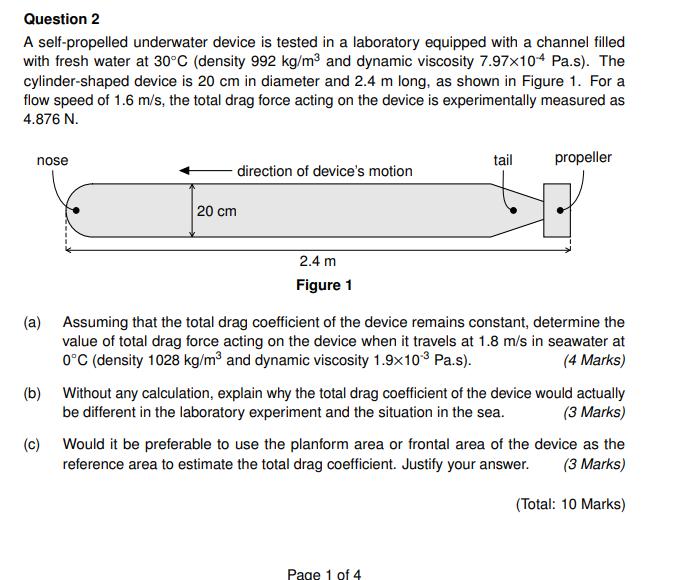
Question 2 A self-propelled underwater device is tested in a laboratory equipped with a channel filled with fresh water at 30C (density 992 kg/m and dynamic viscosity 7.97x10⁴ Pa.s). The cylinder-shaped device is 20 cm in diameter and 2.4 m long, as shown in Figure 1. For a flow speed of 1.6 m/s, the total drag force acting on the device is experimentally measured as 4.876 N. nose - direction of device's motion 20 cm (c) 2.4 m Figure 1 tail (a) Assuming that the total drag coefficient of the device remains constant, determine the value of total drag force acting on the device when it travels at 1.8 m/s in seawater at 0C (density 1028 kg/m and dynamic viscosity 1.9x10- Pa.s). (4 Marks) propeller (b) Without any calculation, explain why the total drag coefficient of the device would actually be different in the laboratory experiment and the situation in the sea. (3 Marks) Page 1 of 4 Would it be preferable to use the planform area or frontal area of the device as the reference area to estimate the total drag coefficient. Justify your answer. (3 Marks) (Total: 10 Marks)
Step by Step Solution
3.47 Rating (157 Votes )
There are 3 Steps involved in it
Answer a The total drag force acting on the device at 18 ms in seawater at 0C can be calculated as f... View full answer

Get step-by-step solutions from verified subject matter experts
 Study Help