







Question: For this question, specifically (d)(b). I don't understand the mathematical simplification that reaches us to the answer: When the input size is increased by additive
For this question, specifically (d)(b). I don't understand the mathematical simplification that reaches us to the answer:
When the input size is increased by additive one, the algorithm would get slower by an additive log(n+1) + n[log(n+1)-logn]?
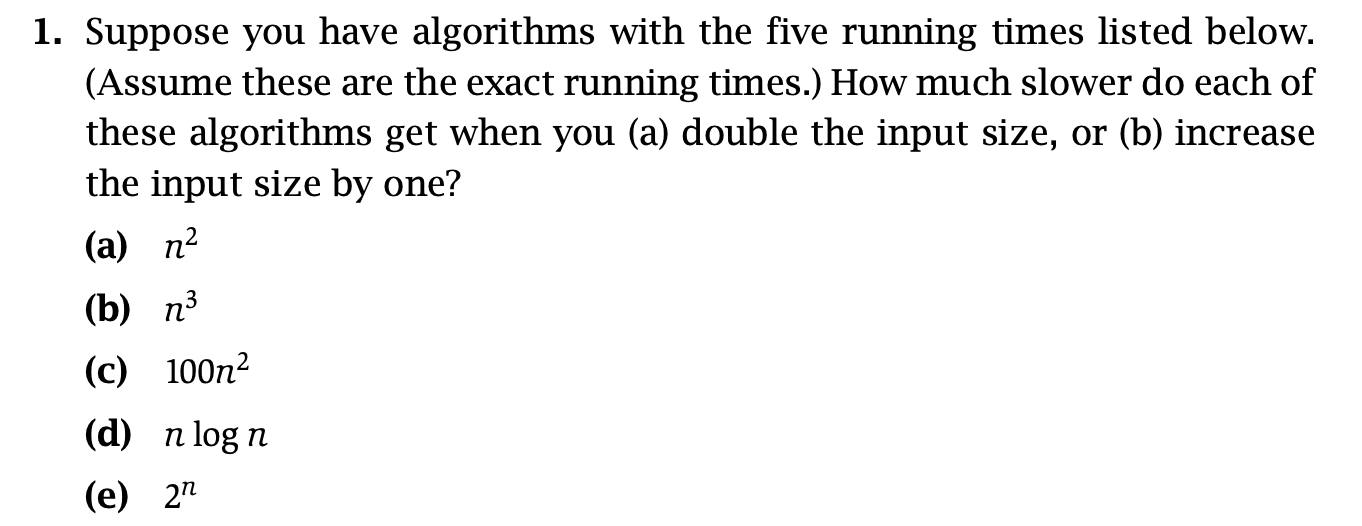
1. Suppose you have algorithms with the five running times listed below. (Assume these are the exact running times.) How much slower do each of these algorithms get when you (a) double the input size, or (b) increase the input size by one? (a) n2 (b) n3 (c) 100n2 (d) nlogn (e) 2n
Step by Step Solution
There are 3 Steps involved in it
1 Expert Approved Answer
Step: 1 Unlock

Question Has Been Solved by an Expert!
Get step-by-step solutions from verified subject matter experts
Step: 2 Unlock
Step: 3 Unlock
 Study Help