







Question: [ For this question submit the following: a . m file called runme _ q 2 . m , further upload this code separately as
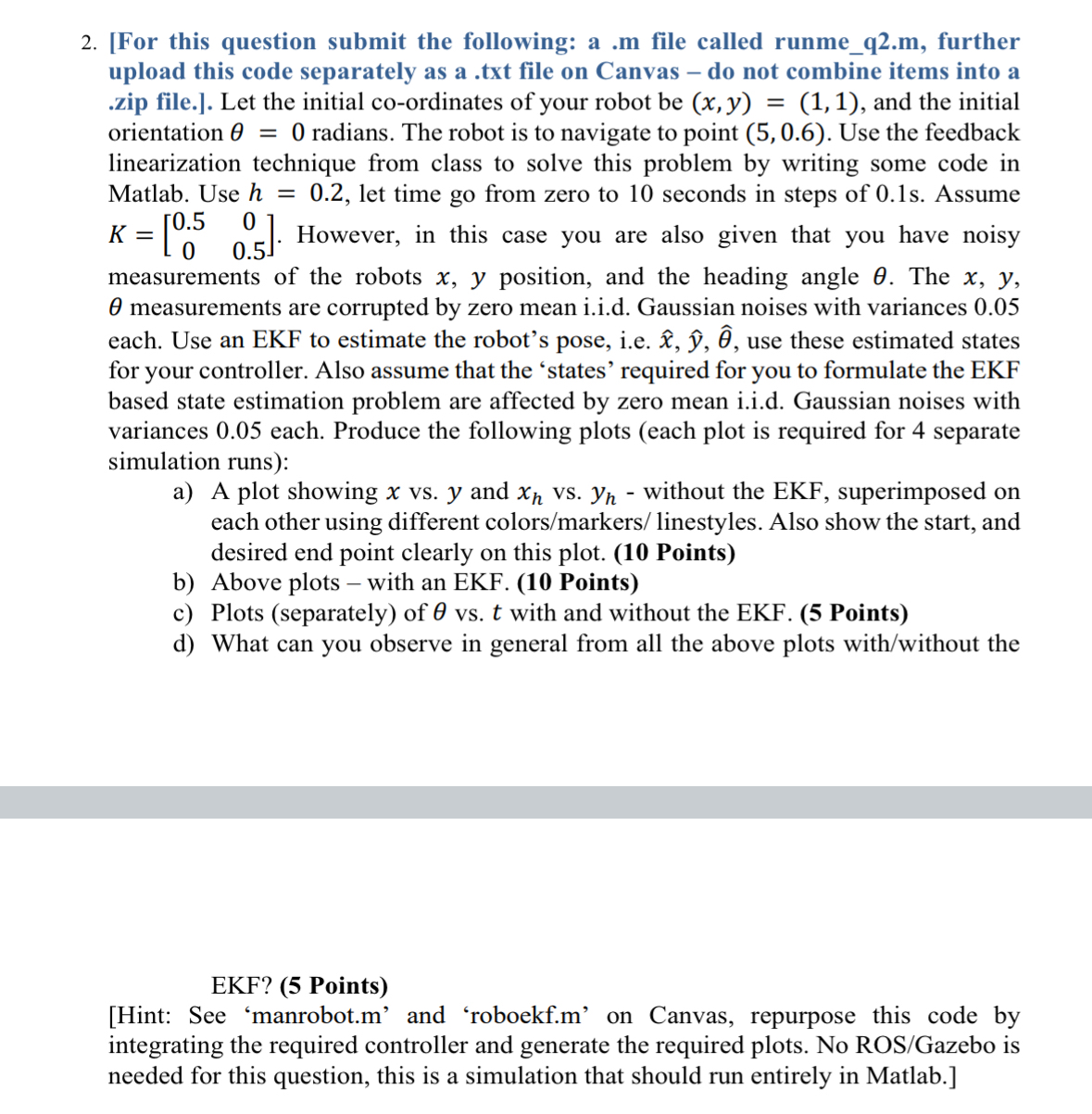
For this question submit the following: a m file called runmeqm further upload this code separately as a txt file on Canvas do not combine items into a zip file. Let the initial coordinates of your robot be and the initial orientation radians. The robot is to navigate to point Use the feedback linearization technique from class to solve this problem by writing some code in Matlab. Use let time go from zero to seconds in steps of s Assume However, in this case you are also given that you have noisy measurements of the robots position, and the heading angle The measurements are corrupted by zero mean iid Gaussian noises with variances each. Use an EKF to estimate the robot's pose, ie hathathat use these estimated states for your controller. Also assume that the 'states' required for you to formulate the EKF based state estimation problem are affected by zero mean iid Gaussian noises with variances each. Produce the following plots each plot is required for separate simulation runs:
a A plot showing vs and vs without the EKF, superimposed on each other using different colorsmarkers linestyles. Also show the start, and desired end point clearly on this plot. Points
b Above plots with an EKF. Points
c Plots separately of vs with and without the EKF. Points
d What can you observe in general from all the above plots withwithout the
EKF? Points
Hint: See 'manrobot.m and 'roboekf.m on Canvas, repurpose this code by integrating the required controller and generate the required plots. No ROSGazebo is needed for this question, this is a simulation that should run entirely in Matlab.
Step by Step Solution
There are 3 Steps involved in it
1 Expert Approved Answer
Step: 1 Unlock

Question Has Been Solved by an Expert!
Get step-by-step solutions from verified subject matter experts
Step: 2 Unlock
Step: 3 Unlock
 Study Help