







Question: For this team assignment, you and your co-managers are asked to collaboratively discuss and develop responses to each of the following questions prior to entering
For this team assignment, you and your co-managers are asked to collaboratively discuss and develop responses to each of the following questions prior to entering your final set of decisions for this week. Please make certain to address all aspects of each question specifically in your responses which each should be 1 to 2 paragraphs in length. For additional help in answering these questions, see the Exercise for Simulation Participants sections at the end of each chapter. There are similar questions to the ones found below and links to corresponding sections in the textbook (Thompson, Crafting & Executing Strategy: The Quest for Competitive Advantage: Concepts and Cases 23e).
- Write a brief strategic vision for your company (see Table 2.1 in the textbook for guidance) and a tagline for your company that summarizes and communicates your value proposition.
- Describe your companys financial and strategic objectives for the next 3-5 years.
- List five key components of your companys strategy and explain why you chose each component.
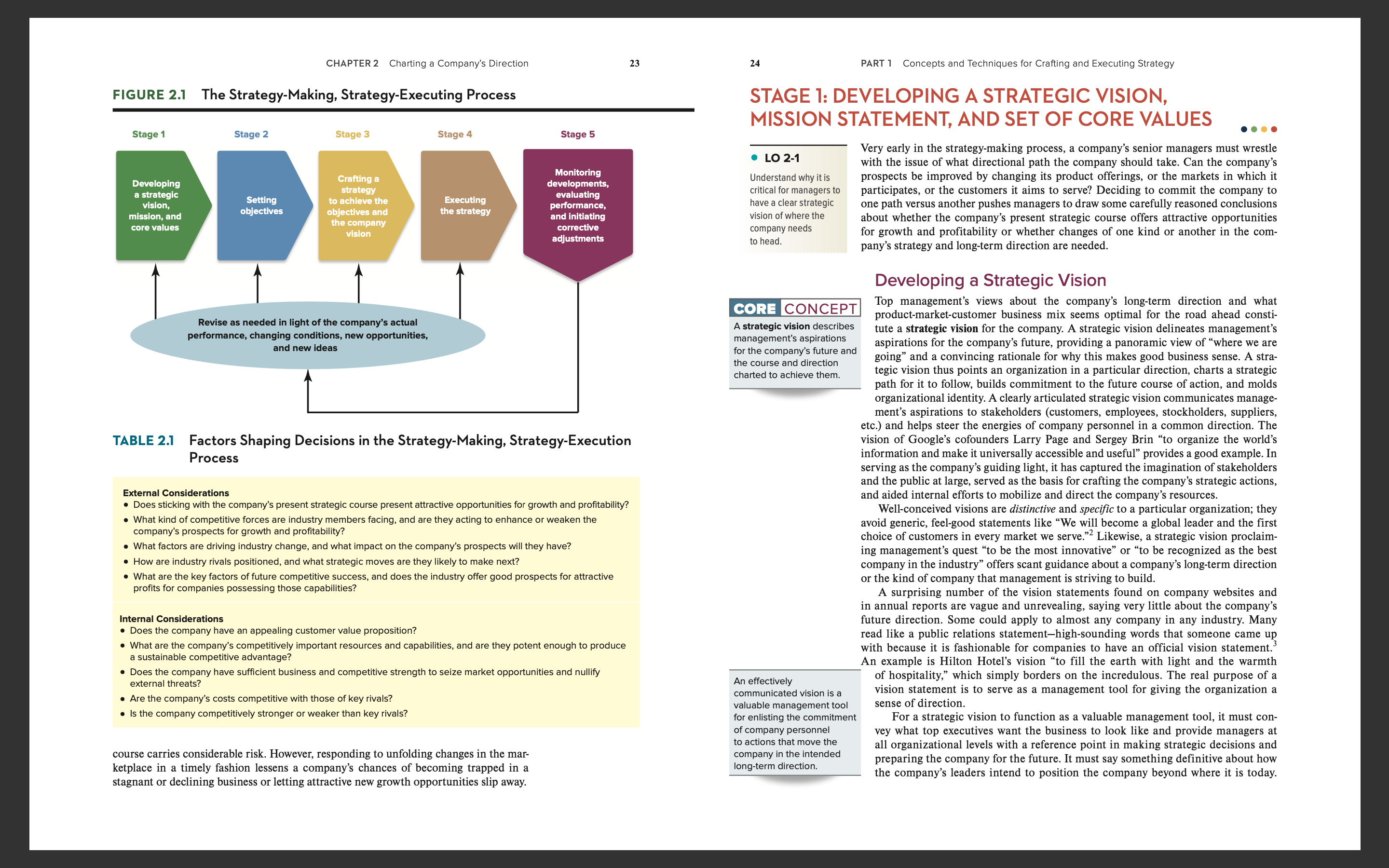
CHAPTER 2 Charting a Company's Direction 23 24 PART 1 Concepts and Techniques for Crafting and Executing Strategy FIGURE 2.1 The Strategy-Making, Strategy-Executing Process TABLE 2.1 Factors Shaping Decisions in the Strategy-Making, Strategy-Execution Process External Considerations - Does sticking with the company's present strategic course present attractive opportunities for growth and profitability? - What kind of competitive forces are industry members facing, and are they acting to enhance or weaken the company's prospects for growth and profitability? - What factors are driving industry change, and what impact on the company's prospects will they have? - How are industry rivals positioned, and what strategic moves are they likely to make next? - What are the key factors of future competitive success, and does the industry offer good prospects for attractive profits for companies possessing those capabilities? Internal Considerations - Does the company have an appealing customer value proposition? - What are the company's competitively important resources and capabilities, and are they potent enough to produce a sustainable competitive advantage? - Does the company have sufficient business and competitive strength to seize market opportunities and nullify external threats? - Are the company's costs competitive with those of key rivals? - Is the company competitively stronger or weaker than key rivals? course carries considerable risk. However, responding to unfolding changes in the marketplace in a timely fashion lessens a company's chances of becoming trapped in a stagnant or declining business or letting attractive new growth opportunities slip away. STAGE 1: DEVELOPING A STRATEGIC VISION, MISSION STATEMENT, AND SET OF CORE VALUES - LO 2-1 Understand why it is critical for managers to have a clear strategic vision of where the company needs to head. Very early in the strategy-making process, a company's senior managers must wrestle with the issue of what directional path the company should take. Can the company's prospects be improved by changing its product offerings, or the markets in which it participates, or the customers it aims to serve? Deciding to commit the company to one path versus another pushes managers to draw some carefully reasoned conclusions about whether the company's present strategic course offers attractive opportunities for growth and profitability or whether changes of one kind or another in the company's strategy and long-term direction are needed. Developing a Strategic Vision Top management's views about the company's long-term direction and what product-market-customer business mix seems optimal for the road ahead constitute a strategic vision for the company. A strategic vision delineates management's aspirations for the company's future, providing a panoramic view of "where we are going and a convincing rationale for why this makes good business sense. A strategic vision thus points an organization in a particular direction, charts a strategic path for it to follow, builds commitment to the future course of action, and molds organizational identity. A clearly articulated strategic vision communicates management's aspirations to stakeholders (customers, employees, stockholders, suppliers, etc.) and helps steer the energies of company personnel in a common direction. The vision of Google's cofounders Larry Page and Sergey Brin "to organize the world's information and make it universally accessible and useful" provides a good example. In serving as the company's guiding light, it has captured the imagination of stakeholders and the public at large, served as the basis for crafting the company's strategic actions, and aided internal efforts to mobilize and direct the company's resources. Well-conceived visions are distinctive and specific to a particular organization; they avoid generic, feel-good statements like "We will become a global leader and the first choice of customers in every market we serve." 2 Likewise, a strategic vision proclaiming management's quest "to be the most innovative" or "to be recognized as the best company in the industry" offers scant guidance about a company's long-term direction or the kind of company that management is striving to build. A surprising number of the vision statements found on company websites and in annual reports are vague and unrevealing, saying very little about the company's future direction. Some could apply to almost any company in any industry. Many read like a public relations statement-high-sounding words that someone came up with because it is fashionable for companies to have an official vision statement. 3 An example is Hilton Hotel's vision "to fill the earth with light and the warmth An effectively communicated vision is a valuable management tool for enlisting the commitment of company personnel to actions that move the company in the intended long-term direction. of hospitality," which simply borders on the incredulous. The real purpose of a vision statement is to serve as a management tool for giving the organization a sense of direction. For a strategic vision to function as a valuable management tool, it must convey what top executives want the business to look like and provide managers at all organizational levels with a reference point in making strategic decisions and preparing the company for the future. It must say something definitive about how the company's leaders intend to position the company beyond where it is today. CHAPTER 2 Charting a Company's Direction 23 24 PART 1 Concepts and Techniques for Crafting and Executing Strategy FIGURE 2.1 The Strategy-Making, Strategy-Executing Process TABLE 2.1 Factors Shaping Decisions in the Strategy-Making, Strategy-Execution Process External Considerations - Does sticking with the company's present strategic course present attractive opportunities for growth and profitability? - What kind of competitive forces are industry members facing, and are they acting to enhance or weaken the company's prospects for growth and profitability? - What factors are driving industry change, and what impact on the company's prospects will they have? - How are industry rivals positioned, and what strategic moves are they likely to make next? - What are the key factors of future competitive success, and does the industry offer good prospects for attractive profits for companies possessing those capabilities? Internal Considerations - Does the company have an appealing customer value proposition? - What are the company's competitively important resources and capabilities, and are they potent enough to produce a sustainable competitive advantage? - Does the company have sufficient business and competitive strength to seize market opportunities and nullify external threats? - Are the company's costs competitive with those of key rivals? - Is the company competitively stronger or weaker than key rivals? course carries considerable risk. However, responding to unfolding changes in the marketplace in a timely fashion lessens a company's chances of becoming trapped in a stagnant or declining business or letting attractive new growth opportunities slip away. STAGE 1: DEVELOPING A STRATEGIC VISION, MISSION STATEMENT, AND SET OF CORE VALUES - LO 2-1 Understand why it is critical for managers to have a clear strategic vision of where the company needs to head. Very early in the strategy-making process, a company's senior managers must wrestle with the issue of what directional path the company should take. Can the company's prospects be improved by changing its product offerings, or the markets in which it participates, or the customers it aims to serve? Deciding to commit the company to one path versus another pushes managers to draw some carefully reasoned conclusions about whether the company's present strategic course offers attractive opportunities for growth and profitability or whether changes of one kind or another in the company's strategy and long-term direction are needed. Developing a Strategic Vision Top management's views about the company's long-term direction and what product-market-customer business mix seems optimal for the road ahead constitute a strategic vision for the company. A strategic vision delineates management's aspirations for the company's future, providing a panoramic view of "where we are going and a convincing rationale for why this makes good business sense. A strategic vision thus points an organization in a particular direction, charts a strategic path for it to follow, builds commitment to the future course of action, and molds organizational identity. A clearly articulated strategic vision communicates management's aspirations to stakeholders (customers, employees, stockholders, suppliers, etc.) and helps steer the energies of company personnel in a common direction. The vision of Google's cofounders Larry Page and Sergey Brin "to organize the world's information and make it universally accessible and useful" provides a good example. In serving as the company's guiding light, it has captured the imagination of stakeholders and the public at large, served as the basis for crafting the company's strategic actions, and aided internal efforts to mobilize and direct the company's resources. Well-conceived visions are distinctive and specific to a particular organization; they avoid generic, feel-good statements like "We will become a global leader and the first choice of customers in every market we serve." 2 Likewise, a strategic vision proclaiming management's quest "to be the most innovative" or "to be recognized as the best company in the industry" offers scant guidance about a company's long-term direction or the kind of company that management is striving to build. A surprising number of the vision statements found on company websites and in annual reports are vague and unrevealing, saying very little about the company's future direction. Some could apply to almost any company in any industry. Many read like a public relations statement-high-sounding words that someone came up with because it is fashionable for companies to have an official vision statement. 3 An example is Hilton Hotel's vision "to fill the earth with light and the warmth An effectively communicated vision is a valuable management tool for enlisting the commitment of company personnel to actions that move the company in the intended long-term direction. of hospitality," which simply borders on the incredulous. The real purpose of a vision statement is to serve as a management tool for giving the organization a sense of direction. For a strategic vision to function as a valuable management tool, it must convey what top executives want the business to look like and provide managers at all organizational levels with a reference point in making strategic decisions and preparing the company for the future. It must say something definitive about how the company's leaders intend to position the company beyond where it is today
Step by Step Solution
There are 3 Steps involved in it

Get step-by-step solutions from verified subject matter experts
 Study Help