







Question: For this week's assignment, we'd like you to take a brief look at the financial situation the US Medicare System finds itself in. There are
For this week's assignment, we'd like you to take a brief look at the financial situation the US Medicare System finds itself in. There are entire courses taught on the program, it's big and complex, so please do not treat this as much more than a brief amuse-bouche before a many coursed meal. Medicare in the US is a multi-pronged health-insurance program run by the federal government to provide for the health needs of senior citizens (that is a separate program from the Medicaid program which is a federal program run through the states to provide medical insurance to low-income Americans). There are actually several different types of insurance offered - one covering hospitals and continuing care, another covering "regular" doctor visits and some equipment and home care, and another newer program to cover prescription drugs. Beneficiaries (generally over the age of 65) pay small (or no) premiums to be a part of the various programs and then have "coinsurance" to pay and deductibles to meet when they make use of the services. These amounts are determined by formulas from the Center for Medicaid and Medicare Services and are considerably lower than the cost of private health insurance that you may have obtained during your working life, and far smaller than private insurance that you might purchase (if you can get it at all) in retirement. Of largest relevance for this week's work is the way the program generates revenues and makes expenditures to medical providers. The program is structured as a "Pay As You Go" program, which means that the funds to pay for medical expenses today come from taxpayers today. To put it another way, the payroll taxes that you contribute to pay for Medicare are not saved and accumulated for your own future health insurance needs, but rather that are directed to pay for the current beneficiaries of the program. This structure would work quite well when we have what is known as a "low dependency ratio" - there are lots of young workers paying taxes to support the medical insurance for a smaller number of older citizens, and it works less well as the dependency ratio increases (i.e. fewer taxpaying younger workers to support the older citizens). Please address all of the following prompts.
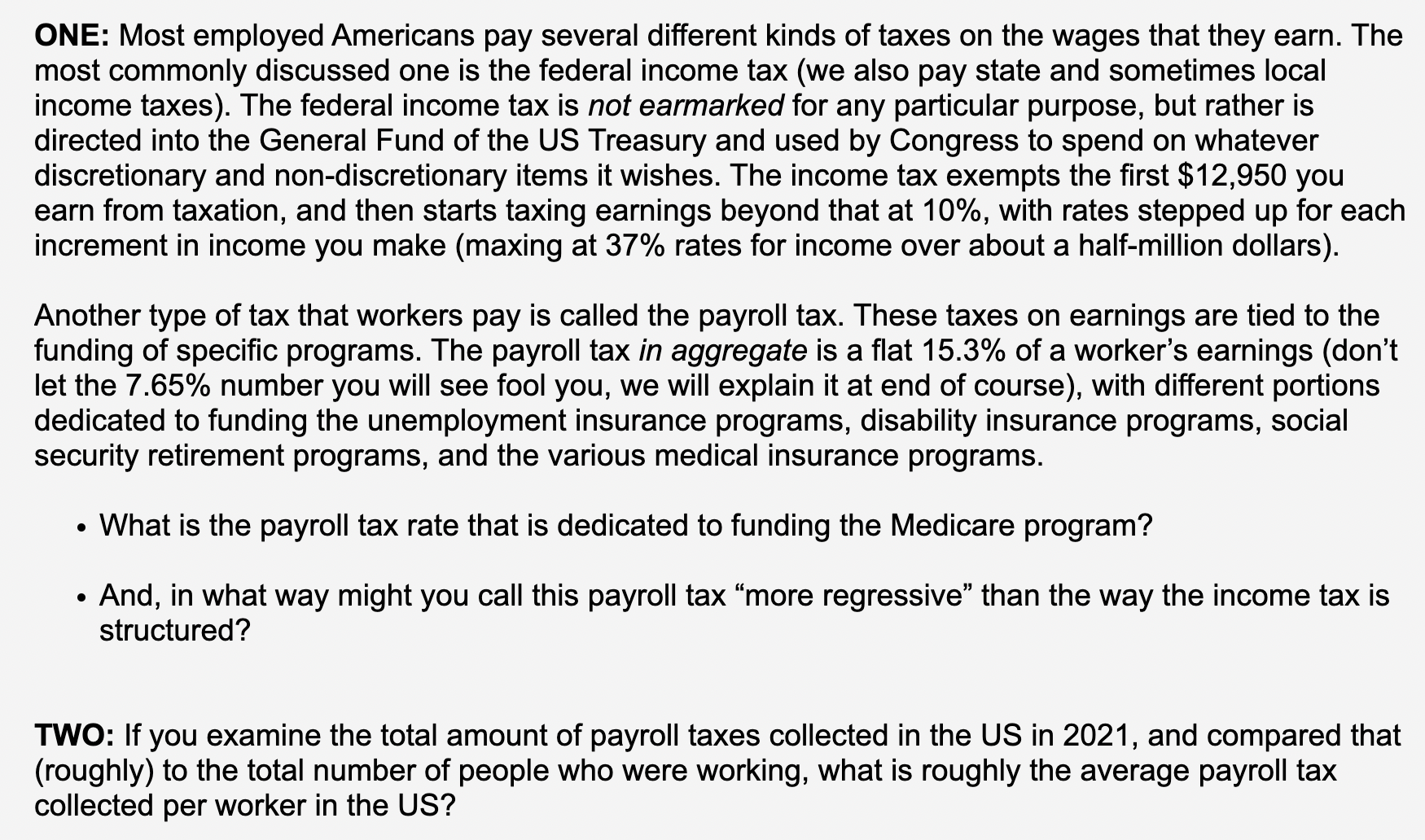
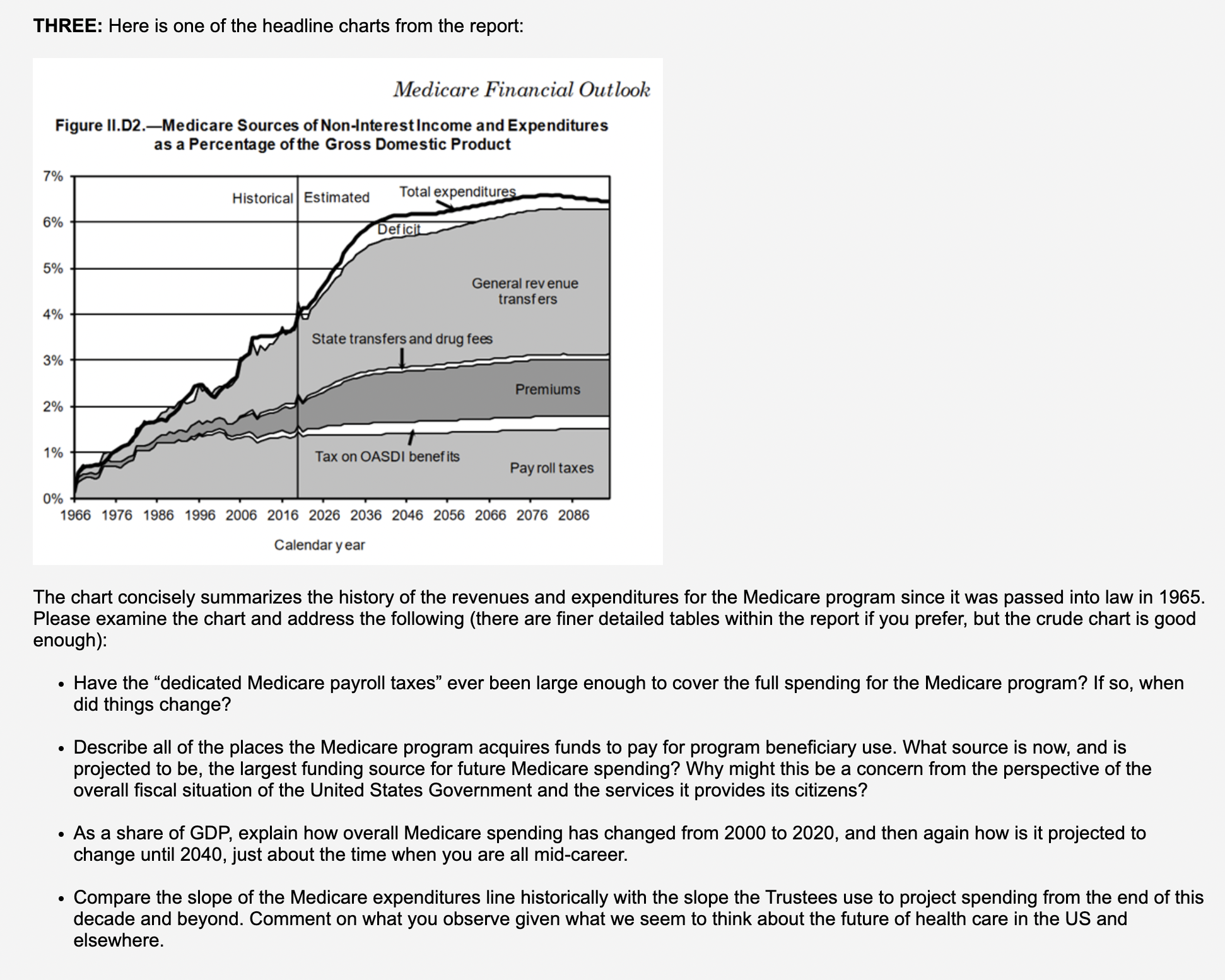
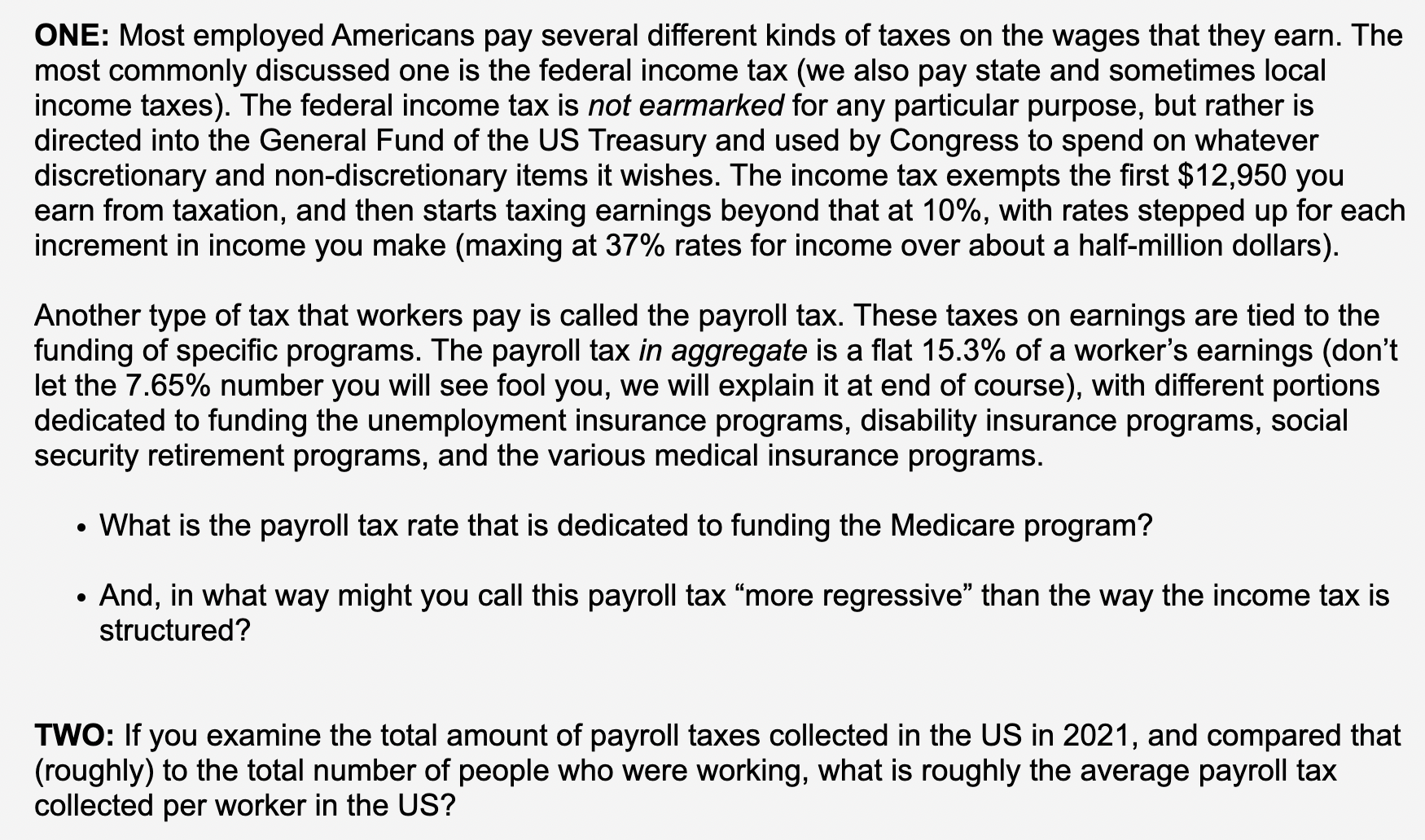
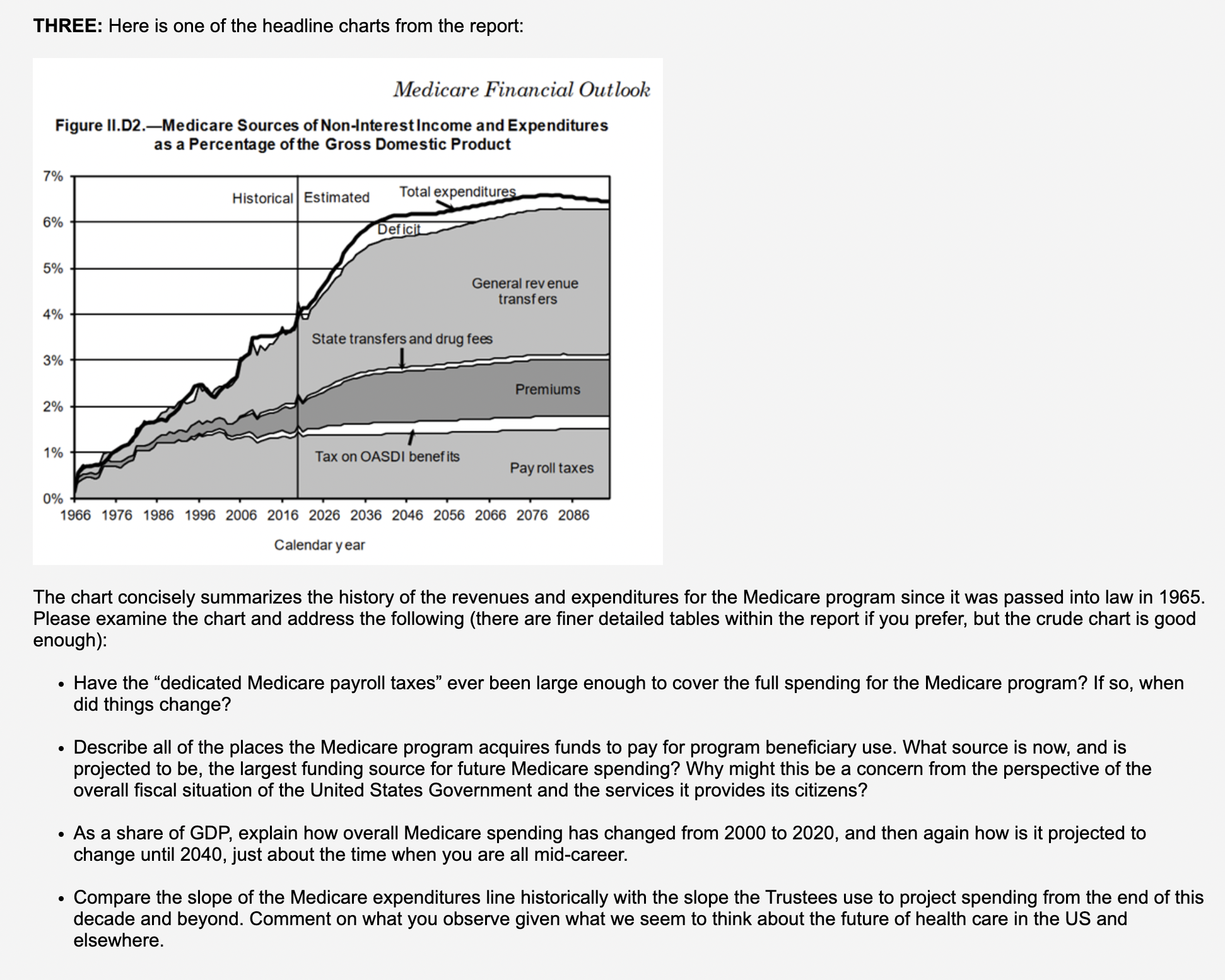
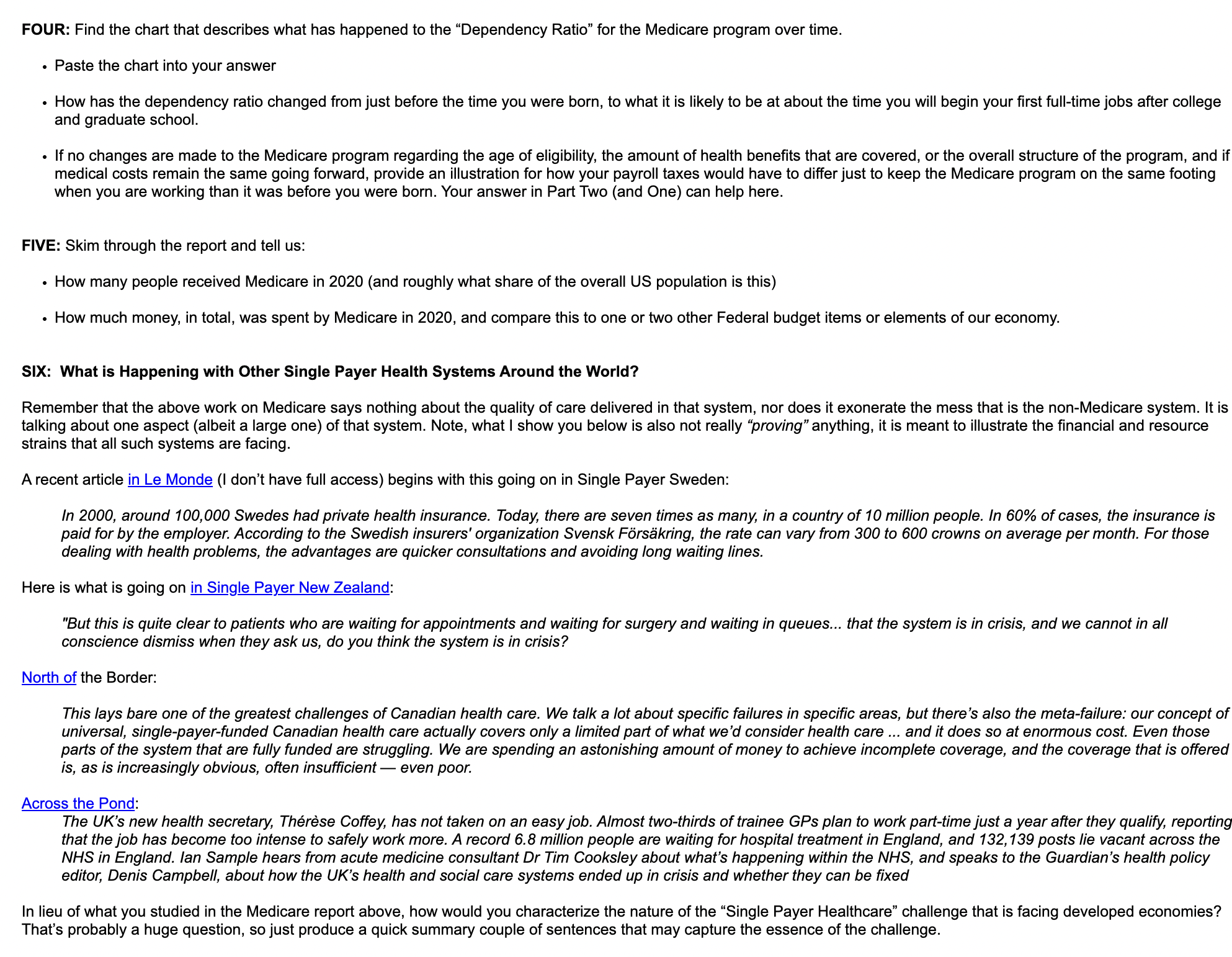
ONE: Most employed Americans pay several different kinds of taxes on the wages that they earn. The most commonly discussed one is the federal income tax (we also pay state and sometimes local income taxes). The federal income tax is not earmarked for any particular purpose, but rather is directed into the General Fund of the US Treasury and used by Congress to spend on whatever discretionary and non-discretionary items it wishes. The income tax exempts the first $12,950 you earn from taxation, and then starts taxing earnings beyond that at 10%, with rates stepped up for each increment in income you make (maxing at 37% rates for income over about a half-million dollars). Another type of tax that workers pay is called the payroll tax. These taxes on earnings are tied to the funding of specific programs. The payroll tax in aggregate is a flat 15.3% of a worker's earnings (don't let the 7.65% number you will see fool you, we will explain it at end of course), with different portions dedicated to funding the unemployment insurance programs, disability insurance programs, social security retirement programs, and the various medical insurance programs. - What is the payroll tax rate that is dedicated to funding the Medicare program? . And, in what way might you call this payroll tax \"more regressive" than the way the income tax is structured? TWO: If you examine the total amount of payroll taxes collected in the US in 2021, and compared that (roughly) to the total number of people who were working, what is roughly the average payroll tax collected per worker in the US? THREE: Here is one of the headline charts from the report: Medicare Financial Outlook Figure ll.D2.Medicare Sources of Non-Interest Income and Expenditures as a Percentage ofthe Gross Domestic Product 7 \"/0 5 % 5 % General rev enue transfers 4 % 3 % 2 % 1% 0% 1966 1976 1986 1996 2006 2016 2026 2036 2046 2056 2066 2076 2086 Calendar y ear The chart concisely summarizes the history of the revenues and expenditures for the Medicare program since it was passed into law in 1965. Please examine the chart and address the following (there are ner detailed tables within the report if you prefer, but the crude chart is good enoughy . Have the \"dedicated Medicare payroll taxes" ever been large enough to cover the full spending for the Medicare program? If so, when did things change? - Describe all of the places the Medicare program acquires funds to pay for program beneciary use. What source is now, and is projected to be, the largest funding source for future Medicare spending? Why might this be a concern from the perspective of the overall fiscal situation of the United States Government and the services it provides its citizens? - As a share of GDP, explain how overall Medicare spending has changed from 2000 to 2020, and then again how is it projected to change until 2040, just about the time when you are all mid-career. - Compare the slope of the Medicare expenditures line historically with the slope the Trustees use to project spending from the end of this decade and beyond. Comment on what you observe given what we seem to think about the future of health care in the US and elsewhere. FOUR: Find the chart that describes what has happened to the \"Dependency Ratio" for the Medicare program over time. - Paste the chart into your answer - How has the dependency ratio changed from just before the time you were born, to what it is likely to be at about the time you will begin your rst full-time jobs after college and graduate school. - If no changes are made to the Medicare program regarding the age of eligibility, the amount of health benets that are covered, or the overall structure of the program, and if medical costs remain the same going forward, provide an illustration for how your payroll taxes would have to differ just to keep the Medicare program on the same footing when you are working than it was before you were born. Your answer in Part Two (and One) can help here. FIVE: Skim through the report and tell us: - How many people received Medicare in 2020 (and roughly what share at the overall US population is this) - How much money, in total, was spent by Medicare in 2020, and compare this to one or two other Federal budget items or elements of our economy. SIX: What is Happening with Other Single Payer Health Systems Around the World? Remember that the above work on Medicare says nothing about the quality of care delivered in that system, nor does it exonerate the mess that is the non-Medicare system. It is talking about one aspect (albeit a large one) of that system. Note, what I show you below is also not really \"proving"anything, it is meant to illustrate the financial and resource strains that all such systems are facing. A recent article in Le Monde (I don't have full access) begins with this going on in Single Payer Sweden: in 2000, around 100,000 Swedes had private health insurance. Today, there are seven times as many, in a country of 10 million people. In 60% of cases, the insurance is paid for by the employer. According to the Swedish insurers' organization Svensk Forsakring, the rate can vary from 300 to 600 crowns on average per month. For those dealing with health problems, the advantages are quicker consultations and avoiding long waiting lines. Here is what is going on in Single Payer New Zealand: "But this is quite clear to patients who are waiting for appointments and waiting for surgery and waiting in queues... that the system is in crisis, and we cannot in all conscience dismiss when they ask us, do you think the system is in crisis? North of the Border: This lays bare one of the greatest challenges of Canadian health care. We talk a lot about specific failures in specic areas, but there 's also the meta-failure: our concept of universal, single-payer-funded Canadian health care actually covers only a limited part of what we'd consider health care and it does so at enormous cost. Even those parts of the system that are fully funded are struggling. We are spending an astonishing amount of money to achieve incomplete coverage, and the coverage that is offered is, as is increasingly obvious, often insufcient even poor. Across the Pond: The UK's new health secretary, Therese Coffey, has not taken on an easy job. Almost two-thirds of trainee GPs plan to work part-time just a year after they qualify, reporting that the job has become too intense to safely work more. A record 6.8 million people are waiting for hospital treatment in England, and 132,139 posts lie vacant across the NHS in England. lan Sample hears from acute medicine consultant Dr Tim Cooksley about what's happening within the NHS, and speaks to the Guardian's health policy editor; Denis Campbell, about how the UK 's health and social care systems ended up in cn'sis and whether they can be fixed In lieu of what you studied in the Medicare report above, how would you characterize the nature of the \"Single Payer Healthcare\" challenge that is facing developed economies? That's probably a huge question, so just produce a quick summary couple of sentences that may capture the essence of the challenge
Step by Step Solution
There are 3 Steps involved in it

Get step-by-step solutions from verified subject matter experts
 Study Help