







Question: For this week's discussion post, we are going to debate the Keynesian expenditure multiplier, particularly the fiscal multiplier, which measures the impact of each dollar
For this week's discussion post, we are going to debate the Keynesian expenditure multiplier, particularly the fiscal multiplier, which measures the impact of each dollar spent by the government on the aggregate output.
The table below shows different calculations for the Keynesian fiscal multiplier for the United States from different studies. As you can see, during periods of economic expansion (economy is at or above potential GDP), the multiplier is smaller than one (meaning that each dollar spent by the government generates a less-than-one dollar increase in GDP). During periods of economic recession (economy is below potential GDP), the multiplier is greater than one (meaning that each dollar spent by the government generates a larger-than-one dollar increase in GDP). Why do you think that the multiplier changes according to the level of economic activity? In your opinion, do these results strengthen or weaken the Keynesian argument about the importance of government intervention in aggregate demand during economic recessions? Why do you think that different economists find different results in their multiplier calculations?
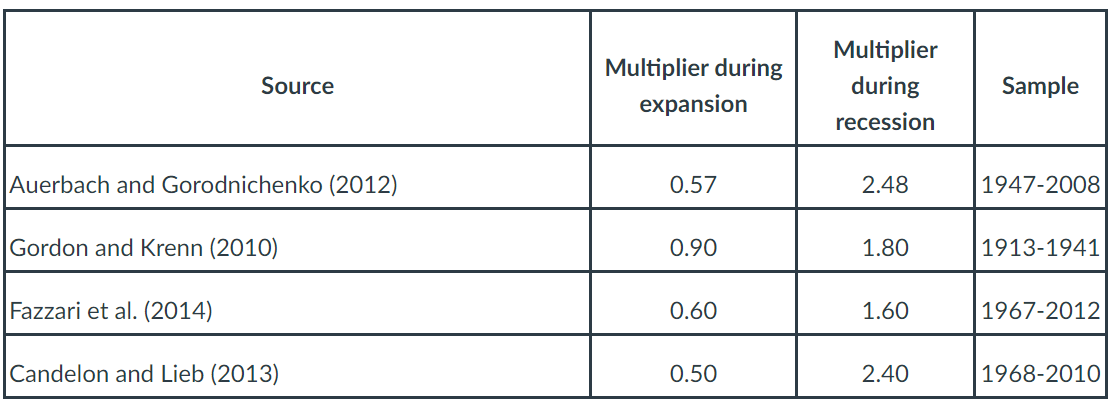
Multiplier Multiplier during Source during Sample expansion recession Auerbach and Gorodnichenko (2012) 0.57 2.48 1947-2008 Gordon and Krenn (2010) 0.90 1.80 1913-1941 Fazzari et al. (2014) 0.60 1.60 1967-2012 Candelon and Lieb (2013) 0.50 2.40 1968-2010
Step by Step Solution
There are 3 Steps involved in it

Get step-by-step solutions from verified subject matter experts
 Study Help