







Question: Forecasting with the Parsimonious Method and Estimating Share Value Using the DCF Model Following are income statements and balance sheets for Cisco Systems. Cisco Systems
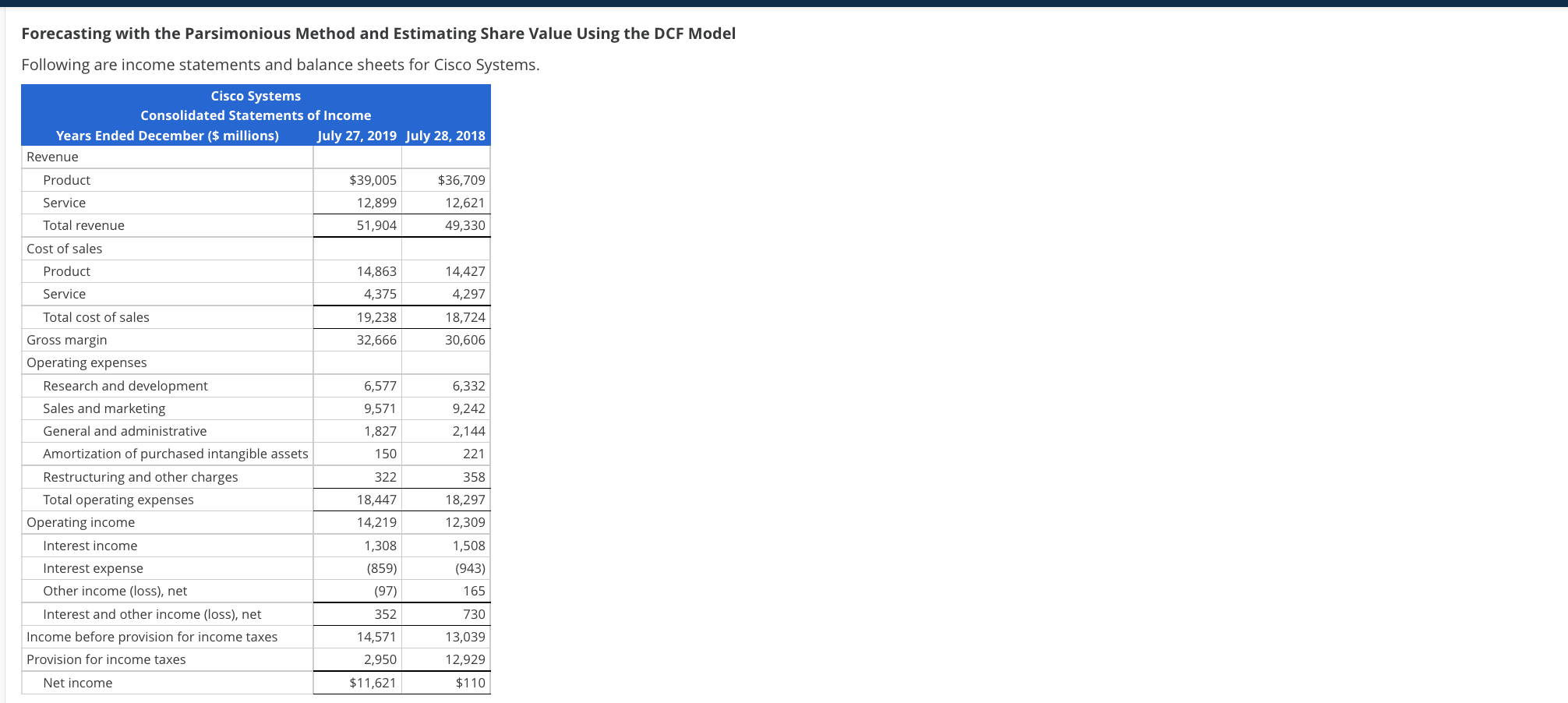
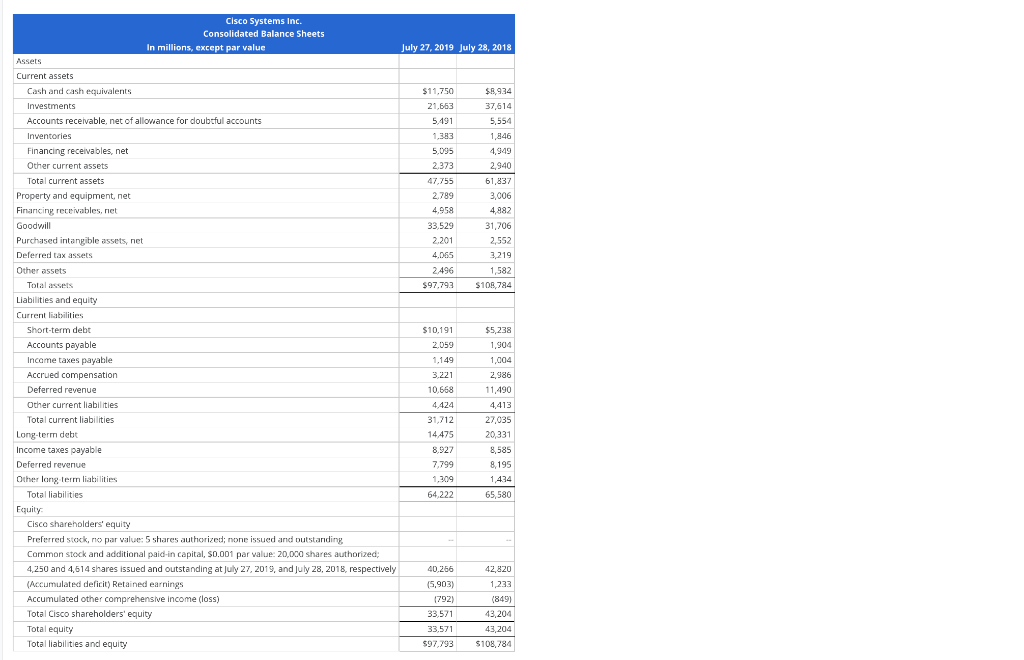
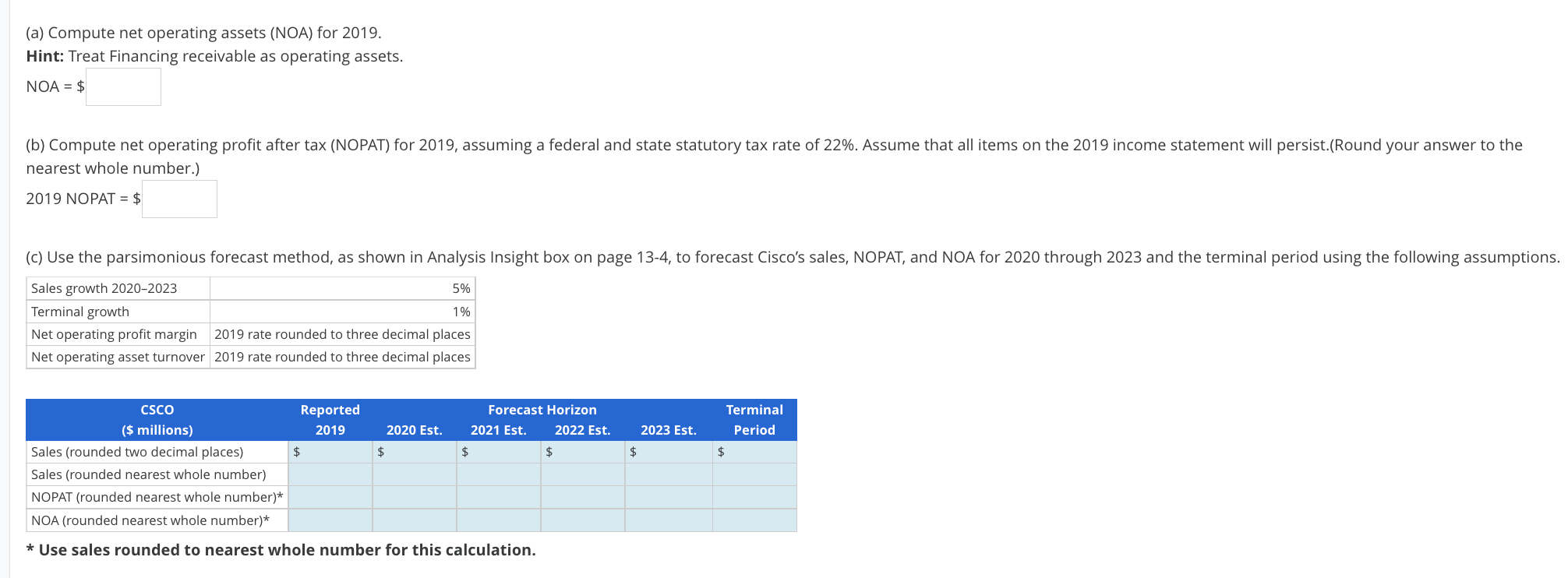
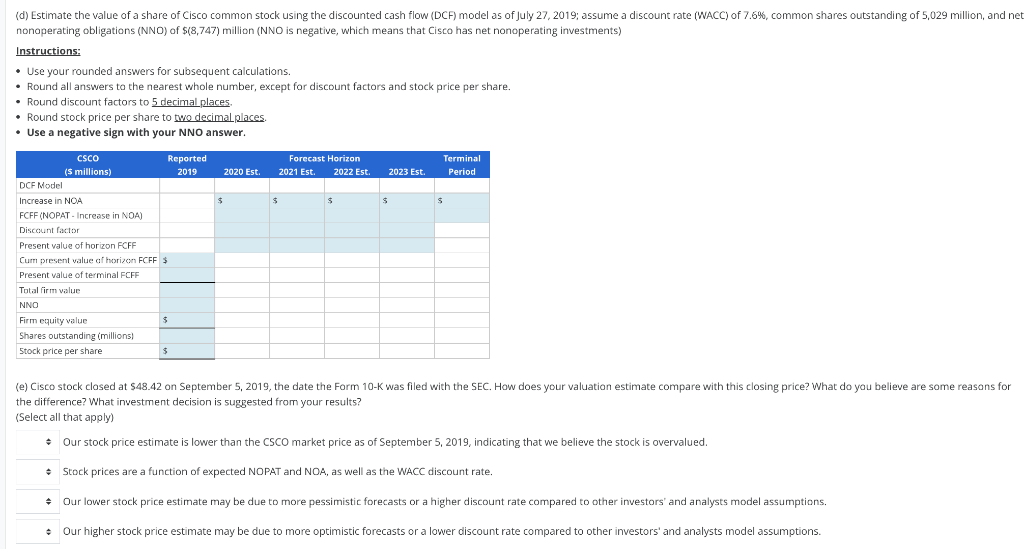
Forecasting with the Parsimonious Method and Estimating Share Value Using the DCF Model Following are income statements and balance sheets for Cisco Systems. Cisco Systems Consolidated Statements of Income Years Ended December ($ millions) July 27, 2019 July 28, 2018 Revenue Product $39,005 $36,709 Service 12,899 12,621 Total revenue 51,904 49,330 Cost of sales Product 14,863 14,427 Service 4,375 4,297 Total cost of sales 19,238 18,724 Gross margin 32,666 30,606 Operating expenses Research and development 6,577 6,332 Sales and marketing 9,571 9,242 General and administrative 1,827 2,144 Amortization of purchased intangible assets 150 221 Restructuring and other charges 322 358 Total operating expenses 18,447 18,297 Operating income 14,219 12,309 Interest income 1,308 1,508 Interest expense (859) (943) Other income (loss), net (97) 165 Interest and other income (loss), net 352 Income before provision for income taxes 14,571 13,039 Provision for income taxes 2,950 12,929 Net income $11,621 $110 730 Cisco Systems Inc. Consolidated Balance Sheets In millions, except par value July 27, 2019 July 28, 2018 Assets $11,750 21,563 5,491 1,383 5,095 2.373 47,755 2.789 4,958 Current assets Cash and cash equivalents Investments Accounts receivable, net of allowance for doubtful accounts Inventories Financing receivables, net Other current assets Total current assets Property and equipment, net Financing receivables.net Goodwill Purchased intangible assets, net , Deferred tax assets Other assets Total assets Liabilities and equity Current liabilities Short-term debt Accounts payable Incame taxes payable Accrued compensation Deferred revenue Other current liabilities Total current liabilities $8,934 37,614 5,554 1,846 4.949 2.940 61,837 3,006 4,882 31,706 2,552 3.219 1,582 $108,784 33,529 2.201 4.065 2.496 $97.793 $10.191 $5,238 1.904 1,004 2.059 1,149 3.221 10.668 4,424 31,712 14475 8.927 7.799 1,309 Long-term debt 2,986 11,490 4,413 27.035 20,331 8,585 8,195 1,434 65,580 64.222 Income taxes payable Deferred revenue Other long term liabilities Total liabilities Equity Cisco shareholders' equity Preferred stock, no par value: 5 shares authorized: none issued and outstanding Common stock and additional paid-in capital, $0.001 par value: 20,000 shares authorized: 4,250 and 4,614 shares issued and outstanding at July 27, 2019, and July 28, 2018, respectively (Accumulated deficit) Retained earnings Accumulated other comprehensive income (loss) Total Cisco shareholders' equity Total equity Total liabilities and equity 40.266 (5,903) (792) 33,571 42,820 1,233 (849) 43,204 43,204 $108,784 33,571 $97,793 (a) Compute net operating assets (NOA) for 2019. Hint: Treat Financing receivable as operating assets. NOA = $ (b) Compute net operating profit after tax (NOPAT) for 2019, assuming a federal and state statutory tax rate of 22%. Assume that all items on the 2019 income statement will persist.(Round your answer to the nearest whole number.) 2019 NOPAT = $ (c) Use the parsimonious forecast method, as shown in Analysis Insight box on page 13-4, to forecast Cisco's sales, NOPAT, and NOA for 2020 through 2023 and the terminal period using the following assumptions. Sales growth 2020-2023 5% Terminal growth 1% Net operating profit margin 2019 rate rounded to three decimal places Net operating asset turnover 2019 rate rounded to three decimal places Reported 2019 Terminal Period 2020 Est. Forecast Horizon 2021 Est. 2022 Est. $ $ 2023 Est. $ $ $ $ CSCO ($ millions) Sales (rounded two decimal places) Sales (rounded nearest whole number) NOPAT (rounded nearest whole number)* NOA (rounded nearest whole number)* * Use sales rounded to nearest whole number for this calculation. (d) Estimate the value of a share of Cisco common stock using the discounted cash flow (DCF) model as of July 27, 2019; assume a discount rate (WACC) of 7.6%, common shares outstanding of 5,029 million, and net nonoperating obligations (NNO) of $(8,747) million (NNO is negative, which means that Cisco has net nonoperating investments) Instructions: Use your rounded answers for subsequent calculations. Round all answers to the nearest whole number, except for discount factors and stock price per share. Round discount factors to 5 decimal places Round stock price per share to two decimal places Use a negative sign with your NNO answer. Forecast Horizon 2021 Est 2022 Est Terminal Period 2020 Est 2023 Est CSCO Reported (5 millions) 2019 DCF Model Increase in NOA FCFF (NOPAT - Increase in NOA) Discount for Present value of horizon FCFF Cum present value of horizon FCFF $ Present value of terminal FCFF Total firm value NNO Firm equity value $ Shares outstanding (millions Stock price per share $ (e) Cisco stock closed at $48.42 on September 5, 2019, the date the Form 10-K was filed with the SEC. How does your valuation estimate compare with this closing price? What do you believe are some reasons for the difference? What investment decision is suggested from your results? (Select all that apply) Our stock price estimate is lower than the CSCO market price as of September 5, 2019, indicating that we believe the stock is overvalued. Stock prices are a function of expected NOPAT and NOA, as well as the WACC discount rate. Our lower stock price estimate may be due to more pessimistic forecasts or a higher discount rate compared to other investors' and analysts model assumptions. Our higher stock price estimate may be due to more optimistic forecasts or a lower discount rate compared to other investors' and analysts model assumptions
Step by Step Solution
There are 3 Steps involved in it

Get step-by-step solutions from verified subject matter experts
 Study Help