







Question: FORMATIVE ASSESSMENT 1 [100 MARKS] Read the case study below and answer the question that follows. Keflavik Paper Company In recent years, Keflavik Paper Company
![FORMATIVE ASSESSMENT 1 [100 MARKS] Read the case study below and](https://s3.amazonaws.com/si.experts.images/answers/2024/06/667cc7f18c4b5_681667cc7f160d82.jpg)
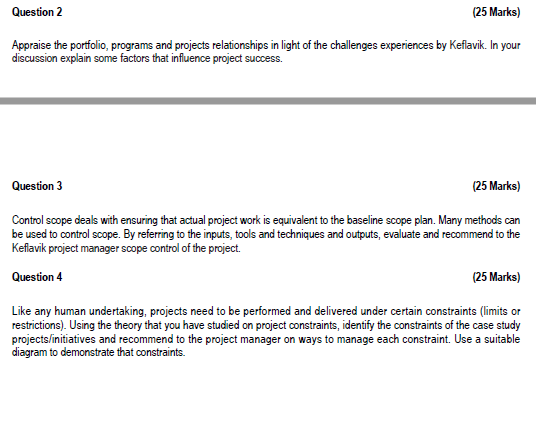
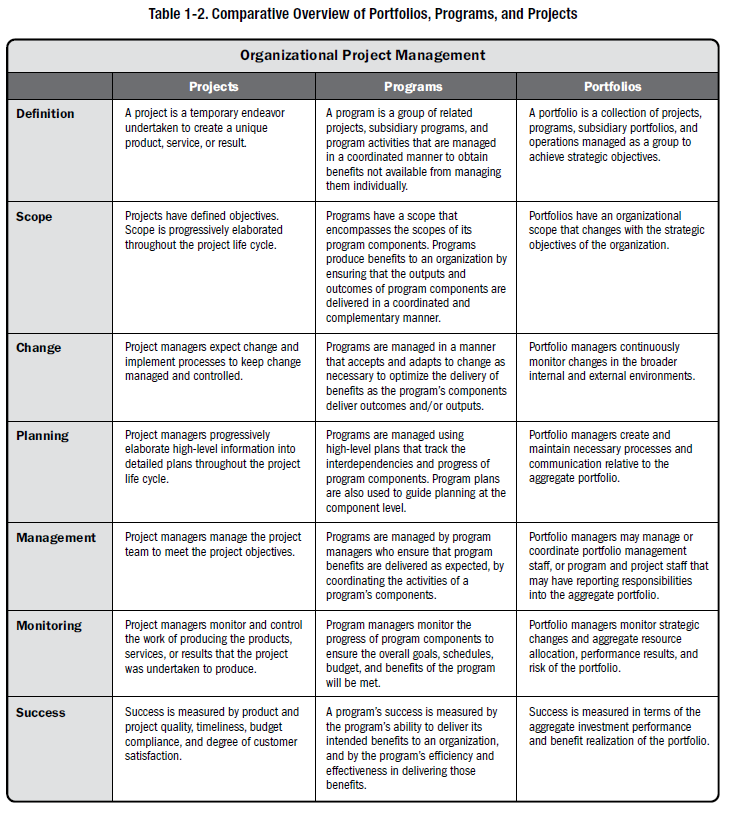
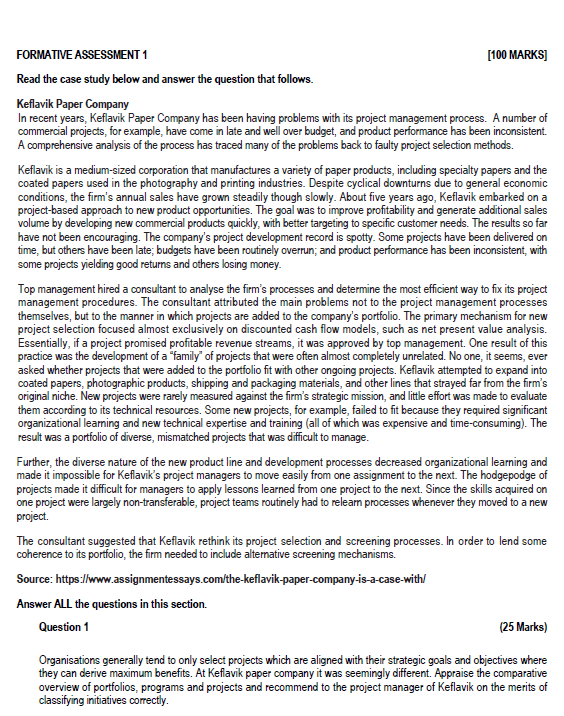
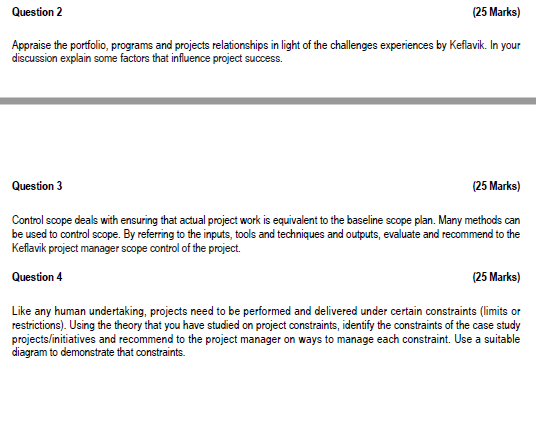
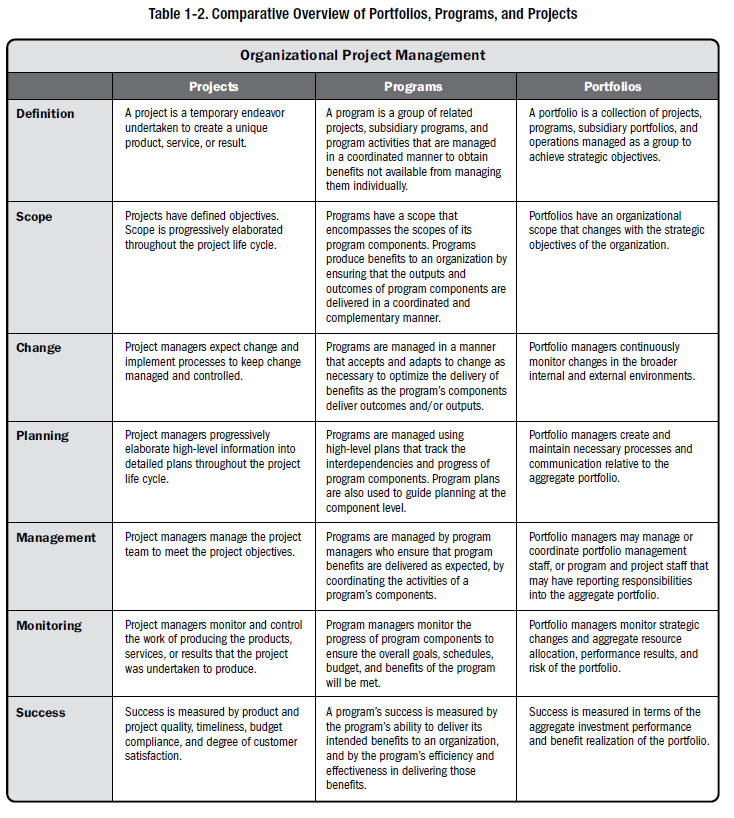
FORMATIVE ASSESSMENT 1 [100 MARKS] Read the case study below and answer the question that follows. Keflavik Paper Company In recent years, Keflavik Paper Company has been having problems with its project management process. A number of commercial projects, for example, have come in late and well over budget, and product performance has been inconsistent. A comprehensive analysis of the process has traced many of the problems back to faulty project selection methods. Keflavik is a medium-sized corporation that manufactures a variety of paper products, including specialty papers and the coated papers used in the photography and printing industries. Despite cyclical downturns due to general economic conditions, the firm's annual sales have grown steadily though slowly. About five years ago, Keflavik embarked on a project-based approach to new product opportunities. The goal was to improve profitability and generate additional sales volume by developing new commercial products quickly, with better targeting to specific customer needs. The results so far have not been encouraging. The company's project development record is spotty. Some projects have been delivered on time, but others have been late; budgets have been routinely overrun; and product performance has been inconsistent, with some projects yielding good returns and others losing money. Top management hired a consultant to analyse the firm's processes and determine the most efficient way to fix its project management procedures. The consultant attributed the main problems not to the project management processes themselves, but to the manner in which projects are added to the company's portfolio. The primary mechanism for new project selection focused almost exclusively on discounted cash flow models, such as net present value analysis. Essentially, if a project promised profitable revenue streams, it was approved by top management. One result of this practice was the development of a "family" of projects that were often almost completely unrelated. No one, it seems, ever asked whether projects that were added to the portfolio fit with other ongoing projects. Keflavik attempted to expand into coated papers, photographic products, shipping and packaging materials, and other lines that strayed far from the firm's original niche. New projects were rarely measured against the firm's strategic mission, and little effort was made to evaluate them according to its technical resources. Some new projects, for example, failed to fit because they required significant organizational learning and new technical expertise and training (all of which was expensive and time-consuming). The result was a portfolio of diverse, mismatched projects that was difficult to manage Further, the diverse nature of the new product line and development processes decreased organizational learning and made it impossible for Keflavik's project managers to move easily from one assignment to the next. The hodgepodge of projects made it difficult for managers to apply lessons learned from one project to the next. Since the skills acquired on one project were largely non-transferable, project teams routinely had to relearn processes whenever they moved to a new project. The consultant suggested that Keflavik rethink its project selection and screening processes. In order to lend some coherence to its portfolio, the firm needed to include alternative screening mechanisms. Source: https://www.assignmentessays.com/the-keflavik-paper-company-is-a-case-with/ Answer ALL the questions in this section. Question 1 (25 Marks) Organisations generally tend to only select projects which are aligned with their strategic goals and objectives where they can derive maximum benefits. At Keflavik paper company it was seemingly different. Appraise the comparative overview of portfolios, programs and projects and recommend to the project manager of Keflavik on the merits of classifying initiatives correctly.Question 2 (25 Marks) Appraise the portfolio, programs and projects relationships in light of the challenges experiences by Keflavik. In your discussion explain some factors that influence project success. Question 3 (25 Marks) Control scope deals with ensuring that actual project work is equivalent to the baseline scope plan. Many methods can be used to control scope. By referring to the inputs, tools and techniques and outputs, evaluate and recommend to the Keflavik project manager scope control of the project. Question 4 (25 Marks) Like any human undertaking, projects need to be performed and delivered under certain constraints (limits or restrictions). Using the theory that you have studied on project constraints, identify the constraints of the case study projects/initiatives and recommend to the project manager on ways to manage each constraint. Use a suitable diagram to demonstrate that constraints.Table 1-2. Comparative Overview of Portfolios, Programs, and Projects Organizational Project Management Projects Programs Portfolios Definition A project is a temporary endeavor A program is a group of related A portfolio is a collection of projects, undertaken to create a unique projects, subsidiary programs, and programs, subsidiary portfolios, and product, service, or result. program activities that are managed operations managed as a group to in a coordinated manner to obtain achieve strategic objectives. benefits not available from managing them individually. Scope Projects have defined objectives. Programs have a scope that Portfolios have an organizational Scope is progressively elaborated encompasses the scopes of its scope that changes with the strategic throughout the project life cycle. program components. Programs objectives of the organization. produce benefits to an organization by ensuring that the outputs and outcomes of program components are delivered in a coordinated and complementary manner. Change Project managers expect change and Programs are managed in a manner Portfolio managers continuously implement processes to keep change that accepts and adapts to change as monitor changes in the broade managed and controlled. necessary to optimize the delivery of internal and external environments. benefits as the program's components deliver outcomes and/ or outputs. Planning Project managers progressively Programs are managed using Portfolio managers create and elaborate high-level information into high-level plans that track the maintain necessary processes and detailed plans throughout the project interdependencies and progress of communication relative to the life cycle. program components. Program plans aggregate portfolio are also used to guide planning at the component level Management Project managers manage the project Programs are managed by program Portfolio managers may manage or team to meet the project objectives. managers who ensure that program coordinate portfolio management benefits are delivered as expected, by staff, or program and project staff that coordinating the activities of a may have reporting responsibilities program's components. into the aggregate portfolio. Monitoring Project managers monitor and control Program managers monitor the Portfolio managers monitor strategic the work of producing the products, progress of program components to changes and aggregate resource services, or results that the project ensure the overall goals, schedules, allocation, performance results, and was undertaken to produce. budget, and benefits of the program risk of the portfolio. will be met Success Success is measured by product and A program's success is measured by Success is measured in terms of the project quality, timeliness, budget the program's ability to deliver its aggregate investment performance compliance, and degree of customer intended benefits to an organization, and benefit realization of the portfolio. satisfaction. and by the program's efficiency and effectiveness in delivering those benefits
Step by Step Solution
There are 3 Steps involved in it

Get step-by-step solutions from verified subject matter experts
 Study Help