







Question: Four (4) points possible for each solution. Partial credit is possible! You may use scratch paper to practice your solution or try out a problem
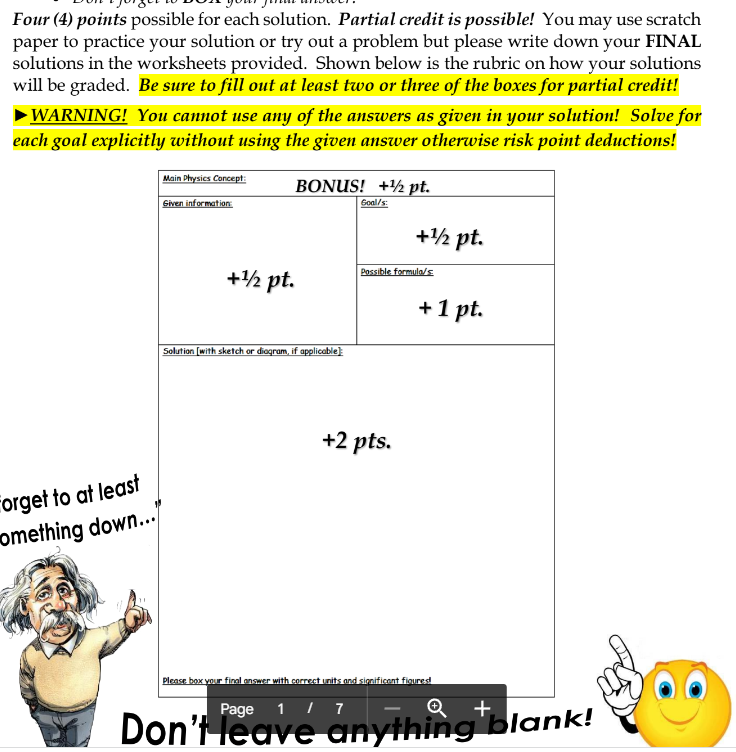
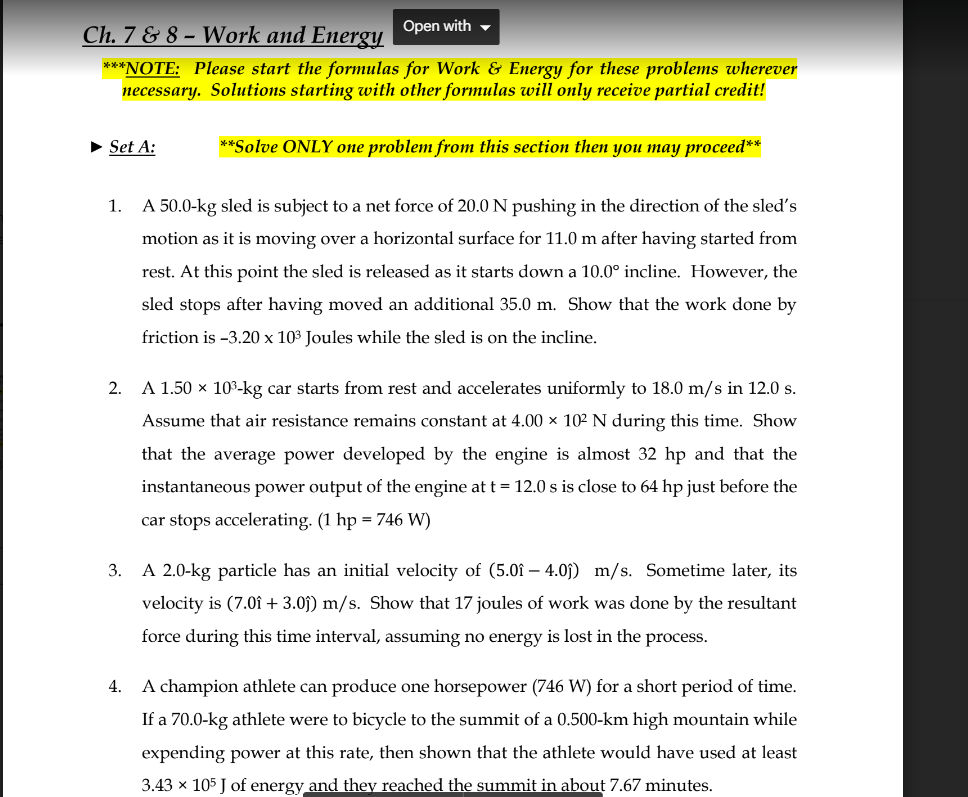
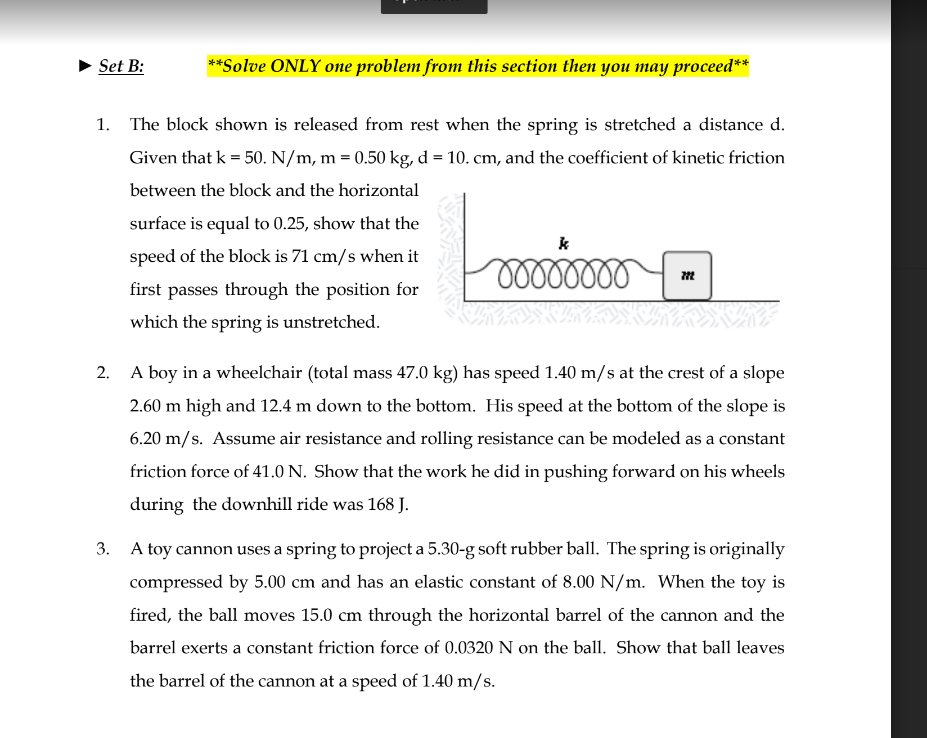
Four (4) points possible for each solution. Partial credit is possible! You may use scratch paper to practice your solution or try out a problem but please write down your FINAL solutions in the worksheets provided. Shown below is the rubric on how your solutions will be graded. Be sure to fill out at least two or three of the boxes for partial credit! >WARNING! You cannot use any of the answers as given in your solution! Solve for each goal explicitly without using the given answer otherwise risk point deductions! Main Physics Concept: BONUS! +/2 pt. Given information Goal/'s: +1/2 pt. +1/2 pt. Possible formula/s + 1 pt. Solution [with sketch or diagram, if applicable] +2 pts. orget to at least omething down... Please box your final answer with correct units and significant figures! Don't leave anything' lank!Open with v *\"NOTE: Please start the formulas for Work fr Energy for these problems wherever necessary. Solutions starting with otherforrnnlns will only receive partial credit! I- Set A: \"Solve ONLY one problem from this section then you may proceed \"' 1. A SOJJLkg slot] is subject to a net force of 20.0 N pushing in the direction of the sled's motion as it is moving over a horizontal surface for 11.0 m after having started from rest. At this point the sled is released as it starts down a 1M)" incline. However, the sled stops after having moved an additional 35.0 in. Show that the work done by friction is -3.20 x 10³ ]oules While the sled is on the incline. 2. A 1.50 X 101143; car starts from rest and accelerates uniformly to 18.0 m/s in 12.0 s. Assume that air resistance remains constant at 4.00 X 10² N during this time. Show that the average power developed by the engine is almost 32 hp and that the instantaneous power output of the engine at t = 121] sis close to 64 hp just before the car stops accelerating. {1 hp = 746 W) 3. A lit-kg particle has an initial velocity of [5.01 4.0i) m/s. Sometime later, its velocity is {7.0i + 3.01) m/s. Show that 17 joules of work was done by the resultant force during this time interval, assuming no energy is lost in the process. 4. A champion athlete can produce one horsepower (1216 W) for a short period of time. If a CHILD-kg athlete were to bicycle to the summit of a DIEGO-km high mountain While expending power at this rate, then shown that the athlete would have used at least 3.43 X 10⁵i of energy and the}: reached the summit in ahOut 7.67 rru'nutes. Set B: **Solve ONLY one problem from this section then you may proceed** 1. The block shown is released from rest when the spring is stretched a distance d. Given that k = 50. N/m, m = 0.50 kg, d = 10. cm, and the coefficient of kinetic friction between the block and the horizontal surface is equal to 0.25, show that the speed of the block is 71 cm/s when it first passes through the position for 80808080 which the spring is unstretched. 2. A boy in a wheelchair (total mass 47.0 kg) has speed 1.40 m/s at the crest of a slope 2.60 m high and 12.4 m down to the bottom. His speed at the bottom of the slope is 6.20 m/s. Assume air resistance and rolling resistance can be modeled as a constant friction force of 41.0 N. Show that the work he did in pushing forward on his wheels during the downhill ride was 168 J. 3. A toy cannon uses a spring to project a 5.30-g soft rubber ball. The spring is originally compressed by 5.00 cm and has an elastic constant of 8.00 N/m. When the toy is fired, the ball moves 15.0 cm through the horizontal barrel of the cannon and the barrel exerts a constant friction force of 0.0320 N on the ball. Show that ball leaves the barrel of the cannon at a speed of 1.40 m/s
Step by Step Solution
There are 3 Steps involved in it

Get step-by-step solutions from verified subject matter experts
 Study Help