







Question: Four binary signals (A, B, C and D) are used to define an integer in the hexadecimal range (O to F). The decimal digit satisfies
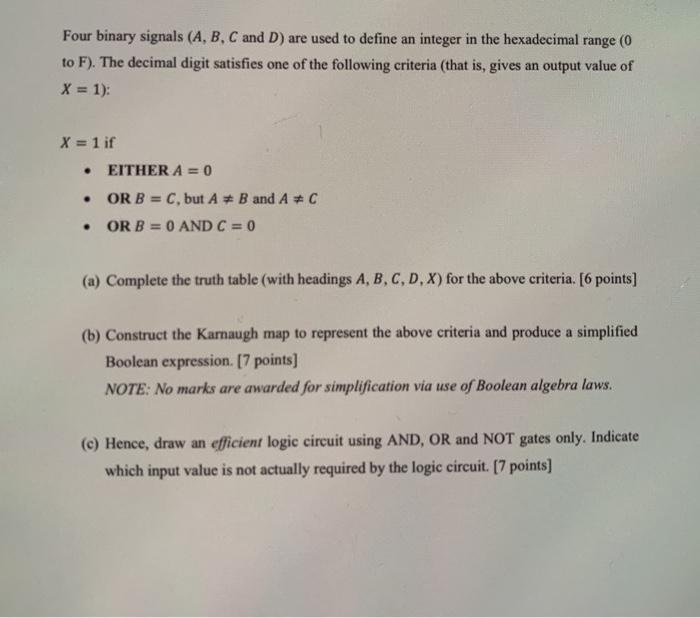
Four binary signals (A, B, C and D) are used to define an integer in the hexadecimal range (O to F). The decimal digit satisfies one of the following criteria (that is, gives an output value of X = 1) X = 1 if EITHER A = 0 OR B = C, but A + B and A #C OR B = 0 AND C = 0 (a) Complete the truth table (with headings A,B,C,D, X) for the above criteria. [6 points) (b) Construct the Karnaugh map to represent the above criteria and produce a simplified Boolean expression. [7 points) NOTE: No marks are awarded for simplification via use of Boolean algebra laws. (e) Hence, draw an efficient logic circuit using AND, OR and NOT gates only. Indicate which input value is not actually required by the logic circuit. [7 points)
Step by Step Solution
There are 3 Steps involved in it

Get step-by-step solutions from verified subject matter experts
 Study Help