





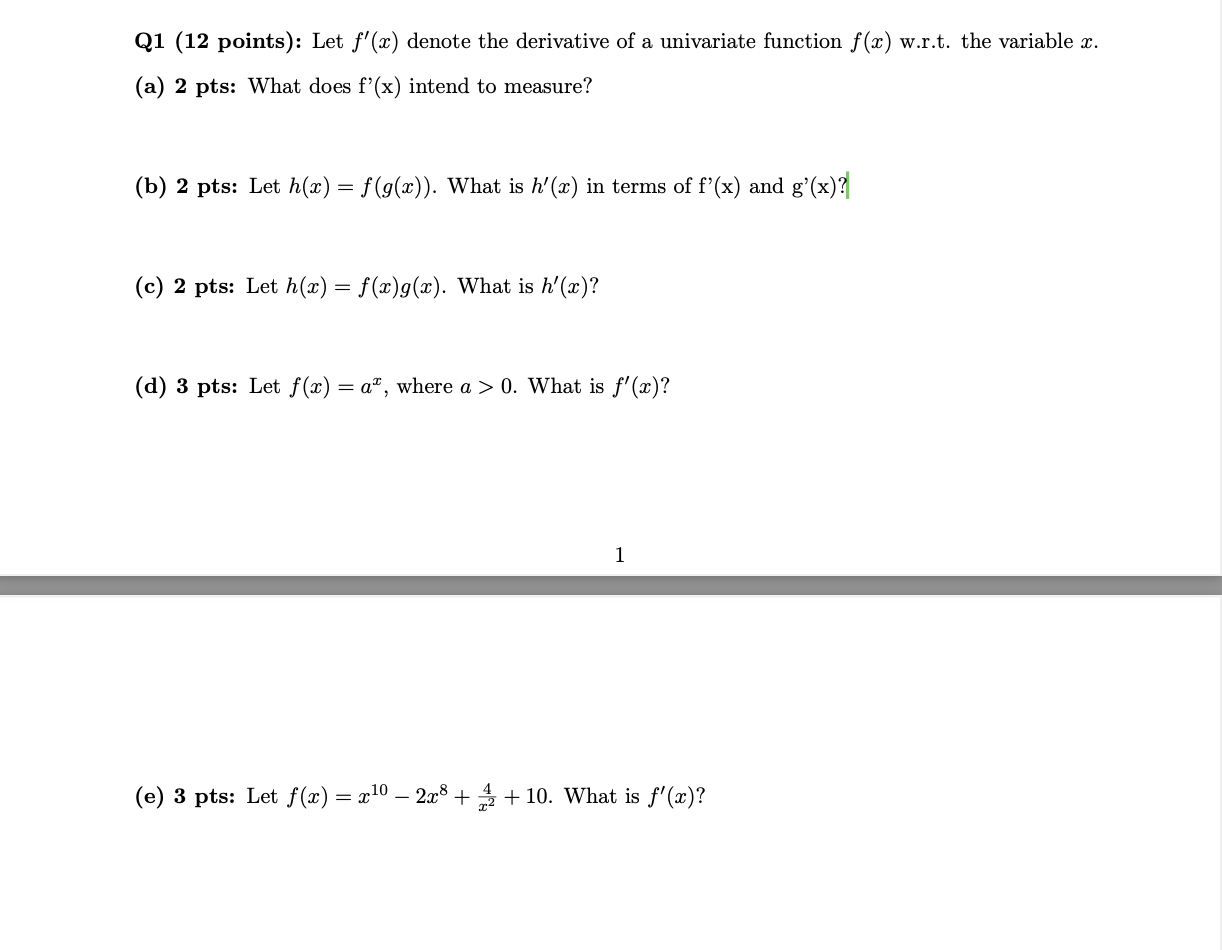
Question: fQ3 (45 points): Let f be a multi-variate function, and let x be one of the variables in f. Let us denote the partial derivative
\fQ3 (45 points): Let f be a multi-variate\fQ3 (45 points): Let f be a multi-variate\fQ3 (45 points): Let f be a multi-variate
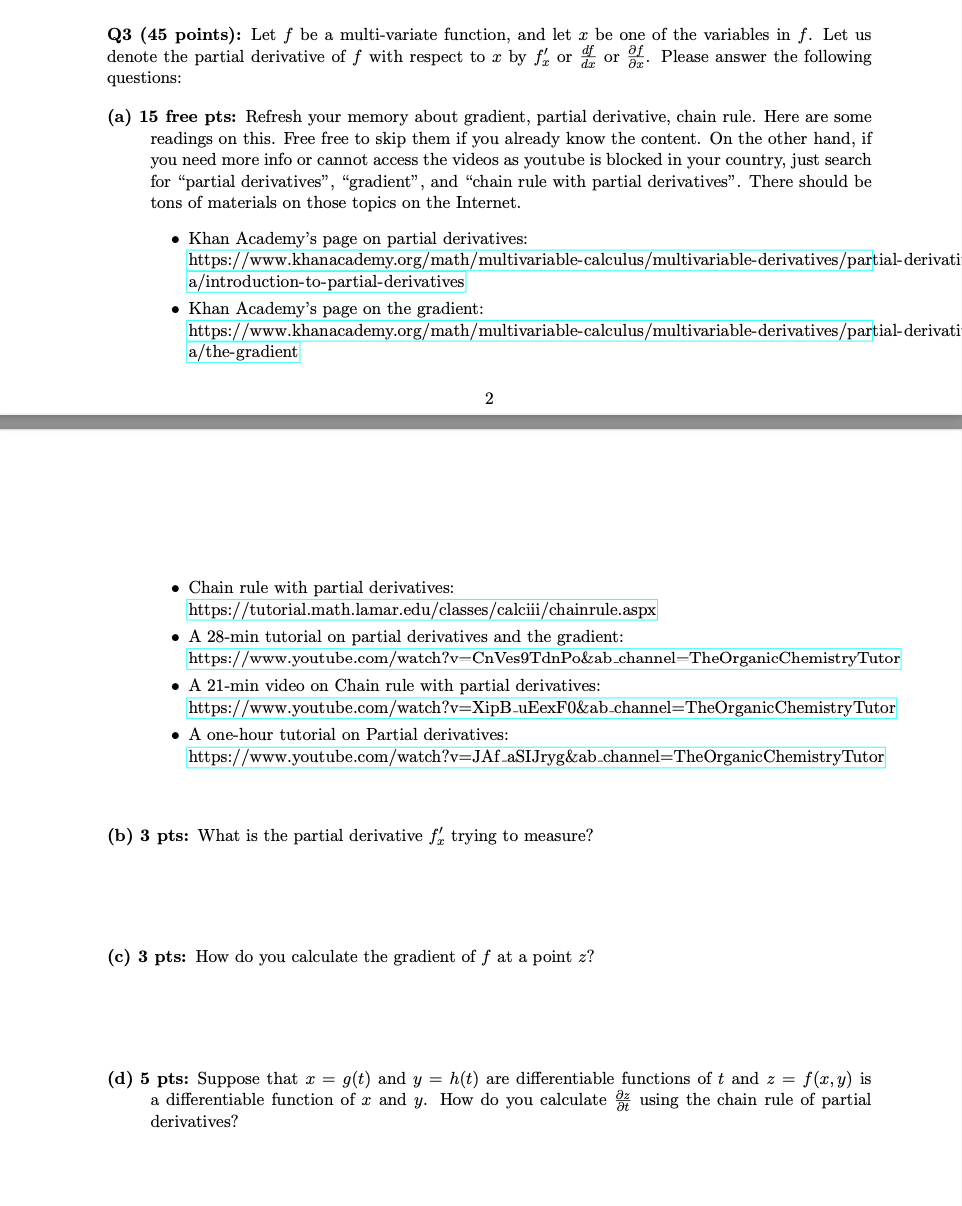
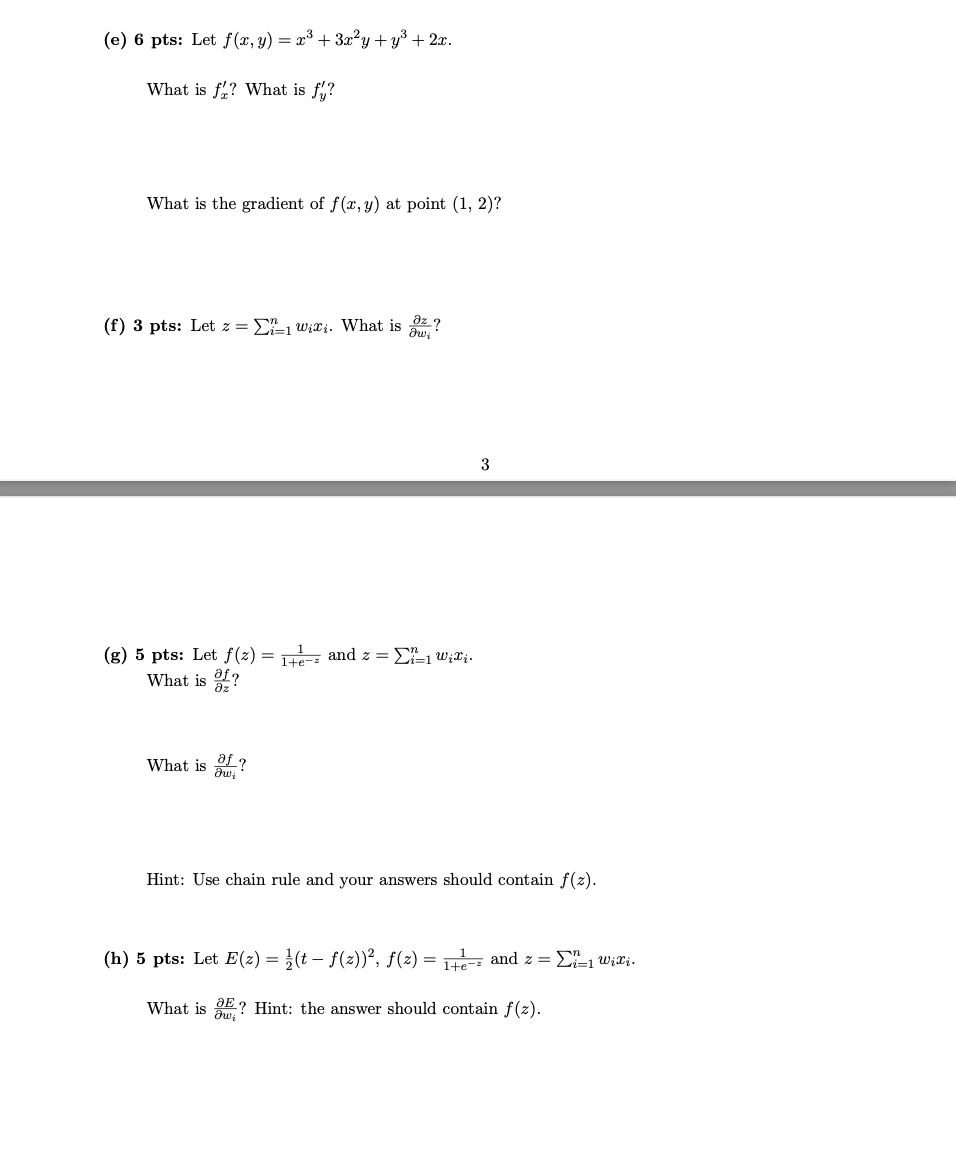
\fQ3 (45 points): Let f be a multi-variate function, and let x be one of the variables in f. Let us denote the partial derivative of f with respect to r by fr or a or ,. Please answer the following questions: (a) 15 free pts: Refresh your memory about gradient, partial derivative, chain rule. Here are some readings on this. Free free to skip them if you already know the content. On the other hand, if you need more info or cannot access the videos as youtube is blocked in your country, just search for "partial derivatives", "gradient", and "chain rule with partial derivatives". There should be tons of materials on those topics on the Internet. . Khan Academy's page on partial derivatives: https://www.khanacademy.org/math/multivariable-calculus/multivariable-derivatives/partial-derivati a/introduction-to-partial-derivatives . Khan Academy's page on the gradient: https://www.khanacademy.org/math/multivariable-calculus/multivariable-derivatives/partial-derivati a/the-gradient 2 . Chain rule with partial derivatives: https://tutorial.math.lamar.edu/classes/calciii/chainrule.aspx . A 28-min tutorial on partial derivatives and the gradient: https://www.youtube.com/watch?v-CnVes9TanPo&ab_channel-TheOrganicChemistryTutor . A 21-min video on Chain rule with partial derivatives: https://www.youtube.com/watch?v=XipB-uEexFO&ab-channel=TheOrganicChemistry Tutor . A one-hour tutorial on Partial derivatives: https://www.youtube.com/watch?v=JAfaSIJryg&ab_channel=TheOrganicChemistryTutor (b) 3 pts: What is the partial derivative fr trying to measure? (c) 3 pts: How do you calculate the gradient of f at a point z? (d) 5 pts: Suppose that x = g(t) and y = h(t) are differentiable functions of t and z = f(x, y) is a differentiable function of x and y. How do you calculate of using the chain rule of partial derivatives?(e) 6 pts: Let f(x, y) = 23 + 3x y + y3 + 2x. What is fi? What is fy? What is the gradient of f(x, y) at point (1, 2)? (f) 3 pts: Let z = EL-1 wiri. What is aw, 3 (g) 5 pts: Let f(z) = Ite- and z = EM- wix;. What is of? of ? What is out ' Hint: Use chain rule and your answers should contain f (z). (h) 5 pts: Let E(z) = }(t - f(2))2, f(z) = Item and z = El-1 Witi. What is due $ 25 ? Hint: the answer should contain f(z)
Step by Step Solution

There are 3 Steps involved in it

1 Expert Approved Answer
Step: 1 Unlock blur-text-image

Question Has Been Solved by an Expert!

Get step-by-step solutions from verified subject matter experts

Step: 2 Unlock
Step: 3 Unlock

Students Have Also Explored These Related Mathematics Questions!