







Question: Free rider problems are everywhere. For example, some restaurants let food servers keep their own tips. Other restaurants the tip pool changes the server's incentive
Free rider problems are everywhere. For example, some restaurants let food servers keep their own tips. Other restaurants the tip pool changes the server's incentive to be nice to the customer.
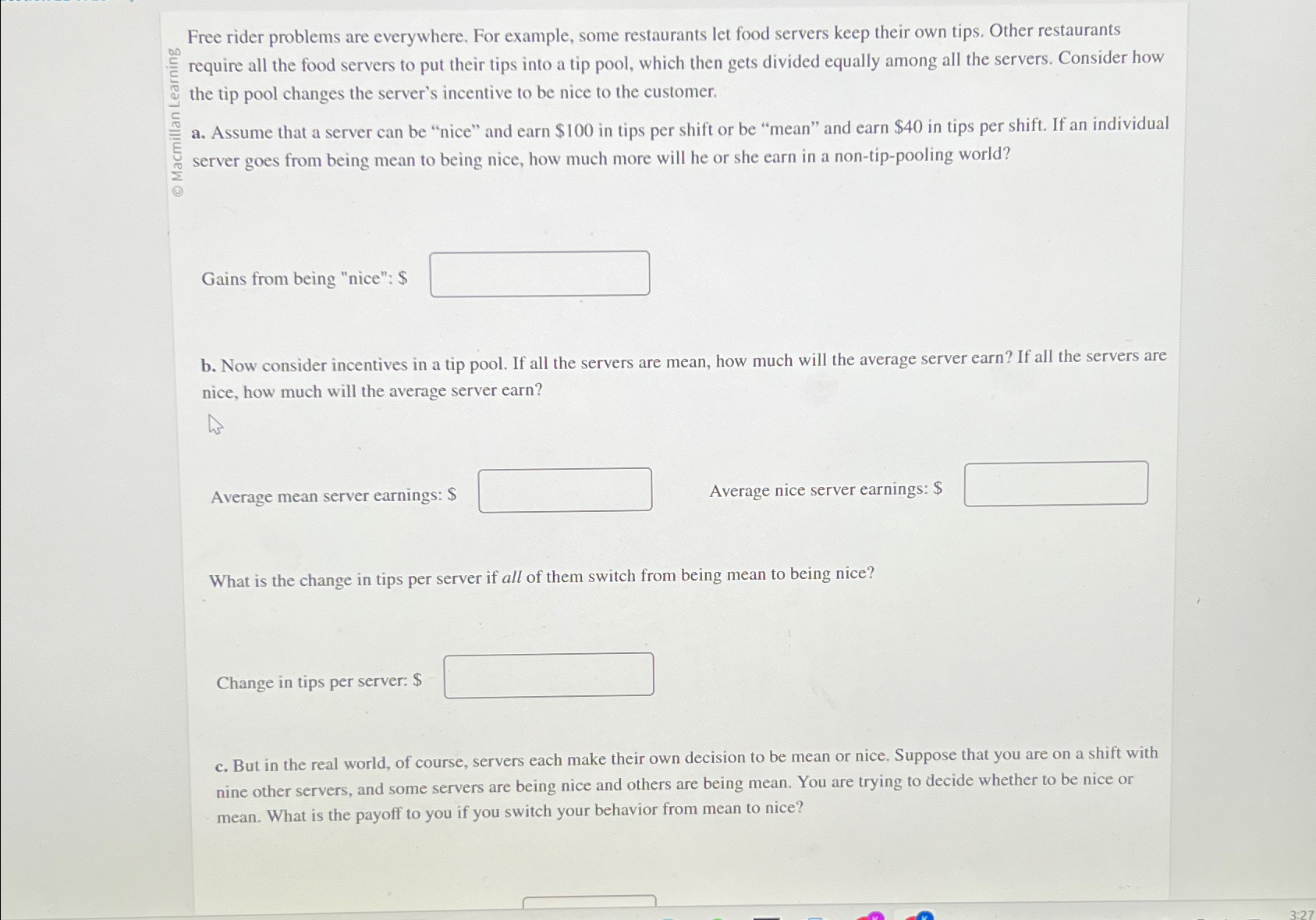
a Assume that a server can be "nice" and earn $ in tips per shift or be "mean" and earn $ in tips per shift. If an individual server goes from being mean to being nice, how much more will he or she earn in a nontippooling world?
Gains from being "nice": $
b Now consider incentives in a tip pool. If all the servers are mean, how much will the average server earn? If all the servers are nice, how much will the average server earn?
Average mean server earnings: $
Average nice server earnings: $
What is the change in tips per server if all of them switch from being mean to being nice?
Change in tips per server: $
c But in the real world, of course, servers each make their own decision to be mean or nice. Suppose that you are on a shift with nine other servers, and some servers are being nice and others are being mean. You are trying to decide whether to be nice or mean. What is the payoff to you if you switch your behavior from mean to nice?
Step by Step Solution
There are 3 Steps involved in it
1 Expert Approved Answer
Step: 1 Unlock

Question Has Been Solved by an Expert!
Get step-by-step solutions from verified subject matter experts
Step: 2 Unlock
Step: 3 Unlock
 Study Help