







Question: From a management stand point how would you summarize the following passage ? International Issues in Strategic Management EASE 6 A123 Systems: A New Lithium-Ion
From a management stand point how would you summarize the following passage?
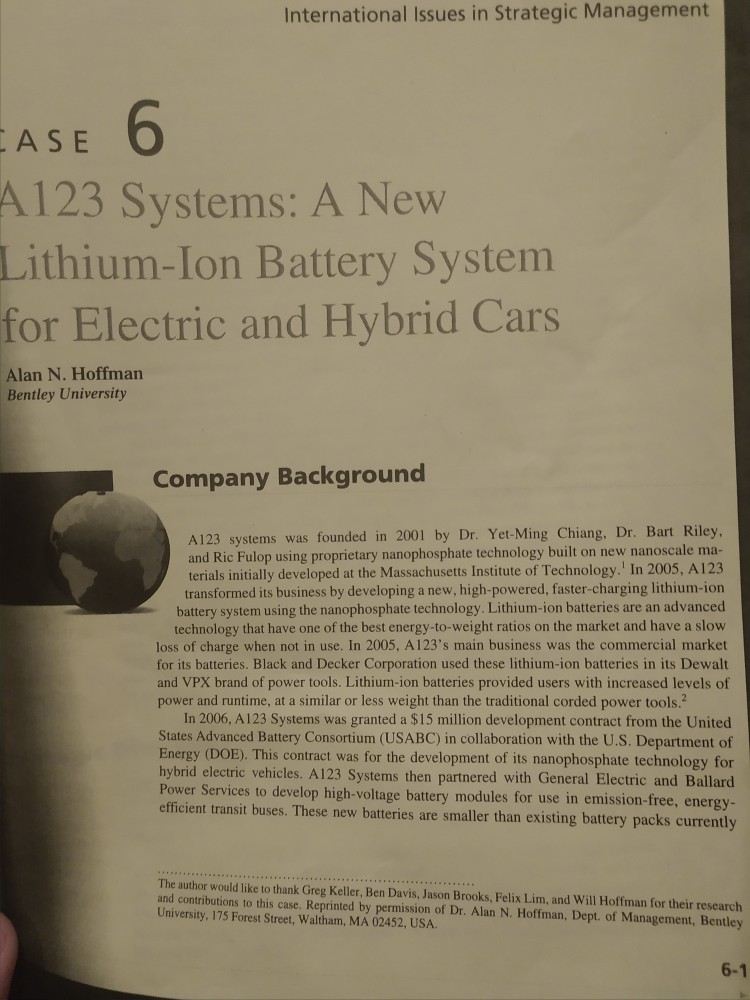
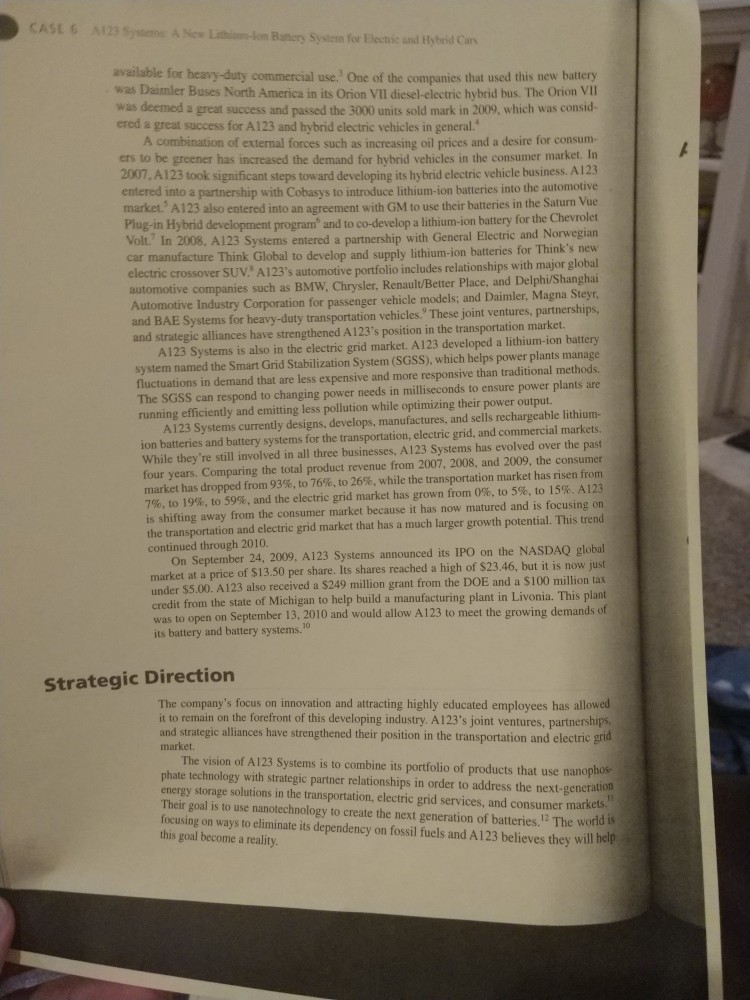
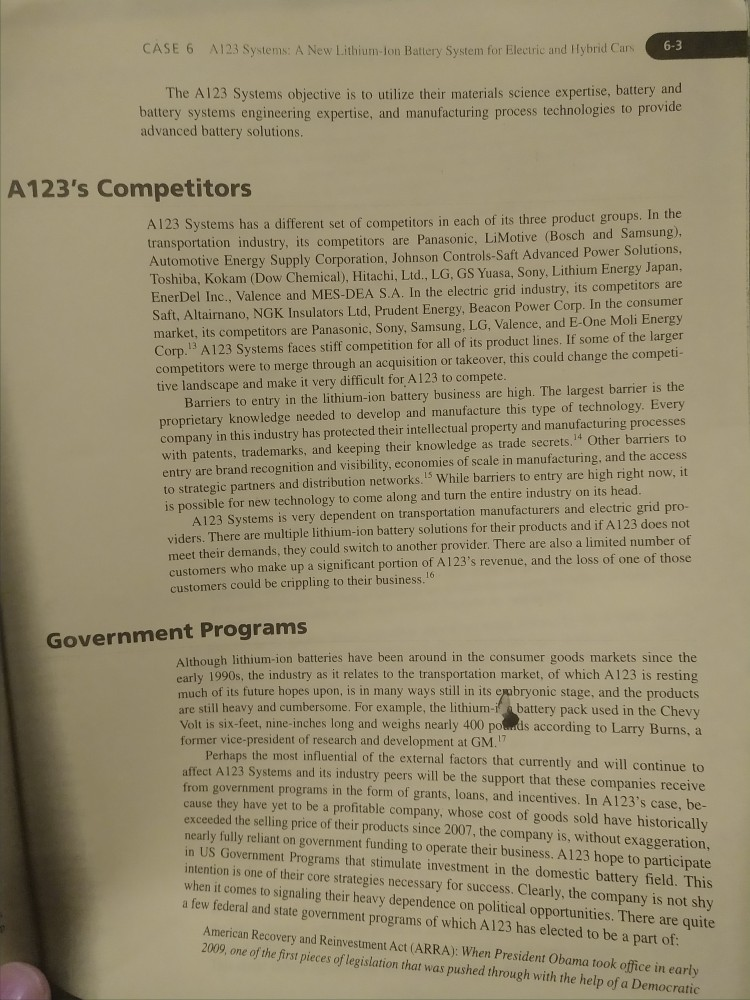
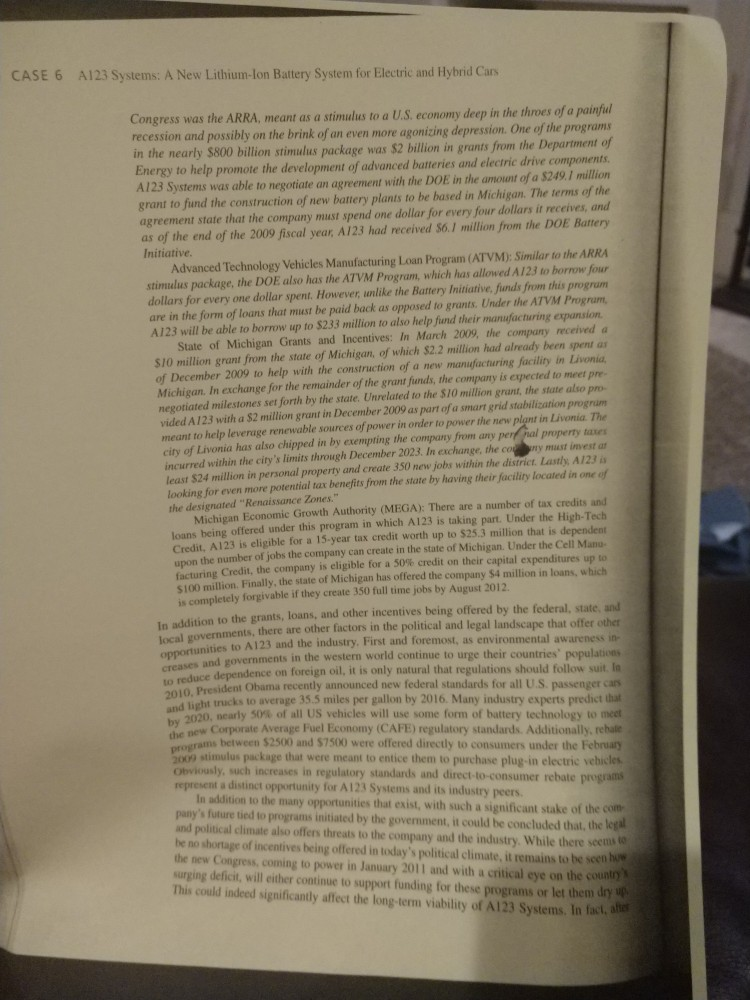

International Issues in Strategic Management EASE 6 A123 Systems: A New Lithium-Ion Battery System for Electric and Hybrid Cars Alan N. Hoffman Bentley University Company Background A123 systems was founded in 2001 by Dr. Yet-Ming Chiang. Dr. Bart Riley. and Ric Fulop using proprietary nanophosphate technology built on new nanoscale ma- terials initially developed at the Massachusetts Institute of Technology. In 2005, A123 transformed its business by developing a new, high-powered, faster-charging lithium-ion battery system using the nanophosphate technology. Lithium-ion batteries are an advanced technology that have one of the best energy-to-weight ratios on the market and have a slow loss of charge when not in use. In 2005, A123's main business was the commercial market for its batteries. Black and Decker Corporation used these lithium-ion batteries in its Dewalt and VPX brand of power tools. Lithium-ion batteries provided users with increased levels of power and runtime, at a similar or less weight than the traditional corded power tools. In 2006, A123 Systems was granted a $15 million development contract from the United States Advanced Battery Consortium (USABC) in collaboration with the U.S. Department of Energy (DOE). This contract was for the development of its nanophosphate technology for hybrid electric vehicles. A123 Systems then partnered with General Electric and Ballard Power Services to develop high-voltage battery modules for use in emission-free, energy- efficient transit buses. These new batteries are smaller than existing battery packs currently The author would like to thank Greg Keller, Ben Davis, Jason Brooks, Felix Lim, and Will Hoffman for their research and contributions to this case. Reprinted by permission of Dr. Alan N. Hoffman, Dept. of Management, Bentley University, 175 Forest Street, Waltham, MA 02452, USA. 6-1 CASE M123 Ne o n Banen Sistem for Bestandteid ble for heavy-duty commercial use. One of the companies that used this new pa was Damer Buses North America in its Orion VII diesel-electrie hybrid bus. The Onion was deemed a great success and passed the 3000 units sold mark in 2009, which was consid ered a great success for A123 and hybrid electric vehicles in general A combination of external forces such as increasing oil prices and a desire for consum ens to be greener has increased the demand for hybrid vehicles in the consumer mange UNT, A123 took significant steps toward developing its hybrid electric vehicle business A123 entered into a partnership with Cobasys to introduce lithium-ion batteries into the automotive market A123 also entered into an agreement with GM to use their batteries in the Saturn Vue hug-in Hybnd development program and to co-develop a lithium-ion battery for the Chevrolet Volt. In 2008, A123 Systems entered a partnership with General Electric and Non car manufacture Think Global to develop and supply lithium-ion batteries for Think's new clectric crossover SUV. A123's automotive portfolio includes relationships with major global automotive companies such as BMW, Chrysler. Renault/Better Place, and Delphi/Shanghai Automotive Industry Corporation for passenger vehicle models and Daimler. Magna Steyr and BAE Systems for heavy-duty transportation vehicles. These joint ventures, partnerships and strategic alliances have strengthened A123's position in the transportation A123 Systems is also in the electric grid market. A123 developed a lithium-ion battery system named the Smart Grid Stabilization System (SGSS), which helps power plants manage fluctuations in demand that are less expensive and more responsive than traditional methods, The SGSS can respond to changing power needs in milliseconds to ensure power plants are running efficiently and emitting less pollution while optimizing their power output. A123 Systems currently designs, develops, manufactures, and sells rechargeable lithium- ion batteries and battery systems for the transportation, electric grid, and commercial markets, While they're still involved in all three businesses, A123 Systems has evolved over four years. Comparing the total product revenue from 2007, 2008, and 2009, the consumer market has dropped from 93%, to 76% to 26%, while the transportation market has risen from 7% to 19%, to 59%, and the electric grid market has grown from 0%, to 5%, to 15%. A123 is shifting away from the consumer market because it has now matured and is focusing on the transportation and electric grid market that has a much larger growth potential. This trend, continued through 2010 On September 24, 2009, A123 Systems announced its IPO on the NASDAQ global market at a price of $13.50 per share. Its shares reached a high of $23.46, but it is now just under $5.00. A123 also received a $249 million grant from the DOE and a $100 million tax credit from the state of Michigan to help build a manufacturing plant in Livonia. This plant was to open on September 13, 2010 and would allow A123 to meet the growing demands of its battery and battery systems. Strategic Direction The company's focus on innovation and attracting highly educated employees has allowed it to remain on the forefront of this developing industry. A123's joint ventures, partnership and strategic alliances have strengthened their position in the transportation and electric pre market. The vision of A123 Systems is to combine its portfolio of products that use nanophos phate technology with strategic partner relationships in order to address the next generatio energy storage solutions in the transportation, electric grid services, and consumer markets Their goal is to use nanotechnology to create the next generation of batteries. The world focusing on ways to eliminate its dependency on fossil fuels and A123 believes they will help this goal become a reality. CASE 6 A123 Systems: A New Lithium-Ion Battery System for Electric and Hybrid Can 6-3 The A123 Systems objective is to utilize their materials science expertise, battery and battery systems engineering expertise, and manufacturing process technologies to provide advanced battery solutions. A123's Competitors A123 Systems has a different set of competitors in each of its three product groups. In the transportation industry, its competitors are Panasonic, LiMotive (Bosch and Samsung), Automotive Energy Supply Corporation, Johnson Controls-Saft Advanced Power Solutions, Toshiba, Kokam (Dow Chemical), Hitachi, Ltd., LG, GS Yuasa, Sony, Lithium Energy Japan EnerDel Inc., Valence and MES-DEA S.A. In the electric grid industry. its competitors are Saft, Altairano, NGK Insulators Ltd, Prudent Energy, Beacon Power Corp. In the consumer market, its competitors are Panasonic, Sony, Samsung, LG, Valence, and E-One Moli Energy Corp." A123 Systems faces stiff competition for all of its product lines. If some of the larger competitors were to merge through an acquisition or takeover, this could change the competi tive landscape and make it very difficult for A123 to compete. Barriers to entry in the lithium-ion battery business are high. The largest barrier is the proprietary knowledge needed to develop and manufacture this type of technology. Every company in this industry has protected their intellectual property and manufacturing processes with patents, trademarks, and keeping their knowledge as trade secrets. Other barriers to entry are brand recognition and visibility, economies of scale in manufacturing, and the access to strategic partners and distribution networks. While barriers to entry are high right now, it is possible for new technology to come along and turn the entire industry on its head. A123 Systems is very dependent on transportation manufacturers and electric grid pro- viders. There are multiple lithium-ion battery solutions for their products and if A123 does not meet their demands, they could switch to another provider. There are also a limited number of customers who make up a significant portion of A123's revenue, and the loss of one of those customers could be crippling to their business. 16 Government Programs Although lithium-ion batteries have been around in the consumer goods markets since the early 1990s, the industry as it relates to the transportation market, of which A123 is resting much of its future hopes upon, is in many ways still in its exubryonic stage, and the products battery pack used in the Chevy are still heavy and cumbersome. For example, the lithium- t Volt is six-feet, nine-inches long and weighs nearly 400 powds according to Larry Burns, a former vice-president of research and development at GM." Perhaps the most influential of the external factors that currently and will continue to affect A123 Systems and its industry peers will be the support that these companies receive from government programs in the form of grants, loans, and incentives. In A123's case, be- cause they have yet to be a profitable company, whose cost of goods sold have historically exceeded the selling price of their products since 2007, the company is, without exaggeration. nearly fully reliant on government funding to operate their business. A123 hope to participate in US Government Programs that stimulate investment in the domestic battery field. This intention is one of their core strategies necessary for success. Clearly, the company is not shy when it comes to signaling their heavy dependence on political opportunities. There are quite a few federal and state government programs of which A123 has elected to be a part of: American Recovery and Reinvestment Act (ARRA): When President Obama took office in early 2009, one of the first pieces of legislation that was pushed through with the help of a Democrati! CASE 6 A123 Systems: A New Lithium-Ion Battery System for Electric and Hybrid Cars Congress was the ARRA, meant as a stimulus to a U.S. economy deep in the throes of a painful recession and possibly on the brink of an even more agonizing depression. One of the programs in the nearly 8800 billion stimulus package was $2 billion in grants from the Department of Energy to help promote the development of advanced batteries and electric drive components A123 Systems was able to negotiate an agreement with the DOE in the amount of a $249.7 million grant to find the construction of new battery plants to be based in Michigan. The terms of the agreement state that the company must spend one dollar for every four dollars it receives, and as of the end of the 2009 fiscal year, A723 had received $6.7 million from the DOE Battery Initiative. Advanced Technology Vehicles Manufacturing Loan Program (ATVM): Similar to the ARRA stimulus package, the DOE also has the ATVM Program, which has allowed A123 to borrow four dollars for every one dollar spent. However, unlike the Battery Initiative. funds from this program are in the form of loans that must be paid back as opposed to grants. Under the ATVM Program A123 will be able to borrow up to $233 million to also help find their manufacturing expansion State of Michigan Grants and Incentives: In March 2009, the company received a $10 million grant from the state of Michigan, of which $2.2 million had already been spent ar of December 2009 to help with the construction of a new manufacturing facility in Livonia Michigan. In exchange for the remainder of the grant funds, the company is expected to meet pre negotiated milestones set forth by the state. Unrelated to the $10 million grant, the state also pro vided A123 with a $2 million grant in December 2009 as part of a smart grid stabilization program meant to help leverage renewable sources of power in order to power the new plant in Livonia. The city of Livonia has also chipped in by exempting the company from any per al property taxe incurred within the city's limits through December 2023. in exchange the cosy mastimesta least $24 million in personal property and create 350 new jobs within the district. Last A123 looking for even more potential tax benefits from the state by having their facility located in one of the designated "Renaissance Zones." Michigan Economie Growth Authority (MEGA): There are a number of tax credits and loans being offered under this program in which A123 is taking part. Under the High-Tech Credit A123 is eligible for a 15-year tax credit worth up to $25.3 million that is dependent on the number of jobs the company can create in the state of Michigan. Under the Cell M facturing Credit, the company is eligible for a 50% credit on their capital expenditures up to million. Finally, the state of Michigan has offered the company S4 million in loans, which is completely forgivable if they create 350 full time jobs by August 2012 in to the grants, loans, and other incentives being offered by the federal state werments, there are other factors in the political and legal landscape that offer the local governmen unities to A123 and the industry. First and foremost, as environmental awareness in and governments in the western world continue to urge their countries populations duce dependence on foreign oil, it is only natural that regulations should follow suit. In Desident Obama recently announced new federal standards for all US passenger car light trucks to average 33.5 miles per gallon by 2016. Many industry experts predict that 2020, nearly 50% of all US vehicles will use some form of battery technology to meet new Corporate Average Fuel Economy (CAFE) regulatory standards. Additionally real arams between $2500 and S7500 were offered directly to consumers under the February 5000 stimulus package that were meant to entice them to purchase plug-in electric vehicles Obviously, such increases in regulatory standards and direct-to-consumer rebate programs represent a distinct opportunity for A123 Systems and its industry peers. In addition to the many opportunities that exist, with such a significant stake of the com pally ture tied to programs initiated by the government, it could be concluded that the lor and political climate also offers threats to the company and the industry. While there seems e no shortage of incentives being offered in today's political climate it remains to be seen the new Congress, coming to power in January 2011 and with a critical eye on the count surging deficit, will either continue to support funding for these prorams or let them do This could indeed significantly affect the long-term viability of A123 Systems. In fact, 6-5 CASE 6 A123 Systems: A New Lithium-Ion Battery System for Electric and Hybrid Cars a pointed question was asked about the company's capital expenditure outlook on the latest camings call in November 2010. David Vieau, the CEO and Michael Rubino, the outgoing CFO, provided generally vague answers regarding how they intend to fund the company's operations beyond 2012 if all of their current funds become exhausted. Furthermore, they were also unable to provide any revenue visibility into 2011 and beyond. simply stating that a lot will depend on the scale up of their customers to ramp up production of electric vehicles. If the company is unable to augment the funds received from the government with actual profits from battery sales. then the uncertainty of the political climate could pose a major threat to the company. In such a highly technical industry that requires a high level of expertise in research and development, the last significant major threat to the livelihood of A123 lies in the protection of its intellectual property, specifically in the proprietary nanophosphate technology that it uses to produce and package its lithium-ion batteries. A large part of the company's success will depend on its ability to protect its patents and trademarks while at the same time not infring- ing upon other companies. The company currently owns or licenses 19 patents in the United States and at the time of this writing was in the process of applying for 77 more. In foreign markets, they own or license 29 patents and have applied for 151 that are currently pending." The outcome of the patents currently in the application process could either help to provide A123 with a sustainable competitive advantage in the future if granted, or quickly eliminate any such potential advantage if declined. Furthermore, any lawsuits filed either on behalf of or against the company with regard to patent technology could affect their ability to do business. They are currently involved in two lawsuits with Hydro-Quebec regarding licensed patents it has received from University of Texas. Both Hydro-Quebec and UT allege that some of the electrode technology that A123 uses in its batteries infringe on their patents. In response, A123 has countersued and the lawsuit is ongoing. As of the November 2010 earnings call, the Senior managers at A123 have stated that settlement discussions related to the case continued throughout the third quarter, but that no resolution is in sight and that more court activity should pick up in December 2010 Social and Demographic Trends Februar Contrary to what some skepties continue to steadfastly believe, there is significant evidence that worldwide climate change resulting from the effects of greenhouse gases is a real issue that needs real solutions. One of those solutions calls for the reduction in the use of fossil fuels such as coal and oil, and A123 Systems, with its lithium-ion advanced battery systems, was created to help solve that problem. The opportunity is there for A123 to capitalize upon the increasing awareness of environmental issues, as consumers begin to shift away from auto- mobiles with conventional gasoline engines. The company believes that as the technological expertise to create advanced batteries matures, it will continue to drive down manufacturing costs, which can then be passed on to the customer in the form of an economically viable alternative to gasoline-powered vehicles. Once consumers begin to realize the economic benefits of lithium-ion batteries to go along with the environmental benefits, it will create a vast opportunity for A123 and its industry as the adoption of hybrids and plug-in electric vehicles increases dramatically. To take it one step further, the company further believes that the increased adoption of hybrids and plug-in electric vehicles will only help create a positive feedback loop in the form of network effects that benefits the creation of next-generation bat- tery technologies. As mentioned earlier in the political/legal section, the government is also doing its part with stricter regulatory standards, such as CAFE, and by encouraging consumers to purchase hybrid and electric cars through the use of tax credits. Another opportunity for A123 Systems that results from the environmental movement to reduce dependence on fossil fuels lies in the electric grid services market, which generated
Step by Step Solution
There are 3 Steps involved in it
1 Expert Approved Answer
Step: 1 Unlock

Question Has Been Solved by an Expert!
Get step-by-step solutions from verified subject matter experts
Step: 2 Unlock
Step: 3 Unlock
 Study Help