







Question: From Problem 2 we know that that the logical implication ( E E x P ( x ) ) ? ? ( E E x
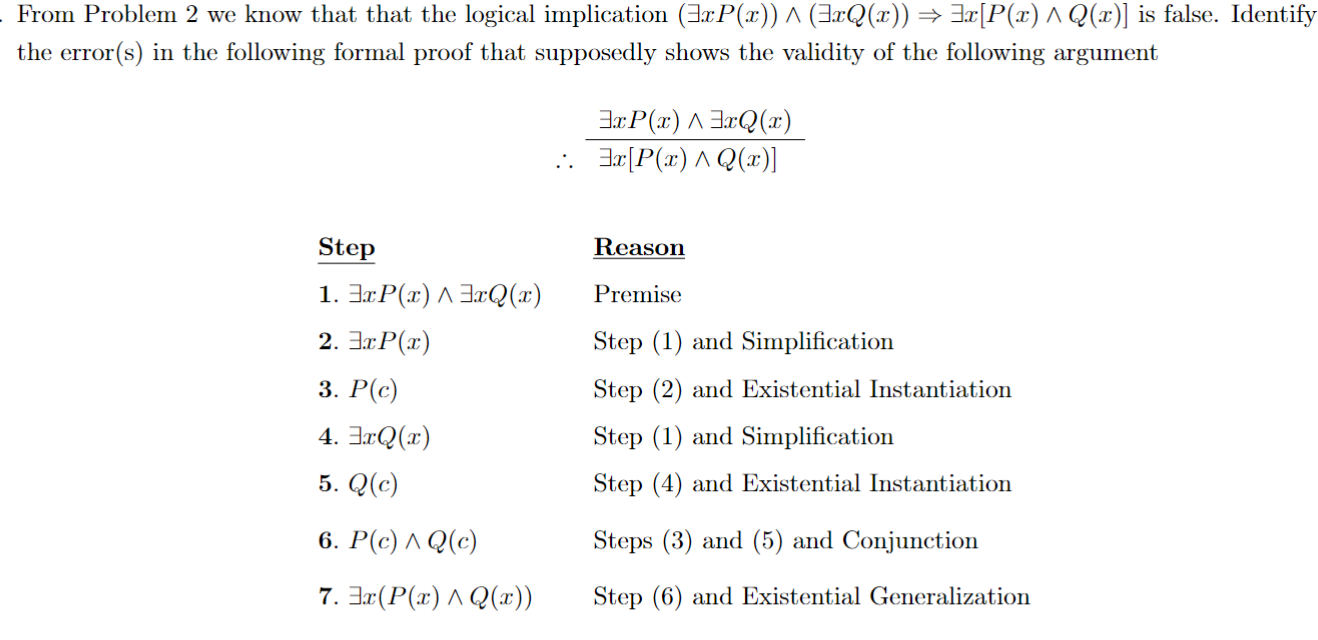
From Problem we know that that the logical implication EEx is false. Identify
the errors in the following formal proof that supposedly shows the validity of the following argument
:
Step
EExPEExQ
EExP
EExQ
EEx
Reason
Premise
Step and Simplification
Step and Existential Instantiation
Step and Simplification
Step and Existential Instantiation
Steps and and Conjunction
Step and Existential Generalizationrom Problem we know that that the logical implication xP xxQxxP x Qx is false. Identify
the errors in the following formal proof that supposedly shows the validity of the following argument
xP xxQx
xP x Qx
Step Reason
xP xxQx Premise
xP x Step and Simplification
P c Step and Existential Instantiation
xQx Step and Simplification
Qc Step and Existential Instantiation
P c Qc Steps and and Conjunction
xP x Qx Step and Existential Generalization
Step by Step Solution
There are 3 Steps involved in it
1 Expert Approved Answer
Step: 1 Unlock

Question Has Been Solved by an Expert!
Get step-by-step solutions from verified subject matter experts
Step: 2 Unlock
Step: 3 Unlock
 Study Help