



Question: from the above mentioned study provide the conclusions These results can be divided into four categories, which represent certain levels of striving for power, so
from the above mentioned study provide the conclusions
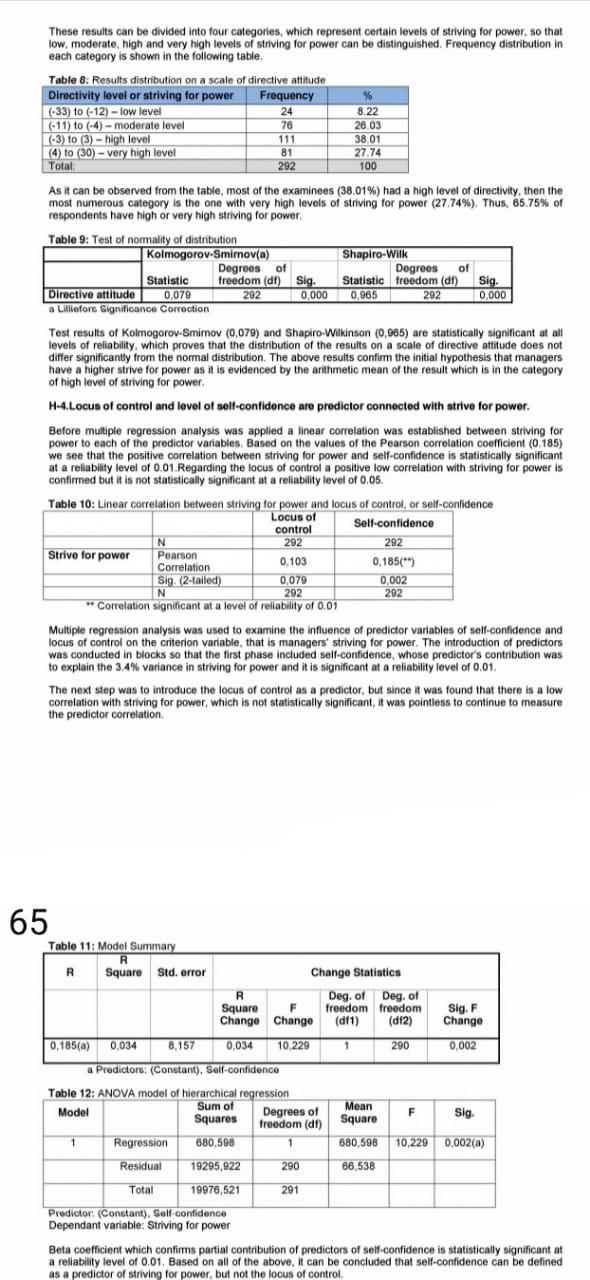
These results can be divided into four categories, which represent certain levels of striving for power, so that low, moderate, high and very high levels of striving for power can be distinguished. Frequency distribution in each category is shown in the following table, Table 8: Results distribution on a scale of directive attitude Directivity level or striving for power Frequency % (-33) to (-12) - low level 24 8.22 (-11) to (-4) - moderate level 76 26.03 (-3) to (3) - high level 111 38.01 (4) to (30) - very high level 81 27.74 Total: 292 100 As it can be observed from the table, most of the examinees (38,01%) had a high level of directivity, then the most numerous category is the one with very high levels of striving for power (27.74%). Thus, 65.75% of respondents have high or very high striving for power, Table 9: Test of normality of distribution Kolmogorov.Smirnov(a) Shapiro-Wilk Degrees of Degrees of Statistic freedom (dt) Siq. Statistic freedom (dt) Siq. Directive attitude 0,079 292 0,000 0,965 292 0,000 a Lilliefore Significance Correction Test results of Kolmogorov-Smimov (0.079) and Shapiro-Wilkinson (0,965) are statistically significant at all levels of reliability, which proves that the distribution of the results on a scale of directive attitude does not differ significantly from the normal distribution. The above results confirm the initial hypothesis that managers have a higher strive for power as it is evidenced by the arithmetic mean of the result which is in the category of high level of striving for power H-4.Locus of control and level of self-confidence are predictor connected with strive for power, Before multiple regression analysis was applied a linear correlation was established between striving for power to each of the predictor variables. Based on the values of the Pearson correlation coefficient (0.185) we see that the positive correlation between striving for power and self-confidence is statistically significant at a reliability level of 0.01 Regarding the focus of control a positive low correlation with striving for power is confirmed but it is not statistically significant at a reliability level of 0.05 Table 10: Linear correlation between striving for power and locus of control, or self-confidence Locus of control Self-confidence N 292 292 Strive for power Pearson Correlation 0.103 0.185("") Sig (2-tailed) 0,079 0,002 N 292 292 ** Correlation significant at a level of reliability of 0.01 Multiple regression analysis was used to examine the influence of predictor variables of self-confidence and locus of control on the criterion variable, that is managers' striving for power. The introduction of predictors was conducted in blocks so that the first phase included self-confidence, whose predictor's contribution was to explain the 3.4% variance in striving for power and it is significant at a reliability level of 0.01 The next step was to introduce the focus of control as a predictor, but since it was found that there is a low correlation with striving for power, which is not statistically significant, it was pointless to continue to measure the predictor correlation 65 Table 11: Model Summary : R R Square Std. error Change Statistics R Deg. of Deg. of Square F freedom freedom Sig. F Change Change (df1) (012) Change 0,185(a) 0,034 8,157 0,034 10,229 1 290 0,002 a ) a Predictors. (Constant), Self-confidence Table 12: ANOVA model of hierarchical regression Model Sum of Mean Degrees of Squares F Square Sig freedom (dt) 1 Regression 680,598 1 680,598 10,229 0,002(a) Residual 19295,922 290 66,538 Total 19976,521 291 Predictor (Constant), Self confidence Dependant variable: Striving for power Beta coefficient which confirms partial contribution of predictors of self-confidence is statistically significant at a reliability level of 0,01. Based on all of the above, it can be concluded that self-confidence can be defined as a predictor of striving for power, but not the locus of controlStep by Step Solution
There are 3 Steps involved in it
1 Expert Approved Answer
Step: 1 Unlock

Question Has Been Solved by an Expert!
Get step-by-step solutions from verified subject matter experts
Step: 2 Unlock
Step: 3 Unlock