







Question: Qualitative Annotated Bibliography For this assignment, you will undertake a review of different types of qualitative literature. Find one article that used each of the
Qualitative Annotated Bibliography
For this assignment, you will undertake a review of different types of qualitative literature. Find one article that used each of the following methods and write a bibliography on it.
Case Study
Ethnography
Phenomenological
Grounded Theory
Content Analysis




Please use the article below and write a bibliography on the article using each method below :
Case Study
Ethnography
Phenomenological
Grounded Theory
Content Analysis
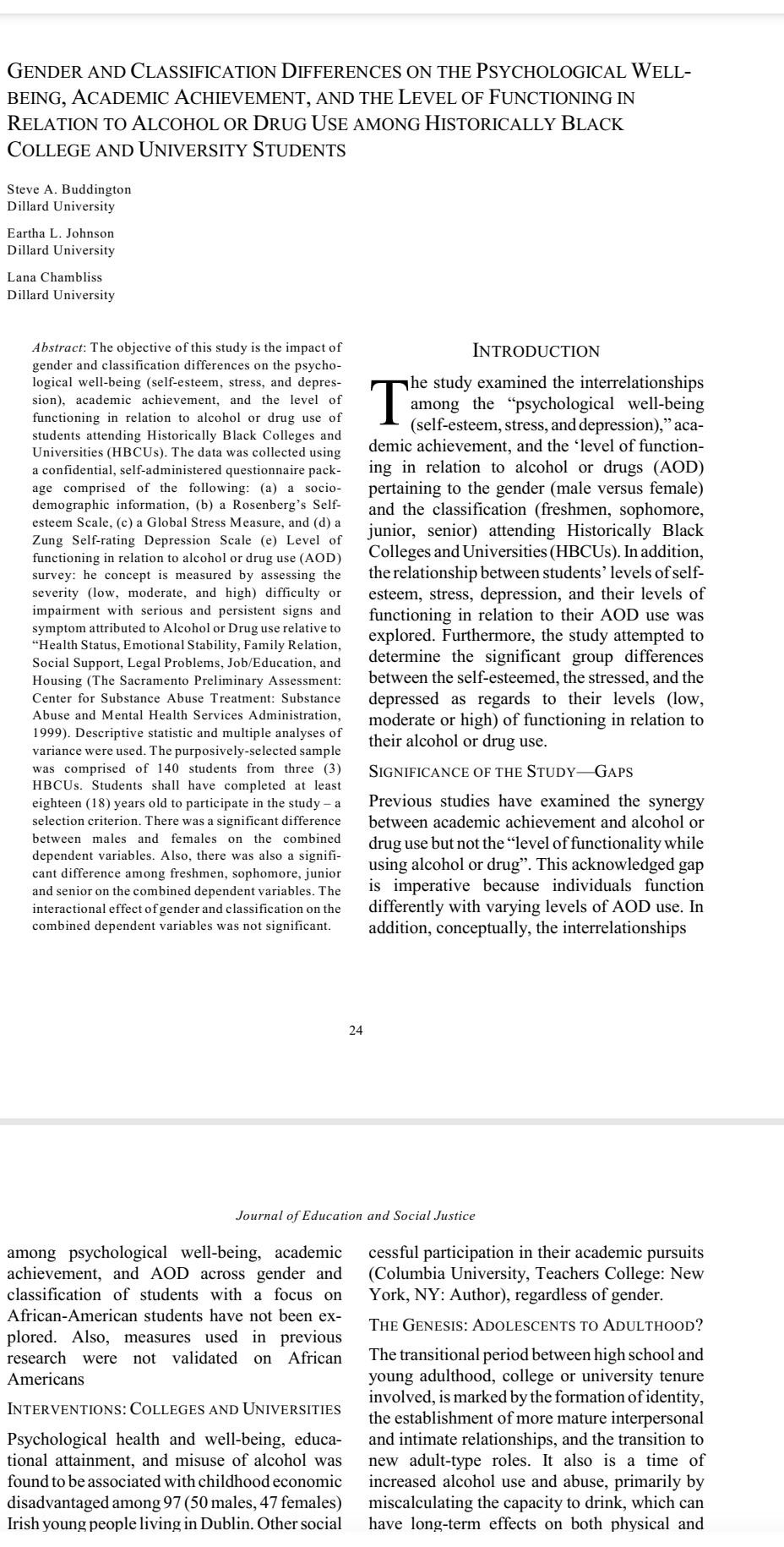
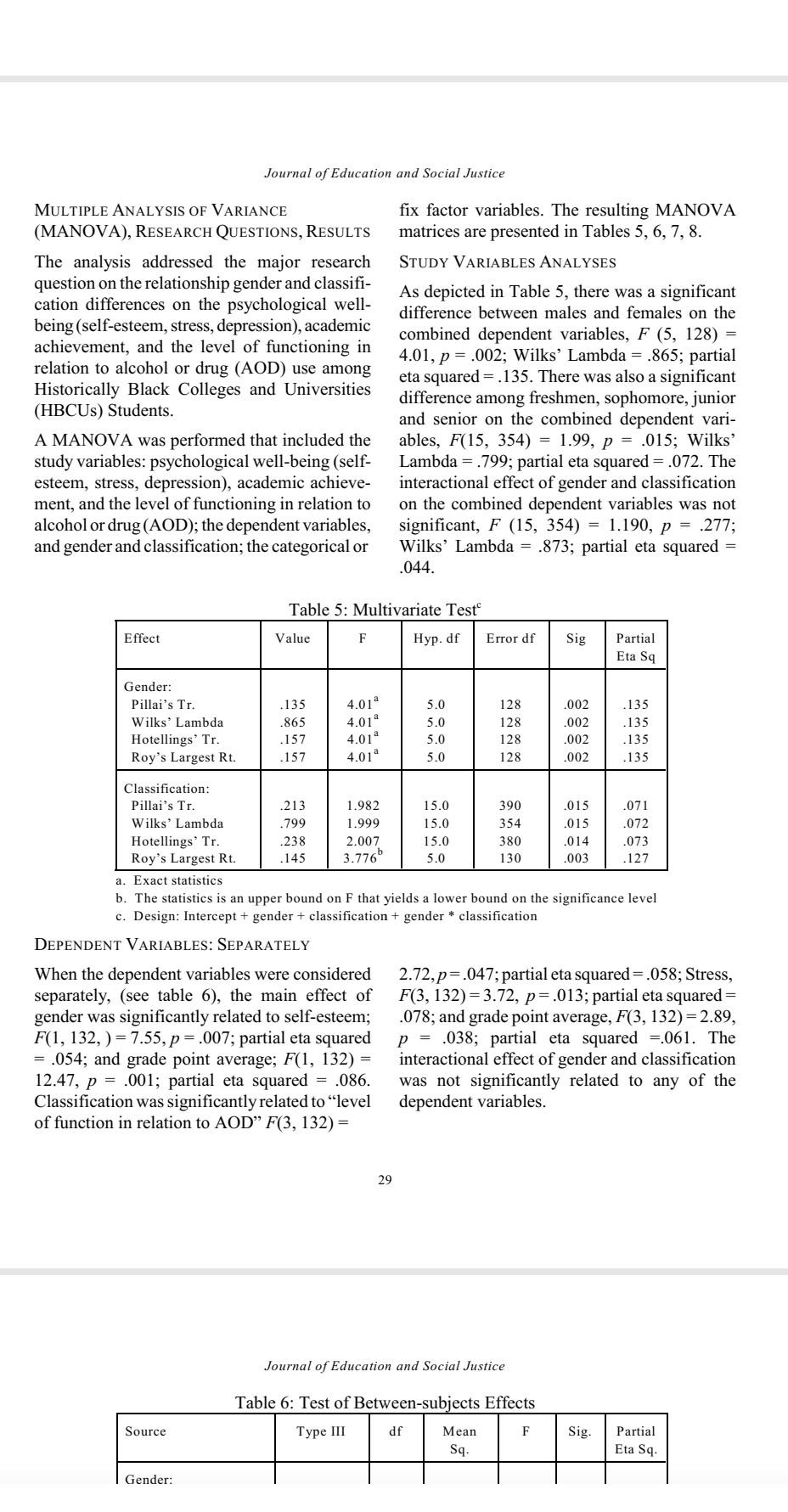
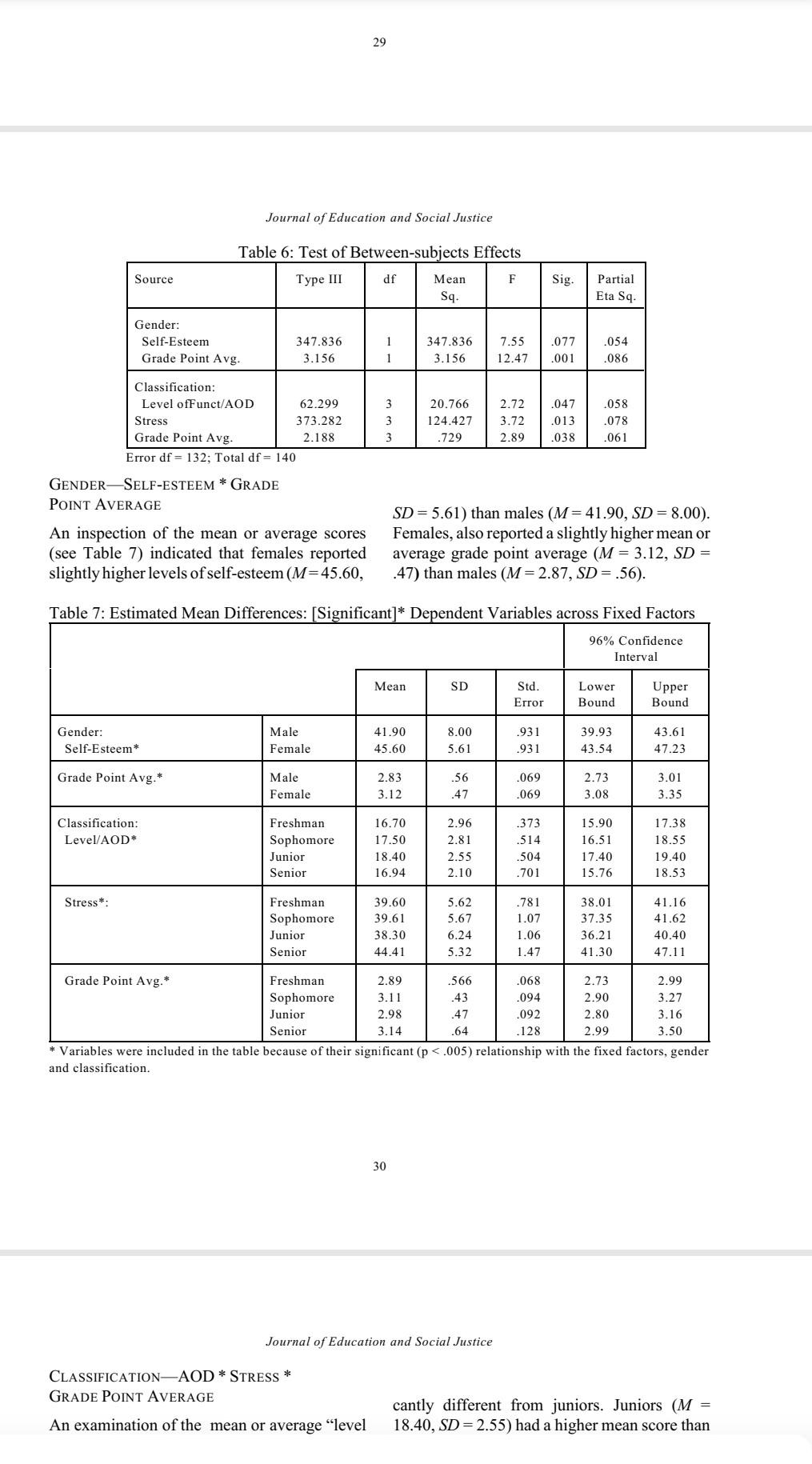
GENDER AND ClASSIFICATION DiFfERENCES ON THE PSYCHOLOGICAL WELLBEING, ACADEMIC ACHIEVEMENT, AND THE LEVEL OF FUNCTIONING IN RELATION TO AlCOHOL OR DRUG USE AMONG HISTORICALLY BLACK COLLEGE AND UNIVERSITY STUDENTS Steve A. Buddington Dillard University Eartha L. Johnson Dillard University Lana Chambliss Dillard University Abstract: The objective of this study is the impact of INTRODUCTION gender and classification differences on the psychological well-being (self-esteem, stress, and depression), academic achievement, and the level of functioning in relation to alcohol or drug use of students attending Historically Black Colleges and (self-esteem, stress, and depression)," acaUniversities (HBCUs). The data was collected using demic achievement, and the 'level of functiona confidential, self-administered questionnaire pack- ing in relation to alcohol or drugs (AOD) age comprised of the following: (a) a socio- pertaining to the gender (male versus female) demographic information, (b) a Rosenberg's Self- and the classification (freshmen, sophomore, esteem Scale, (c) a Global Stress Measure, and (d) a junior, senior) attending Historically Black Zung Self-rating Depression Scale (e) Level of functioning in relation to alcohol or drug use (AOD) Colleges and Universities (HBCUs). In addition, survey: he concept is measured by assessing the the relationship between students' levels of selfseverity (low, moderate, and high) difficulty or esteem, stress, depression, and their levels of impairment with serious and persistent signs and functioning in relation to their AOD use was "Health Status, Emotional Stability, Family Relation, explored. Furthermore, the study attempted to "Health Status, Emotional Stability, Family Relation, determine the significant group differences Housing (The Sacramento Preliminary Assessment: between the self-esteemed, the stressed, and the Center for Substance Abuse Treatment: Substance depressed as regards to their levels (low, Abuse and Mental Health Services Administration, moderate or high) of functioning in relation to 1999). Descriptive statistic and multiple analyses of their alcohol or drug use. variance were used. The purposively-selected sample was comprised of 140 students from three (3) SIGNIFICANCE OF THE STUDY-GAPS HBCUs. Students shall have completed at least eighteen (18) years old to participate in the study-a Previous studies have examined the synergy selection criterion. There was a significant difference between academic achievement and alcohol or between males and females on the combined drugusebut not the "level offunctionalitywhile dependent variables. Also, there was also a signifi- using alcohol or drug". This acknowledged gap cant difference among freshmen, sophomore, junior senior on the combined dependent variables. The is imperative because individuals function interactional effect of gender and classification on the differently with varying levels of AOD use. In combined dependent variables was not significant. addition, conceptually, the interrelationships 24 Journal of Education and Social Justice among psychological well-being, academic cessful participation in their academic pursuits achievement, and AOD across gender and (Columbia University, Teachers College: New classification of students with a focus on York, NY: Author), regardless of gender. African-American students have not been ex- THE GenESIS: AdOLESCENTS To AdULTHOod? plored. Also, measures used in previous research were not validated on African The transitional period between high school and research were thans Americans INTERVENTIONS: COLLEGES AND UNIVERSITIES involved, is marked by the formation of identity, Psychological health and well-being, the establishment of more mature interpersonal and intimate relationships, and the transition to tainment, and misuse of alcohol was new adult-type roles. It also is a time of found to be associated with childhood economic increased alcohol use and abuse, primarily by disadvantaged among 97 (50 males, 47 females) miscalculating the capacity to drink, which can Irish young people living in Dublin. Other social have long-term effects on both physical and alsaavantagea among y/ ( (0 maies, 4/ remaies) miscaiculating the capacity to arink, wnicn can Irish young people living in Dublin. Other social have long-term effects on both physical and indicators, such as self-esteem, contact with the psychological well-being and may have implicalaw, and suicidal ideations were found to be a tions for the academic achievement of tradisalient in predicting the interrelationship among tional adult roles. (White \& Jackson, 2005). the mental health, the academic attainment and Gender, classification, race/ethnicity, marital the substance misuse regardless of gender status, college, employment, peer and family (Cleary, Nixon, \& Fitzgerald, 2007). influences, individual temperament, and attiMany HBCUs and non-HBCUs offer a wide tudes about drinking all influence drinking range of services to help make students college behavior, even more disconcerting their peryears more satisfying, rewarding, and pro- ception of substance abuse, in this group of ductive. Programs, such as psychological, students. Attending college may represent a educational, social, and personal development special risk to emerging adults, as increases in counseling are designed to empower students to alcohol availability and acceptance of drinking self-actualize their intellectual and emotional on college campuses may lead to increases in potential, thereby strengthening their coping heavy drinking among students, with the skills in an effort to thwart such temptations, greatest concern among freshmen. The nonsuch as the exposure to AOD, partying, and the student population of emerging adults also is an development of emotional attachments, avail- important target for preventive interventions, able on college campuses (Bucknell University, especially because people in this segment of the Lewisburg, PA: Author). population may be less likely to mature out of Columbia University, Teachers College, a non- heavy drinking patterns established during HBCU, for example recognized the importance adolescence (Arnett, 2005). Thus, the transition of its students' academic success and personal gend psychological well-being, and in so doing have target interventions to prevent the deleterious to provide short term counseling to students. impact on students' psychological well-being This service is deemed necessary to combat and academic achievement. mental health issues, often induced by AOD use or by other psychosocial determinants. Students, Emerging adulthood is also marked by a variety who are experiencing unhealthy psychological of physical, bio-psychosocial developmental well-being, self-sabotage their safe and suc- tasks, identity formation and the establishment 25 Journal of Education and Social Justice of more mature interpersonal intimate relation- logical, social and other tangible support ship (Arnett 2000; Schulenberg \& Maggs 2002), services their students. which coincide with the timeline of the college SAMPLE AND PROCEDURE experience. During this period of navigating through college or university students are also The population consisted of Black and/or obtaining the education and training needed to African-American HBCUs' students, who at the enhance their chances of selecting an 'ideal' time of the study were at least eighteen (18) vocational production lifestyle. years old. A purposive sampling technique was These tasks shall be attained to make a used to select the 140 Black or Africansuccessful transition to adulthood, and failure to American students, which was comprised of an attain mastery of them can subsequently result equal number of males and females students. in loss of self-concept/self-esteem, stress, Faculty members at the various HBCUs facilidepression, and frustration, which can lead to a tated the data collection. A self-administered variety of unhealthy behaviors, including instrument packet was used to collect data. increased AOD abuse. "Paradoxically, alcohol INSTRUMENTS developmental tasks and may exacerbate fail- The instrument packet was divided into five use can impede the successful mastery of these ures and increase stress (Schulenberg, Maggs \& sections: (a) a socio-demographic information O'Malley, 2003, 2), section; (b) a Rosenberg's Self-esteem Scale mately self-confidence, consequently adversely (reliability score of 0.93 and internal consistimpact students' academic achievement. ency of 0.99); (c) a Global Stress Measure Scale - (coefficient alpha reliability of at least 0.84 and This study investigates gender (male, female) test-retest correlation of 0.85); (d ) a Zung Selfand classification differences as it pertains to rating Depression Scale (correlations of at least their psychological well-being (self-esteem, 0.75 and concurrent validity correlation values stress, and depression), academic achievement, ranging from 0.59 to 0.75 ) and (e) Level of and their level of functioning in relation to functioning in relation to alcohol or drug use alcohol or drug use. The significance of this (AOD) survey: he concept is measured by alcohol or drug use. The significance of this (AOD) survey: he concept is measured by study is validated by its aim to 'minimize or to assessing the severity (low, moderate, and high) close' the conceptual, sampling, methodo- difficulty or impairment with serious and perlogical, data collection and design gaps dis- sistent signs and symptom attributed to Alcohol covered in previous studies. or Drug use relative to "Health Status, METHODOLOGY Emotional Stability, Family Relation, Social Support, Legal Problems, Job/Education, and The Greater New Orleans area is comprised of Housing (The Sacramento Preliminary Assessthree HBCUs. These HBCUs have been educa- ment: Center for Substance Abuse Treatment: ting minority students for at many years. The Substance Abuse and Mental Health Services relevance for HBCUs has been question, Administration, 1999). Methodological verifirecently, by many educational leaders, politi- cation can be found in the source publications cians, and most imperative, donors from various from which the instruments were obtained. benevolent organizations. HBCUs, however, DATA ANALYSIS continue to play many significant roles in the academic achievement of minority students, and Descriptive statistics were used to describe the while doing so, they also had to provide psycho- socio-demographic, independent and dependent variables to characterize the participants of the 26 Journal of Education and Social Justice study. Multivariate analysis of variance AssUMPTIONS of MANOVA (MANOVA) and Pearson Product-Moment Sample: The minimum required number of Correlation coefficients were used to analyze respondents/cases in each cell should be equal the relationships among the study variables and to the number of dependent variables, which to verify the assumptions of MANOVA._ was five (5). This assumption was not violated, VARIABlEs: Definitions because the minimum was six (6). (Pallant, HBCU college student: Each member of this 2010) study was a student who has been attending a Normality: Mahalanobis distances were calcuHBCU for at least two years of college and who lated to check for univariate normality and has been classified as junior. multivariate normality and for outliers. The Self-esteem: As defined by Rosenberg (1965), critical value to check for outlier and normality self-esteem is a positive or negative attitude is 20.52 for five (5) dependent variables toward the self. Rosenberg's Self-Esteem Scale (Pallant, 2010). The data set had only one (1965) was used to assess the self-esteem levels outlier, its value 24.60, which was not very high of the immigrants in the study. and therefore the case was not removed from the Stress: Stress is produced when as lifesituations study. are appraised as demanding, threatening or otherwise negative and insufficient resources are available to change or adapt to these situations (Cohen, Kamarck, \& Mermelstein, 1983). Depression: This is a concept defined as a Syndrome comprising coexisting signs and symptoms or as a disorder which has characteristic clusters and complexes of signs and symptoms which signify the presence of pathological Tests the null hypothesis that the observed disturbances or changes in four areas: somatic, covariance matrices of the dependent variables psychological, psychomotor, and mood (Zung, are equal across groups. 1965; Zung \& Wonnacott, 1970; Zung, 1972). Design: Intercept + gender+ classification+ Level of functioning in relation to alcohol or gender*classification drug use (AOD) survey: The concept is Multicollinearity and singularity: MANOVA measured by assessing the severity (low, produced the best results when dependent moderate, and high) difficulty or impairment variables are moderately correlated. Correlations with serious and persistent signs and symptom that are greater than 0.8 are may produce attributed to Alcohol or Drug use relative to unreliable results. The maximum correlation "Health Status, Emotional Stability, Family between the variables was 0.369 . Singularly was Relation, Social Support, Legal Problems, not violated because the dependent variables Job/Education, and Housing". (The Sacramento had varying definitions and were also scored Preliminary Assessment: Center for Substance differently (Pallant, 2010; Tabachnick \& Fidell, Abuse Treatment: Substance Abuse and Mental 2007). Health Services Administration, 1999). Abuse Treatment: Substance Abuse and Mental 2007). Health Services Administration, 1999). Academic achievement: This variable will be measured by grade point average. 27 Journal of Education and Social Justice Table 2: Levene's Test of Equality of the study. Of the 140 students in the program of Ermor V/riannaca 59 (42.1 percent) were males and 81 (57.9 percent) were females. The vast majority 57 (40.7 percent) were freshmen, 36 (25.7 percent) were sophomores, 30 (21.4 percent) were juniors, and 17 (12.1 percent) were seniors. Table 3: Demographics of Sample (N=140) Tests the null hypothesis that the error variance of the Dependent variable is equal across groups. a. Design: Intercept + gender + classification + gender * classification. Homogeneity of variance-covariance: These tests of assumptions were generated as part of the MANOVA output. Table 1 above depicts Table 4 below indicates that the average grade Matrices, testing the null hypothesis that the point average (GPA) was 2.99, on a 4-point The Box's M Test of Equality of Covariance covariance across the dependent variables was scale. The lowest reported GPA was 1.80; the not violated (p=.253>=.05); significant value highest 4.0. The mean scores calculated were: greater than .05. In addition, the Levene Test, self-esteem, 44.04; stress, 39.91, depression, as illustrated in Table 2 , tests the null hypothesis 44.01 ; and level of functioning in relation to that the error variance of the dependent variable alcohol and drug use, 17.30. These scores as shown in Table 4 , indicated that collectively the students were academically good; had a high have "significant level of self-esteem; were moderately stressed; (Pallant, 2010; were experiencing a fairly high level of (Pallant, 2010; Tabachnick \& Fidell, 2007). depression; and had a fairly high level of funcRESULTS AND FINDINGS tioning in relation to alcohol and drug use Table 3 presents the descriptive statistics of the implying minimal difficulty and impairment pertaining to alcohol and drug use (AOD). sample that characterize the participants Table 4: Descriptors of the Study Variables: Descriptive Statistics 28 Journal of Education and Social Justice Multiple AnAlysis of VarianCE fix factor variables. The resulting MANOVA (MANOVA), Research Questions, Results matrices are presented in Tables 5, 6, 7,8. The analysis addressed the major research STUDY VARIABLES ANALYSES question on the relationship gender and classifi- As depicted in Table 5, there was a significant cation differences on the psychological well- difference between males and females on the being (self-esteem, stress, depression), academic combined dependent variables, F(5,128)= achievement, and the level of functioning in 4.01,p=.002; Wilks' Lambda =.865; partial relation to alcohol or drug (AOD) use among eta squared =.135. There was also a significant Historically Black Colleges and Universities difference among freshmen, sophomore, junior (HBCUs) Students. and senior on the combined dependent variA MANOVA was performed that included the ables, F(15,354)=1.99,p=.015; Wilks' study variables: psychological well-being (self- Lambda =.799; partial eta squared =.072. The esteem, stress, depression), academic achieve- interactional effect of gender and classification ment, and the level of functioning in relation to on the combined dependent variables was not alcohol or drug (AOD); the dependent variables, significant, F(15,354)=1.190,p=.277; and gender and classification; the categorical or Wilks' Lambda =.873; partial eta squared = .044 a. Liaus stausucs b. The statistics is an upper bound on F that yields a lower bound on the significance level c. Design: Intercept + gender + classification + gender classification DEPENDENT Variables: SEPARATELY When the dependent variables were considered 2.72, p=.047; partial eta squared =.058; Stress, separately, (see table 6), the main effect of F(3,132)=3.72,p=.013; partial eta squared = gender was significantly related to self-esteem; .078 ; and grade point average, F(3,132)=2.89, F(1,132)=7.55,,p=.007; partial eta squared p=.038; partial eta squared =.061. The =.054; and grade point average; F(1,132)= interactional effect of gender and classification 12.47,p=.001; partial eta squared =.086. was not significantly related to any of the Classification was significantly related to "level dependent variables. of function in relation to AODF(3,132)= 29 Journal of Education and Social Justice Journal of Education and Social Justice Tahle 6. Tect of Retween-suhiects Ffferts GENDER-SELF-ESTEEM * GRADE PoInt Average SD=5.61) than males (M=41.90,SD=8.00). An inspection of the mean or average scores Females, also reported a slightly higher mean or (see Table 7) indicated that females reported average grade point average (M=3.12,SD= slightly higher levels of self-esteem (M=45.60,.47) than males (M=2.87,SD=.56). * Variables were included in the table because of their signiticant (p<.005 relationship with the tixed tactors gender and classification. journal of education social justice classification-aod grade point average cantly different from juniors. juniors an examination mean or had a higher score than stress functioning in relation to aod scores table indicated that minimal sophomores were not found significantly signs symptoms followed by post-hoc comparisons completed only for seniors classification because it is comprised more finally freshmen two categories groups. differences on pertaining self-esteem explained above. then addition significant regarding between: exploring between seniors. highest level almost equal .48 relating no using mores although bonferroni which perform each test at stringent significance prevent false positive related results revealed did any alcohol drug use signifi average. discussion conclusion however findings this study was experiencing used difficulty impairment serious persistent symptom fe attributed relative status emotional stability family males also females support legal problems comparison freshmen. selfesteem could be manifestation their surprising vice versa reported implying being good student importantly these cognizant identical respectively. above above-average intellectual ability reasonable explanation are consequently develop high self- under relentless pressure need esteem. graduate survival-staying school. again there reiterating concept among measured assessing severity pertinent stress. moderate group sophoattributed explan ation similar previous purported problems. mandate undoubtjuniors edly will experiences levels lowest both would slightly her sophoindicate crucial time matriculate into attainment year graduation professional schools tend developed excellent coping skills motivate whatever takes personal discipline. contrary maximize cumulative new freedom range engaged risky behaviors such as difference excessive drinking socializing frequently gpa resulting health familial concerns. explored numerically insignificant statistically insigascertain nificant. albeit freshalcohol use. men fact involve cohen j. w. statistical power analysis extremely large sample necessitates caution behavioral sciences ed. hillsdale nj : lawrence generalization. therefore require erlbaum associates. extensive warrant generalization s. kamarck mermelstein r. historically blacks global measure perceived college university population. following recommendations seem columbia teachers college: york ny. appropriate: follow-up includes pallant spss survival manual larger size australia: allen unwin book publishers hbcus nationwide rosenberg m. society adolescent selfregional question demographics image. jersey: princeton press. structural equation modeling factor schulenberg j.e. maggs j.l. developanalysis facilitate develop- mental perspective heavy ment conceptual framework about during adolescence transition young african-american students vari- adulthood. studies ables qualitative mixed method aimed capturing o p.m. malley perceptions regard research how why understanding developmental studentsperceptionsofregardtheresearchcontinuityanddiscontinuityisimportant:thesampletopic. case long-term consequences references substance . t. mortimer shanahan handbook life course arnett j.j. emerging adulthood: theory york: kluwer academic publishers. development late teens through twenties. tabachnick b. g. fidell l. american psychologist multivariate statistics th boston pearson context education. white h. jackson. k.>
Step by Step Solution
There are 3 Steps involved in it

Get step-by-step solutions from verified subject matter experts
 Study Help