







Question: From the reading of the case study answer only Question 4. What supplementary services are offered? How do they enhance service delivery? (300 - 500
 From the reading of the case study answer only Question 4.
What supplementary services are offered? How do they enhance service delivery? (300 - 500 Words)
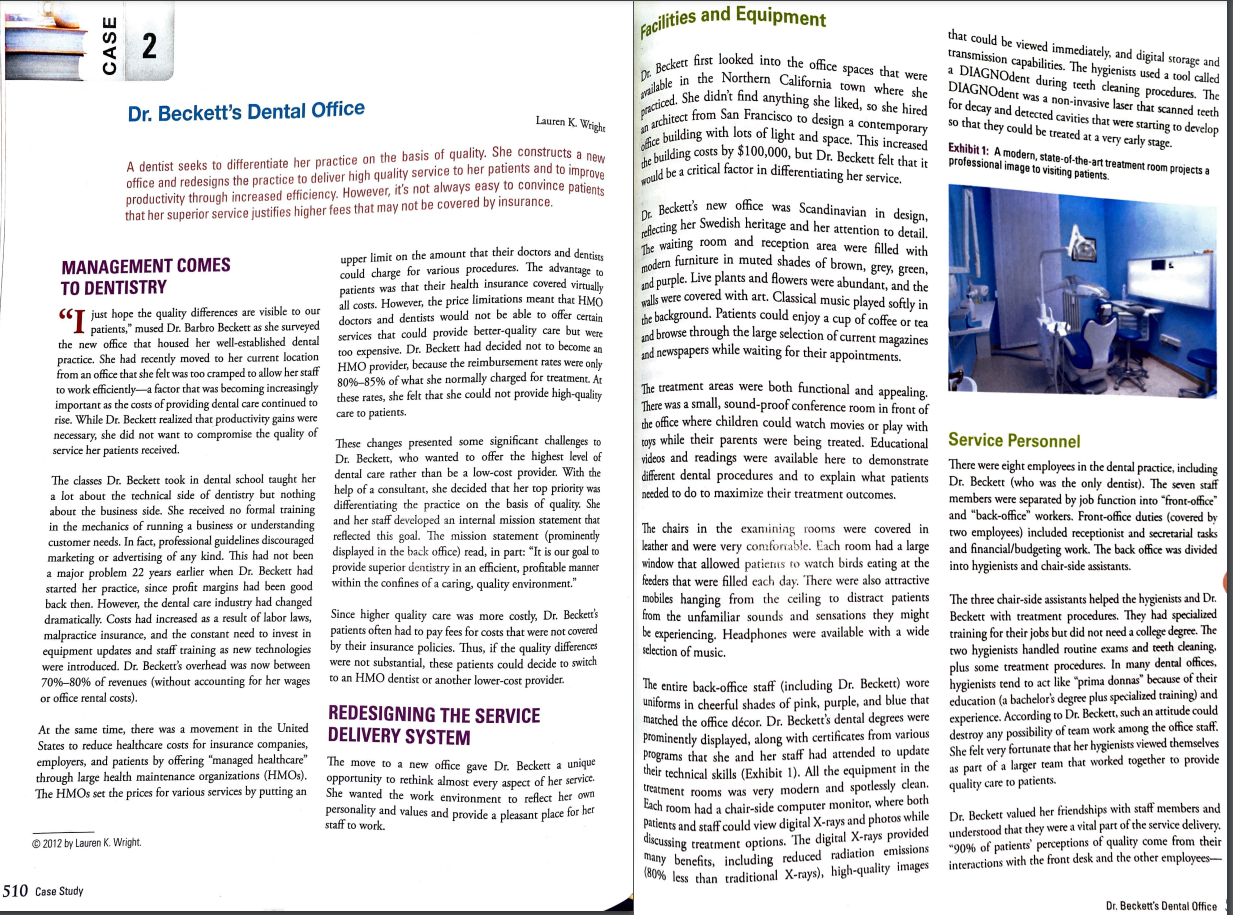
CASE 510 Case Study 2 Dr. Beckett's Dental Office Lauren K. Wright A dentist seeks to differentiate her practice on the basis of quality. She constructs a new office and redesigns the practice to deliver high quality service to her patients and to improve productivity through increased efficiency. However, it's not always easy to convince patients that her superior service justifies higher fees that may not be covered by insurance. upper limit on the amount that their doctors and dentists could charge for various procedures. The advantage to patients was that their health insurance covered virtually all costs. However, the price limitations meant that HMO doctors and dentists would not be able to offer certain services that could provide better-quality care but were to become an too expensive. Dr. Beckett had decided not HMO provider, because the reimbursement rates were only 80%-85% of what she normally charged for treatment. At these rates, she felt that she could not provide high-quality care to patients. These changes presented some significant challenges to Dr. Beckett, who wanted to offer the highest level of dental care rather than be a low-cost provider. With the help of a consultant, she decided that her top priority was differentiating the practice on the basis of quality. She and her staff developed an internal mission statement that reflected this goal. The mission statement (prominently displayed in the back office) read, in part: "It is our goal provide superior dentistry in an efficient, profitable manner within the confines of a caring, quality environment." . Since higher quality care was more costly, Dr. Beckett's patients often had to pay fees for costs that were not covered by their insurance policies. Thus, if the quality differences were not substantial, these patients could decide switch to an HMO dentist or another lower-cost provider. REDESIGNING THE SERVICE DELIVERY SYSTEM The move to a new office gave Dr. Beckett a unique opportunity to rethink almost every aspect of her service. She wanted the work environment to reflect her own personality and values and provide a pleasant place for her staff to work. MANAGEMENT COMES TO DENTISTRY just hope the quality differences are visible to our patients," mused Dr. Barbro Beckett as she surveyed the new office that housed her well-established dental practice. She had recently moved to her current location from an office that she felt was too cramped to allow her staff to work efficiently-a factor that was becoming increasingly important as the costs of providing dental care continued to rise. While Dr. Beckett realized that productivity gains were necessary, she did not want to compromise the quality of service her patients received. the The classes Dr. Beckett took in dental school taught her a lot about the technical side of dentistry but nothing about the business side. She received no formal training understanding in the mechanics of running a business customer needs. In fact, professional guidelines discouraged marketing or advertising of any kind. This had not been a major problem 22 years earlier when Dr. Beckett had started her practice, since profit margins had been good back then. However, the dental care industry had changed dramatically. Costs had increased as a result of labor laws, malpractice insurance, and the constant need to invest in equipment updates and staff training new technologies were introduced. Dr. Beckett's overhead was now between 70%-80% of revenues (without accounting for her wages or office rental costs). At the same time, there was a movement in the United. States to reduce healthcare costs for insurance companies, employers, and patients by offering "managed healthcare" through large health maintenance organizations (HMOs). The HMOs set the prices for various services by putting an 2012 by Lauren K. Wright. Facilities and Equipment Dr Beckett first looked into the office spaces that were available in the Northern California town where she practiced. She didn't find anything she liked, so she hired an architect from San Francisco to design a contemporary office building with lots of light and space. This increased the building costs by $100,000, but Dr. Beckett felt that it he a critical factor in differentiating her service. would Dr. Beckett's new office was Scandinavian in design, reflecting her Swedish heritage and her attention to detail. The waiting room and reception area were filled with modern furniture in muted shades of brown, grey, green, and purple. Live plants and flowers were abundant, and the walls were covered with art. Classical music played softly in the background. Patients could enjoy a cup of coffee or tea and browse through the large selection of current magazines and newspapers while waiting for their appointments. The treatment areas were both functional and appealing. There was a small, sound-proof conference room in front of the office where children could watch movies or play with toys while their parents were being treated. Educational videos and readings were available here to demonstrate different dental procedures and to explain what patients needed to do to maximize their treatment outcomes. The chairs in the examining rooms were covered in leather and were very comfortable. Each room had a large window that allowed patiems to watch birds eating at the feeders that were filled each day. There were also attractive. mobiles hanging from the ceiling to distract patients from the unfamiliar sounds and sensations they might be experiencing. Headphones were available with a wide selection of music. the The entire back-office staff (including Dr. Beckett) wore uniforms in cheerful shades of pink, purple, and blue that matched the office dcor. Dr. Beckett's dental degrees were prominently displayed, along with certificates from various programs that she and her staff had attended to update their technical skills (Exhibit 1). All the equipment treatment rooms was very modern and spotlessly clean. Each room had a chair-side computer monitor, where both patients and staff could view digital X-rays and photos while discussing treatment options. The digital X-rays provided many benefits, including reduced radiation emissions (80% less than traditional X-rays), high-quality images that could be viewed immediately, and digital storage and transmission capabilities. The hygienists used a tool called a DIAGNOdent during teeth cleaning procedures. The DIAGNOdent was a non-invasive laser that scanned teeth for decay and detected cavities that were starting to develop so that they could be treated at a very early stage. Exhibit 1: A modern, state-of-the-art treatment room projects a professional image to visiting patients. Service Personnel There were eight employees in the dental practice, including Dr. Beckett (who was the only dentist). The seven staff members were separated by job function into "front-office" and "back-office" workers. Front-office duties (covered by two employees) included receptionist and secretarial tasks and financial/budgeting work. The back office was divided into hygienists and chair-side assistants. The three chair-side assistants helped the hygienists and Dr. Beckett with treatment procedures. They had specialized training for their jobs but did not need a college degree. The two hygienists handled routine exams and teeth cleaning, plus some treatment procedures. In many dental offices, hygienists tend to act like "prima donnas" because of their ) and education (a bachelor's degree plus specialized training) a experience. According to Dr. Beckett, such an attitude could destroy any possibility of team work among the office staff. She felt very fortunate that her hygienists viewed themselves as part of a larger team that worked together to provide quality care to patients. Dr. Beckett valued her friendships with staff members and understood that they were a vital part of the service delivery. "90% of patients' perceptions of quality come from their interactions with the front desk and the other employees- Dr. Beckett's Dental Office once a year (paid for by Dr. Beckett); spouses were welcome to participate but had to cover their own trip expenses. Past destinations for these excursions had included Hawaii and Washington, D.C. Procedures and Patients With the help of a consultant, all the office systems (including billing, ordering, lab work, and patient treatment) were redesigned. One of the main goals was to standardize some of the routine procedures to reduce the occurrence of errors and ensure that all patients received the same level of care Specific times were allotted for each procedure, and the staff worked very hard to see that these time requirements were met. Office policy specified that patients should be kept waiting no longer than 20 minutes without being given the option to reschedule, and employees often called patients in advance if they knew there would be a delay. They to fill in cancellations to make sure office also attempted capacity was maximized. Staff members substituted for each other when necessary or helped with tasks that were not specifically in their job descriptions in order to make things run more smoothly. Dr. Beckett's practice included about 2,000 "active" patients (and many more who came infrequently). They were mostly white-collar workers with professional jobs (university employees, healthcare workers, and managers/owners of local establishments.) She did no advertising; all of her new business came from positive word of mouth by current patients. Dr. Beckett's practice was so busy that patients Par often had to wait 3-4 months for a routine cleaning and exam (if f they didn't have their appointments automatically scheduled every six months), but they didn't seem to mind the delay. The dentist believed that referrals were a real advantage, because new patients didn't come in "cold." She did not have to sell herself, because they had already been told about her service by friends or family. All new patients were required to have an initial exam so that Dr. Beckett could do a needs assessment and educate them about her service. She believed this was the first indication to patients that her practice was different from others they had experienced. THE BIGGEST CHALLENGE "Redesigning the business was the easy part," Dr. Beckett sighed. "Demonstrating the high level of quality to patients is the hard job." She said it was especially difficult since most not from the staff's technical skills," she stated. When Dr. Beckett began to redesign her practice, she discussed her goals with the staff members and involved them in the decision- making process. The changes meant new expectations and routines for most employees, and some were not willing to adapt. There was some staff turnover (mostly voluntary) as the new office procedures were implemented. The current group worked very well as a team. Dr. Beckett and her staff met briefly each morning to discuss the day's schedule and patients. They also had longer meetings every other week to discuss more strategic issues and resolve any problems that might have developed. During these meetings, employees made suggestions about f the most successful how to improve patient care. Some staff suggestions included "thank you" cards to patients who referred other patients; follow-up calls to patients after major after they'd had procedures; a "gift" bag to give to patients a their teeth cleaned (containing a toothbrush, toothpaste, mouthwash, and floss); buckwheat pillows and blankets for patient comfort during long procedures; coffee and tea in the waiting area; and a photo album in the waiting area with pictures of staff and their families. Exhibit 2: Service delivery is enhanced through customized interaction with patients, both young and old. The expectations for staff performance (in terms of both technical competence and patient interactions) were very high. However, Dr. Beckett provided her employees with many opportunities to update their skills by attending classes and workshops. She also rewarded their hard work by giving monthly bonuses if business was good. Since she shared the financial data with her staff, they could see the difference in revenues if the schedule was slow or patients were dissatisfied. This provided an extra incentive to improve service delivery. The entire office also went on trips together CASE STUDY people either disliked going to the dentist or felt that it was inconvenience and came in with a negative attitude. Dr. Beckett tried to reinforce the idea that quality dental care depended on a positive long-term relationship between and the dental team. The website for the practice patients emphasize www.chicogentledental.com) was designed to e this concept. This philosophy was also reflected in a section of the patient mission statement hanging in the waiting patients were anxious and uncomfortable, which made them more critical of her service delivery. It was not uncommon for patients to say negative things to Dr. Beckett even before treatment began (such as, "I really hate going to the dentist-it's not you, but I just don't want to be here!"). When this happened, she reminded herself that she was providing quality service whether patients appreciated it or not. "The person will usually have to have the dental work done anyway," she remarked, "So I just do the best job I can and make them as comfortable as possible." Even though patients seldom expressed appreciation for her services, she hoped that she had made a positive difference in their health or appearance that would benefit them in the long run. are caring, professional dental team serving a area: "We motivated, quality-oriented patients interested in keeping healthy smiles for a lifetime. Our goal is to offer a progressive and educational environment. Your concerns are our focus," Although Dr. Beckett enjoyed her work, she admitted that it could be difficult to maintain a positive attitude. The job required precision and attention to detail, and the procedures were often painful for patients. She often felt as though she were "walking on eggshells," because she knew STUDY QUESTIONS 1. Which of the seven elements of the Services Marketing Mix are addressed in this case? Give examples of each "P" you identify. 2. Exhibit 3: A team of closely-knit professionals working under the guidance of a clear, common mission statement can help overcome the most negative pre-conceived notions about visiting the dentist. Why do people dislike going to the dentist? Do you feel Dr. Beckett has addressed this problem effectively? How do Dr. Beckett and her staff educate patients 3. about the service they are receiving? What else could they do? 4. What supplementary services are offered? How do they enhance service delivery? 5. Contrast your own dental care experiences with those offered by Dr. Beckett's practice. What differences do you see? Based on your review of this case, what advice would you give to (a) your current or former dentist and (b) Dr. Beckett? 6. Evaluate Dr. Beckett's website (www.chicogentledental. com). What strengths do you think the website has? What improvements would you suggestStep by Step Solution
There are 3 Steps involved in it
1 Expert Approved Answer
Step: 1 Unlock

Question Has Been Solved by an Expert!
Get step-by-step solutions from verified subject matter experts
Step: 2 Unlock
Step: 3 Unlock
 Study Help