







Question: From this case report Identify the key IT management practices, IT systems, and IT decisions that the company made to improve its overall IT maturity
From this case report Identify the key IT management practices, IT systems, and IT decisions that the company made to improve its overall IT maturity level. Present your views in a tabular format taking into consideration of the 6 criteria or dimensions of IT alignment maturity included in the Luftman's (2007) model.
The case report :
ABC (a pseudonym) is an international speciality chemicals manufacturer. Speciality chemicals are ingredients that are added during the blending process of finished products which enhance the products' performance, appearance, or some other quality. The company's customers range across many industries from automotive, electronics, plastics to mining. The company generated sales of around $5.4 billion in 2001 and employed over 20,000 people worldwidePage 3 of 6 with sales in 117 countries. This had resulted in decentralised IT structure, multiple and duplicate IT infrastructure and many redundant IT staff who were operating in an inefficient manner and provided inefficient IT services. During 1999 to 2001 time period, the company experienced a drastic reduction in its sales due to: a) weak global economy, and b) highly competitive industry environment in which many new global rivals emerged. Against this backdrop, Chairman of the Board, Mr Alvin Joseph (a pseudonym) took over as the CEO of the company in late 2001. Shortly thereafter, Mr Joseph announced a new corporate vision and launched the company's 'Aligning for One' business strategy to meet the challenges. With the new strategy, Alvin Jospeh reorganised the company from its divisional structure comprised of 3 divisions with 9 business units, into a new structure of 5 business segments, without the division layer. Each business segment was given responsibility for its own marketing, research, technology, production, and sales. Non-core support services (e.g. supply chain distribution, finance, HR) were grouped and provided through central support services on a global basis. The IT function of the company reported to Mr David Bailey, CFO. He was responsible for reorganising IT function and aligning it with the new business structure and strategy of the company. He decided to centralise the disparate IT functions and aligned them with the business. As a result of restructuring of the IT function, IT processes were simplified and the core IT infrastructure was now centralised. However, it was soon recognised that overall there was a strong need to evaluate IT maturity of the company and to better align the IT function to address the new business strategy announced by the new CEO. Mr Bailey thus immediately ordered the formation of a Strategic Alignment Maturity (SAM) group which included several senior IT and business managers. The group was asked to evaluate the current IT alignment maturity level of the company and to improve it. The SAM group used Luftman's (2007) model as a reference framework and evaluated the current status of IT alignment maturity in the company and presented their findings to Mr Bailey. A summary of the findings is given in table:
| IT Alignment Maturity Dimension | Initial Assessment | Follow up Assessment |
| communication | 2.5 | 3.1 |
| competency/ value | 2.3 | 2.5 |
| partnership | 2.7 | 3.1 |
| governance | 2.1 | 2.8 |
| Scope & Architecture | 3.0 | 3.8 |
| skills | 1.9 | 2.7 |
| Over maturity | Level 2 (committed processes) | Level3 (Established focused processes) |
Upon reviewing the report, Mr Bailey immediately authorised the group to take appropriate actions (both management and technical) to improve the overall IT maturity level to Level 3 (Established focused processes). The SAM group for the next 2 years worked hard with various levels of management and technical managers of the company to incorporate a range of key management practices (including some best practices) and made important IT decisions, and IT systems choices to facilitate the improvement in IT maturity alignment. In the following six sections, many of these actions are described: Dimension 1 (Communication): Prior to the 'Aligning for One' business strategy, the company's alignment maturity for communication was at Level 2 (Rating 2.5). The company demonstrated strong improvements in their business communication process by implementingPage 4 of 6 the following practices: a) Company intranet was redesigned to provide a tool for knowledge sharing, information of business and IT initiatives were posted, and twice a year review of the web-pages on the intranet was done to ensure up-to-date information is displayed, b) the CEO of the company advocated for 'open culture' and introduced company's Intranet column 'Ask Alvin' which in turn presented unprecedented open communications between the CEO and all levels of staff, and c) once a month staff meeting where both business and IT initiatives were discussed. Dimension 2 (Competency/Value): The maturity level of this dimension of IT alignment did not substantially change from a Level 2 (Rating 2.3) after the 'Aligning for One' business strategy was implemented. After the introduction of the new business strategy, the company introduced Service Level Agreements (SLAs) between the IT function and business for both global and regional services. Supporting SLAs are Operational Level Agreements (OLAs) which are technical performance measures. Dimension 3 (Governance): Since the 'Aligning for One' business strategy was implemented, the maturity level of governance dimension approached Level 3 (Rating: 3.1). The new IT structure is now centralised and IT was given an expanded role to provide 24x7 global support. An important change was centralising supply chain systems including a reduction in the number of systems from 87 to 33 worldwide provided by one ERP vendor. An IT steering committee was formed to oversee the significant decisions made by the centralised IT structure. This committee reports directly to the CFO. Dimension 4 (Partnership): The initial maturity level of Partnership dimension at a high Level 2 (Rating 2.7). It improved slightly after the 'Aligning for One' business strategy was implemented to a low Level 3. At the operational level, the company now use 'champions' to act as a link between their e-business initiatives, their local office and their customers. Several key IT initiatives were launched to support the introduction of the new business strategy. In addition, sharing of risks and rewards are not extended to IT employees as well. Dimension 5 (Scope & Architecture): This dimension has become one of the company's most mature alignment facilitators since the 'Aligning for One' business strategy was launched. The implementation of an integrated IT infrastructure provides the pervasive transparency and flexibility necessary to enable global integration of inventory planning. The company also introduced IT standards for hardware and software solutions for their global operations. Additionally, the company has reflected more mature strategic alignment as demonstrated by their use of emerging technologies and e-business models by participating in e-marketplaces. Dimension 6 (Skills): The maturity level of this dimension was initially at a high Level 1. Innovation has long been part of this company's culture, but was restructured at the business unit level. A global management program, implemented as an extension of the 'Aligning for One' business strategy was launched to encourage a process of innovation to all positions (including IT) within the company. Several skills development opportunities were implemented including: a) on-the-job training, b) rotation of employees for 3 to 6 months in a field (For example, a systems analyst goes into the field with a sales person), c) job enrichment (a person takes over the responsibility for a special project) - a marketing manager (for example) develops a customer information system. As a result of the improvements made in the company by implementing a wide range of major management practices, IT solutions, and IT decisions - the chemical company achieved success with the 'Aligning for One' business strategy, with substantial improvements in cash development and headcount reductions.
the image is answer template (example)
(using resources is allowed (must mention it)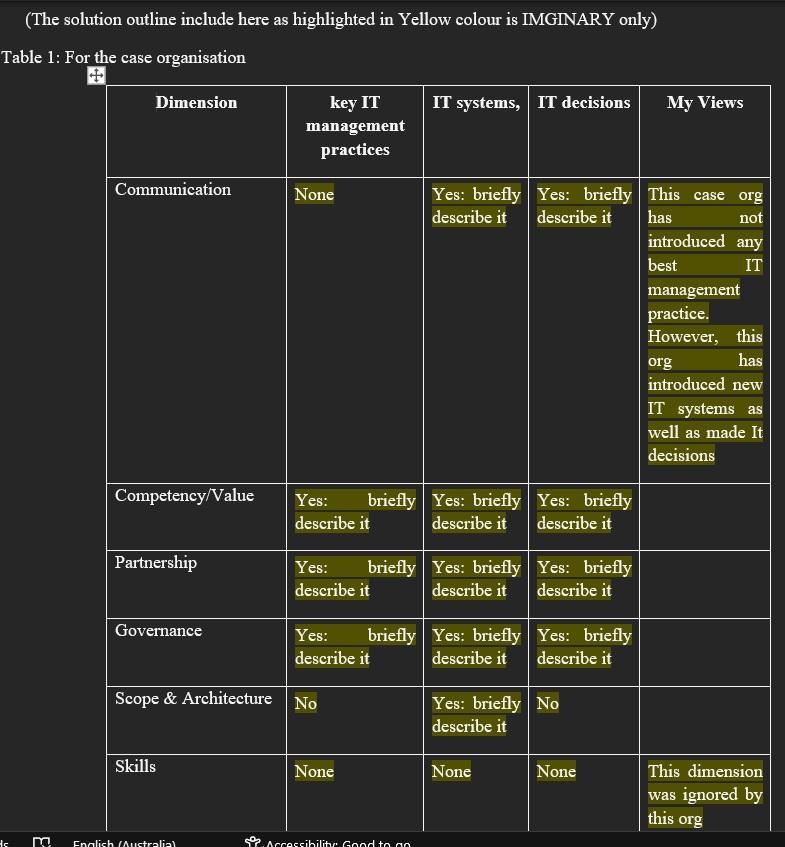
Step by Step Solution
There are 3 Steps involved in it

Get step-by-step solutions from verified subject matter experts
 Study Help