







Question: From this case study, need help with all 6 questions at the end. Thank you PART II INTERPERSONAL SKILLS CASE STUDY 51. LUKE'S HEALTH SYSTEM:
From this case study, need help with all 6 questions at the end. Thank you 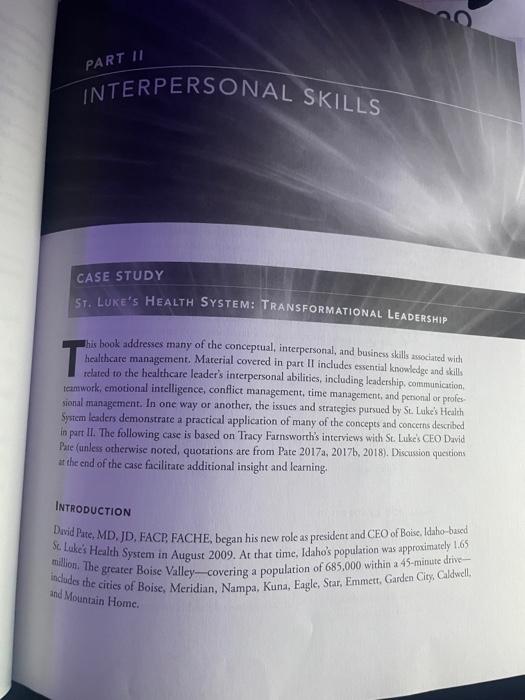
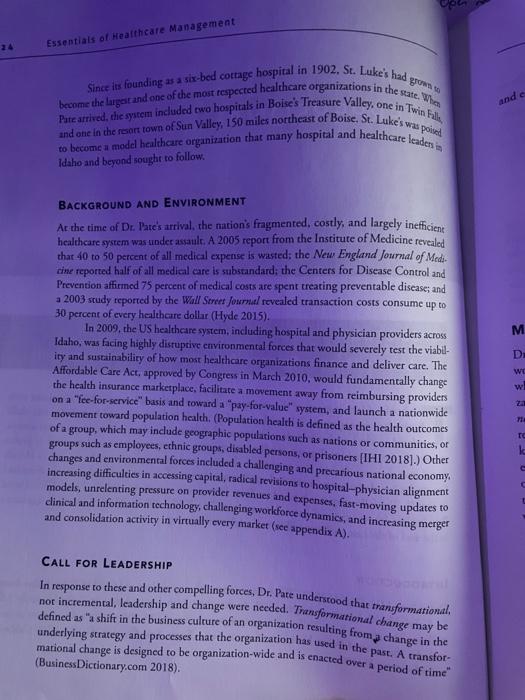
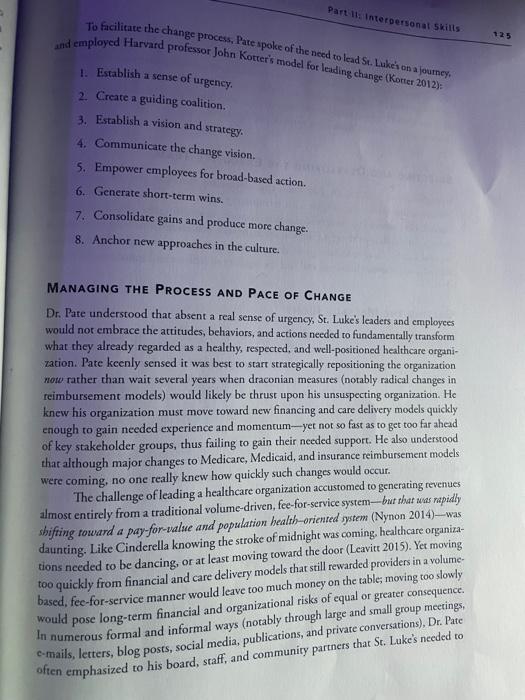
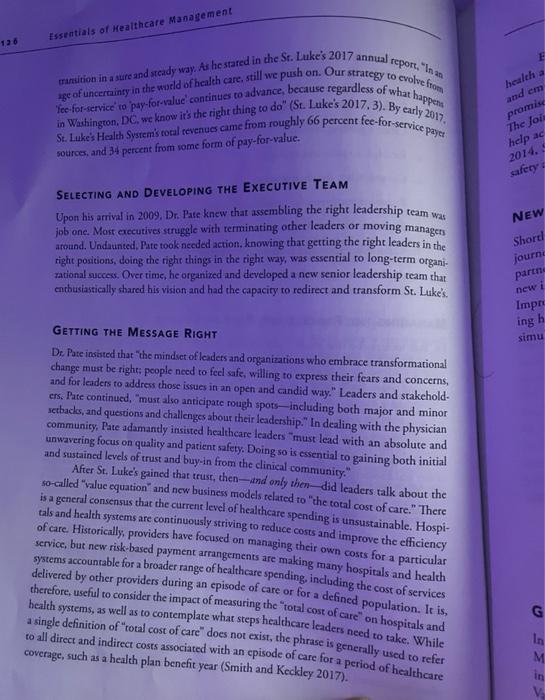
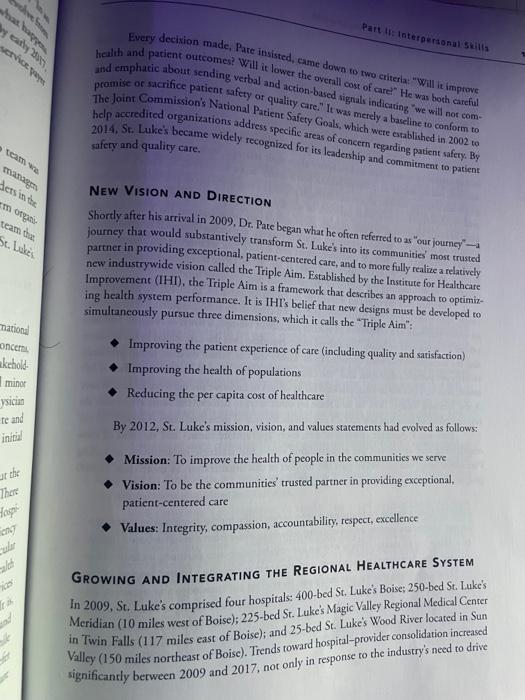
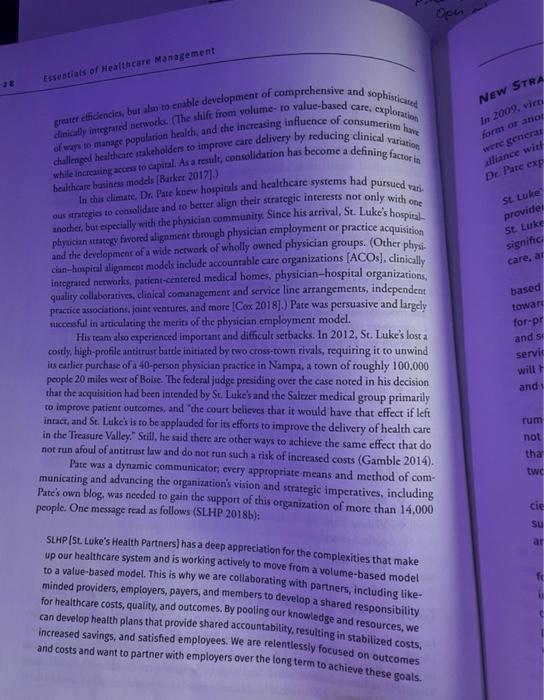
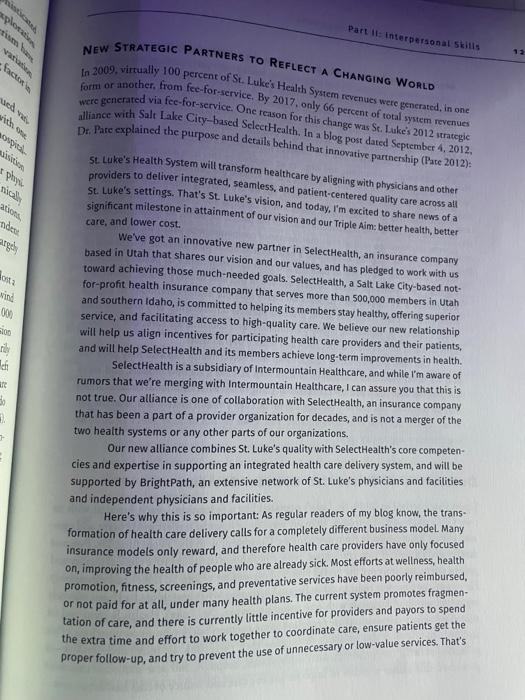
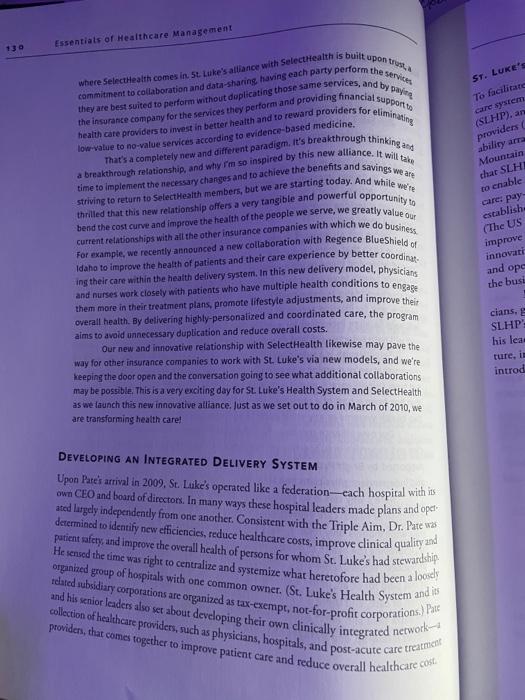
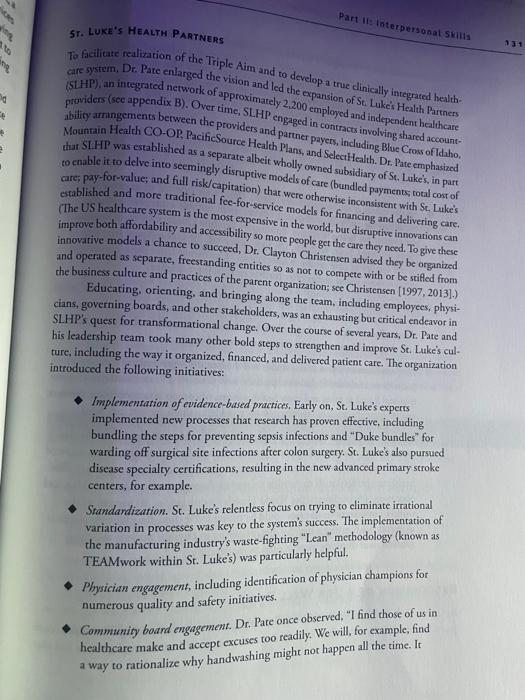
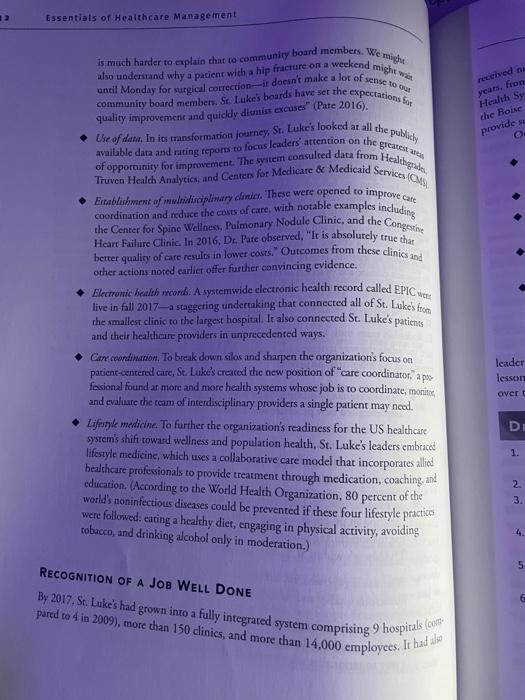
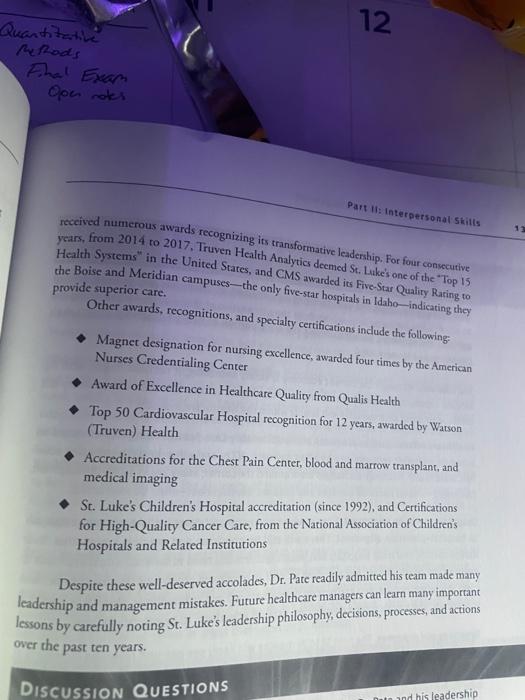
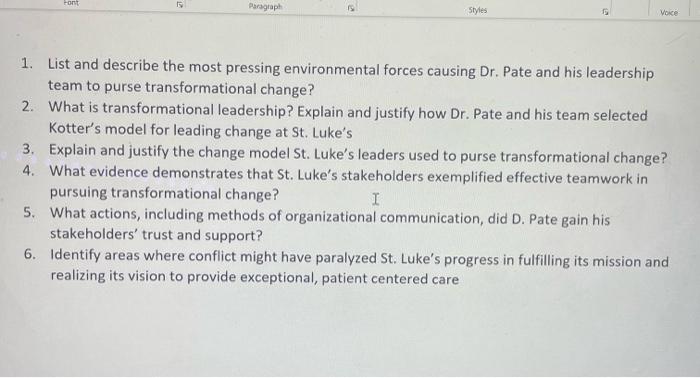
PART II INTERPERSONAL SKILLS CASE STUDY 51. LUKE'S HEALTH SYSTEM: TRANSFORMATIONAL LEADERSHIP . This book addresses many of the conceptual, interpersonal, and busines skills associated with healthcare management. Material covered in part II includes essential knowledge and skills related to the healthcare leader's interpersonal abilities, including leadership, communication, teamwork, emotional intelligence, conflict management, time management, and personal or profes sional management. In one way or another, the issues and strategies pursued by St. Luke's Health System leaders demonstrate a practical application of many of the concepts and concetns described in part II. The following case is based on Tracy Farnsworth's interviews with St. Luke's CEO David Pate (unless otherwise noted quotations are from Pate 2017a, 2017, 2018). Discussion questions at the end of the case facilitate additional insight and learning, INTRODUCTION David Pate, MD, ID, FACP, FACHE, began his new role as president and CEO of Boise, Idaho-based St. Luke's Health System in August 2009. At that time, Idaho's population was approximately 1.65 million. The greater Boise Valley covering a population of 685,000 within a 45-minute drive includes the cities of Boise, Meridian, Nampa, kuna, Eagle, Star, Emmett, Garden City, Caldwell and Mountain Home Essentials of Healthcare Management ande become the largest and one of the most respected healthcare organizations in the state. We Since its founding as a six-bed cottage hospital in 1902, St. Luke's had grown Pate arrived, the system included two hospitals in Boise's Treasure Valley, one in Twin Fille and one in the resort town of Sun Valley, 150 miles northeast of Boise. St. Lukes was posted to become a model healthcare organization that many hospital and healthcare leaders Idaho and beyond sought to follow. M D: BACKGROUND AND ENVIRONMENT At the time of Dr. Pate's arrival, the nation's fragmented, costly, and largely inefficiene healthcare e system was under assault. A 2005 report from the Institute of Medicine revealed that 40 to 50 percent of all medical expense is wasted, the New England Journal of Medi. cine reported half of all medical care is substandard: the Centers for Disease Control and Prevention affirmed 75 percent of medical costs are spent treating preventable disease; and a 2003 study reported by the Wall Street Journal revealed transaction costs consume up to 30 percent of every healthcare dollar (Hyde 2015). In 2009, the US healthcare system, including hospital and physician providers across Idaho, was facing highly disruptive environmental forces that would severely test the viabil- ity and sustainability of how most healthcare organizations finance and deliver care. The Affordable Care Act, approved by Congress in March 2010, would fundamentally change the health insurance marketplace, facilitate a movement away from reimbursing providers on a "fee-for-service" basis and toward a "pay-for-value" system, and launch a nationwide movement toward population health. (Population health is defined as the health outcomes of a group, which may include geographic populations such as nations or communities, or groups such as employees, ethnic groups, disabled persons, or prisoners (IHI 2018].) Other changes and environmental forces included a challenging and precarious national economy. increasing difficulties in accessing capital, radical revisions to hospital-physician alignment models, unrelenting pressure on provider revenues and expenses. fast-moving updates to dinical and information technology, challenging workforce dynamics, and increasing merger and consolidation activity in virtually every market (see appendix A). WE w TE C CALL FOR LEADERSHIP In response to these and other compelling forces , Dr. Pate understood that transformational, nor incremental, leadership and change were needed. Transformational change may be defined as a shift in the business culture of an organization resulting from a change in the underlying strategy and processes that the organization has used in the past. A transfor- mational change is designed to be organization-wide and is enacted over a period of time (Business Dictionary.com 2018). Partit: interpersonal skills 125 To facilitate the change process. Pate spoke of the need to lead St. Luke's on a journey. and employed Harvard professor John Kotter's model for leading change (Korter 2012): 1. Establish a sense of urgency. 2. Create a guiding coalition. 3. Establish a vision and strategy 4. Communicate the change vision. 5. Empower employees for broad-based action. 6. Generate short-term wins. 7. Consolidate gains and produce more change. 8. Anchor new approaches in the culture. MANAGING THE PROCESS AND PACE OF CHANGE Dr. Pare understood that absent a real sense of urgency, St. Luke's leaders and employees would not embrace the attitudes, behaviors, and actions needed to fundamentally transform what they already regarded as a healthy, respected and well-positioned healthcare organi- zation. Pate keenly sensed it was best to start strategically repositioning the organization now rather than wait several years when draconian measures (notably radical changes in reimbursement models) would likely be thrust upon his unsuspecting organization. He knew his organization must move toward new financing and care delivery models quickly enough to gain needed experience and momentum-yet not so fast as to get too far ahead of key stakeholder groups, thus failing to gain their needed support. He also understood that although major changes to Medicare, Medicaid, and insurance reimbursement models were coming, no one really knew how quickly such changes would occur. The challenge of leading a healthcare organization accustomed to generating revenues almost entirely from a traditional volume-driven, fee-for-service system--but that was rapidly shifting toward a pay-for-value and population health-oriented ystem (Nynon 2014)- was daunting. Like Cinderella knowing the stroke of midnight was coming, healthcare organiza- tions needed to be dancing, or at least moving toward the door (Leavitt 2015). Yet moving too quickly from financial and care delivery models that still rewarded providers in a volume based, fee-for-service manner would leave too much money on the table, moving too slowly would pose long-term financial and organizational risks of equal or greater consequence. In numerous formal and informal ways (notably through large and small group meetings, e-mails, letters, blog posts, social media, publications, and private conversations), Dr. Pate often emphasized to his board, staff, and community partners that St. Luke's needed to Essentials of Healthcare Management 126 report. "In an E health a and em Tansition in a sure and steady way. As he sared in the St. Luke's 2017 annual fee-fot-service to pay-for-value continues to advance, because regardless of what happens e of uncertainty in the world of health care still we push on. Our strategy to evolve from in Washington, DC, we know it's the right thing to do(St. Luke's 2017.3). By early 2017, sources and 34 percent from some form of pay-for-value. promise 6 percent fee-for-service pay The Joi help ac 2014.3 safety NEW SELECTING AND DEVELOPING THE EXECUTIVE TEAM Upon his arrival in 2009, Dr. Pate knew that assembling the right leadership team was job one. Most executives struggle with terminating other leaders or moving manager around. Undaunted, Pate took needed action, knowing that getting the right leaders in the right positions, doing the right things in the right way, was essential to long-term organi- rational success. Over time, he organized and developed a new senior leadership team that enthusiastically shared his vision and had the capacity to redirect and transform St. Luke's Short journe partne new i Impr ingh simu GETTING THE MESSAGE RIGHT De Pare insisted that the mindset of leaders and organizations who embrace transformational change must be right: people need to feel safe, willing to express their fears and concerns, and for leaders to address those issues in an open and candid way." Leaders and stakehold- ers. Pate continued. "must also anticipate rough spots including both major and minor setbacks, and questions and challenges about their leadership. In dealing with the physician community, Pate adamantly insisted healthcare leaders "must lead with an absolute and unwavering focus on quality and patient safety. Doing so is essential to gaining both initial and sustained levels of trust and buy-in from the clinical community." After St. Luke's gained that trust, then--and only then did leaders talk about the so-called "valuc equation and new business models related to "the total cost of care." There is a general consensus that the current level of healthcare spending is unsustainable. Hospi- tals and health systems are continuously striving to reduce costs and improve the efficiency of care. Historically, providers have focused on managing their own costs for a service, but new risk-based payment arrangements are making many hospitals and health particular systems accountable for a broader range of healthcare spending including the cost of services delivered by other providers during an episode of care or for a defined population. It is therefore, useful to consider the impact of measuring the total cost of care" on hospitals and health a systems, as well as to contemplate what steps healthcare leaders need to take. While a single definition of total cost of care" does not exist, the phrase is generally used to refer to all direct and indirect costs associated with an cpisode of care for a period of healthcare coverage, such as a health plan benefit year (Smith and Keckley 2017). a G In M in Every Part 1: interpersonal skills ay vo health and patient outcomes? Will it lower the overall cost of care!" He was both careful and emphatic about sending verbal and action-based signals indicating we will not com The Joint Commission's National Patient Safety Goals, which were established in 2002 to help accredited organizations address specific areas of concern regarding patient safety. By 2014, St. Luke's became widely recognized for its leadership and commitment to patient sfery and quality care. . dets in the team than St. Lukes NEW VISION AND DIRECTION Shortly after his arrival in 2009. Dr. Pate began what he often referred to as "our journey journey that would substantively transform St. Luke's into its communities most trusted partner in providing exceptional patient-centered care, and to more fully realize a relatively new industrywide vision called the Triple Aim. Established by the Institute for Healthcare Improvement (IHI), the Triple Aim is a framework that describes an approach to optimiz- ing health system performance. It is IHI's belief that new designs must be developed to simultaneously pursue three dimensions, which it calls the "Triple Aim": mation once akehold Improving the patient experience of care (including quality and satisfaction) Improving the health of populations Reducing the per capita cost of healthcare minor ysician tead By 2012, St. Luke's mission, vision, and values statements had evolved as follows: initial arch There Mission: To improve the health of people in the communities we serve Vision: To be the communities' trusted partner in providing exceptional, patient-centered care Values: Integrity, compassion, accountability, respect, excellence Yogi 27 GROWING AND INTEGRATING THE REGIONAL HEALTHCARE SYSTEM In 2009, S. Luke's comprised four hospitals: 400-bed St. Luke's Boise; 250-bed St. Luke's Meridian (10 miles west of Boise); 225-bed St. Luke's Magic Valley Regional Medical Center in Twin Falls (117 miles east of Boise); and 25-bed St. Luke's Wood River located in Sun significantly between 2009 and 2017, not only in response to the industry's need to drive Valley (150 miles northeast of Boise). Trends toward hospital-provider consolidation increased Essentials of Healthcare Management 28 exploration NEW STRA In 2009. vir form or ano were generar alliance with De Pare exp St. Luke provide St. Luke signific care, ar greater efficiencies, but also to enable development of comprehensive and sophisticated dinically integrated terworlo. (The shift from yolume- to value-based care. of ways to manage population health, and the increasing influence of consumerism har challenged healthcare sakeholders to improve care delivery by reducing clinical variation while increasing accosto capital As a result, consolidation has become a defining factor in healthcare business models (Barker 2017]) In this climate, Dr. Pate knew hospitals and healthcare systems had pursued at ous strategies to consolidate and to better align their strategic interests not only with on another, but especially with the physician community. Since his arrival, St. Luke's hospital physician strategy favored alignment through physician employment or practice acquisition and the development of a wide network of wholly owned physician groups. Other phyxi- cian-hanpital alignment models include accountable care organizations (ACOs)clinically integrated networks, patient-centered medical homes, physician-hospital organizations, quality collaboratives, clinical comanagement and service line arrangements, independent practice associations, joint ventures, and more Coor 2018].) Pate was persuasive and largely successful in articulating the merits of the physician employment model. His team also experienced important and difficult setbacks. In 2012, St. Luke's lost a costly, high-profile antitrust battle initiated by two cross-town rivals, requiring it to unwind its earlier purchase of a 40-person physician practice in Nampa, a town of roughly 100,000 people 20 miles west of Boise. The federal judge presiding over the case noted in his decision that the acquisition had been intended by St. Luke's and the Saltzer medical to improve patient outcomes, and the court believes that it would have that effect if left group primarily intact, and St. Luke's is to be applauded for its efforts to improve the delivery of health care in the Treasure Valley." Still, he said there are other ways to achieve the same effect that do not run afoul of antitrust law and do not run such a risk of increased costs (Gamble 2014). Pate was a dynamic communicator, every appropriate means and method of com- based towar for-pr and s servir will and rum not tha twe municating and advancing the organization's vision and strategic imperatives, including Pate's own blog, was needed to gain the support of this organization of more than 14,000 people. One message read as follows (SLHP 2018b): cie SU ar SLHP (St. Luke's Health Partners) has a deep appreciation for the complexities that make up our healthcare system and is working actively to move from a volume-based model to a value-based model. This is why we are collaborating with partners, including like- minded providers, employers, payers, and members to develop a shared responsibility for healthcare costs, quality, and outcomes. By pooling our knowledge and resources, we can develop health plans that provide shared accountability, resulting in stabilized costs increased savings, and satisfied employees. We are relentlessly focused on Dutcomes and costs and want to partner with employers over the long term to achieve these goals. plorer Partit: interpersonal skills NEW STRATEGIC PARTNERS TO REFLECT A CHANGING WORLD In 2009, virtually 100 percent of St. Luke's Health System revenues were generated in one form or another, from fee-for-service. By 2017. only 66 percent of total system revenues were generated via fee-for-service. One reason for this change was St. Luke's 2012 strategic alliance with Salt Lake City-based Select Health, In a blog post dated September 4, 2012, ved va De Pare explained the purpose and details behind that innovative partnership (Pate 2012): St. Luke's Health System will transform healthcare by aligning with physicians and other providers to deliver integrated, seamless, and patient-centered quality care across all St. Luke's settings. That's St Luke's vision, and today, I'm excited to share news of a significant milestone in attainment of our vision and our Triple Aim: better health, better phyi rice tidest dosta w SOD mily ch re care, and lower cost. We've got an innovative new partner in SelectHealth, an insurance company based in Utah that shares our vision and our values, and has pledged to work with us toward achieving those much-needed goals. SelectHealth, a Salt Lake City-based not for-profit health insurance company that serves more than 500,000 members in Utah and southern Idaho, is committed to helping its members stay healthy, offering superior service, and facilitating access to high-quality care. We believe our new relationship will help us align incentives for participating health care providers and their patients, and will help SelectHealth and its members achieve long-term improvements in health. SelectHealth is a subsidiary of Intermountain Healthcare, and while I'm aware of rumors that we're merging with Intermountain Healthcare, I can assure you that this is not true. Our alliance is one of collaboration with Select Health, an insurance company that has been a part of a provider organization for decades, and is not a merger of the two health systems or any other parts of our organizations. Our new alliance combines St. Luke's quality with SelectHealth's core competen- cies and expertise in supporting an integrated health care delivery system, and will be supported by Brightpath, an extensive network of St. Luke's physicians and facilities and independent physicians and facilities. Here's why this is so important: As regular readers of my blog know, the trans- formation of health care delivery calls for a completely different business model Many insurance models only reward, and therefore health care providers have only focused on, improving the health of people who are already sick. Most efforts at wellness, health promotion, fitness, screenings, and preventative services have been poorly reimbursed, or not paid for at all, under many health plans. The current system promotes fragmen- tation of care, and there is currently little incentive for providers and payors to spend the extra time and effort to work together to coordinate care, ensure patients get the proper follow-up, and try to prevent the use of unnecessary or low-val services. That's 130 Essentials of Healthcare Management ST. LUKE'S To facilitar care system (SLHP), an providers ability arra Mountain that SLHI to enable low-value to no-value services according to evidence-based medicine. we are where Select Health comes in St. Luke's alliance with Select Health is built upon tres they are best suited to perform without duplicating those same services, and by paying commitment to collaboration and data-sharing having each party perform the service the insurance company for the services they perform and providing financial support to health care providers to invest in better health and to reward providers for eliminating That's a completely new and different paradigm. It's breakthrough thinking and a breakthrough relationship, and why I'm so inspired by this new alliance. It will take time to implement the necessary changes and to achieve the benefits and savings striving to return to Select Health members, but we are starting today. And while we're thrilled that this new relationship offers a very tangible and powerful opportunity to bend the cost curve and improve the health of the people we serve, we greatly value our current relationships with all the other insurance companies with which we do business For example, we recently announced a new collaboration with Regence BlueShield of Idaho to improve the health of patients and their care experience by better coordinate ing their care within the health delivery system. In this new delivery model, physicians and nurses work closely with patients who have multiple health conditions to engage them more in their treatment plans, promote lifestyle adjustments, and improve their overall health. By delivering highly-personalized and coordinated care, the program aims to avoid unnecessary duplication and reduce overall costs. Our new and innovative relationship with Select Health likewise may pave the way for other insurance companies to work with St. Luke's via new models, and we're Weeping the door open and the conversation going to see what additional collaborations may be possible. This is a very exciting day for St. Luke's Health System and Select Health as we launch this new innovative atliance. Just as we set out to do in March of 2010, we are transforming health care! care: pay- establish (The US improve innovati and ops the busi cians. SLHP his lea. ture, il introd DEVELOPING AN INTEGRATED DELIVERY SYSTEM Upon Pate's arrival in 2009, St. Luke's operated like a federation-cach hospital with its own CEO and board of directors. In many ways these hospital leaders made plans and opel ated largely independently from one another. Consistent with the Triple Aim, Dr. Pate wa determined to identify new efficiencies, reduce healthcare costs, improve dinical quality and He wensed the time was right to centralize and systemize what heretofore had been a lovely purient safety and improve the overall health of persons for whom St Luke's had stewardship organized group of hospitals with one common owner . (St. Luke's Health System and p raised subsidiary corporations are organized as tax-exempe, not-for-profit corporations, Page and his senior leaders also set about developing their own clinically integrated networking collection of healthcare providers, such as physicians, hospitals, and post-acute providers, that comes together to improve patient care and reduce overall healthcare cost care treatment Part 1: Interpersonal skills 131 ST. LUKE'S HEALTH PARTNERS To facilitate realization of the Triple Aim and to develop a true dinically integrated health care system, Dr. Pate enlarged the vision and led the expansion of St. Luke's Health Partners (SLHP'), an integrated network of approximately 2.200 employed and independent healthcare ability arrangements between the providers and partner payers, including Blue Cross of Idaho, Mountain Health CO-OP, PacificSource Health Plans, and Select Health. Dr. Pate emphasized bar St.HP was established as a separate albeit wholly owned subsidiary of St. Luke's , in part o enable it to delve into seemingly disruptive models of care (bundled payments , total cost of care; pay-for-value, and full risk/capitation) that were otherwise inconsistent with St. Luke's established and more traditional fee-for-service models for financing and delivering are. (The US healthcare system is the most expensive in the world, but disruptive innovations can improve both affordability and accessibility so more people get the care they need. To give these innovative models a chance to succeed, Dr. Clayton Christensen advised they be organized and operated as separate, freestanding entities so as not to compete with or be stifled from the business culture and practices of the parent organization: see Christensen (1997, 2013].) Educating, orienting, and bringing along the team, including employees, physi- cians, governing boards, and other stakeholders, was an exhausting but critical endeavor in SLHP's quest for transformational change. Over the course of several years, Dt. Pate and his leadership team took many other bold steps to strengthen and improve St. Luke's cul- ture, including the way it organized, financed, and delivered patient care. The organization introduced the following initiatives: Implementation of evidence-based practices. Early on, St. Luke's experts implemented new processes that research has proven effective, including bundling the steps for preventing sepsis infections and "Duke bundles" for warding off surgical site infections after colon surgery. St. Luke's also pursued disease specialty certifications, resulting in the new advanced primary stroke centers, for example. Standardization. St. Luke's relentless focus on trying to eliminate irrational variation in processes was key to the system's success. The implementation of the manufacturing industry's waste-fighting "Lean" methodology (known as TEAMwork within St. Luke's) was particularly helpful. Physician engagement, including identification of physician champions for numerous quality and safety initiatives. Community board engagement. Dr. Pate once observed, "I find those of us in healthcare make and accept excuses too readily. We will, for example, find a way to rationalize why handwashing might not happen all the time. It Essentials of Healthcare Management received mi years, fron quality improvement and quickly dismis excuses" (Pate 2016). Health Sy the Boise provides O- is much harder to explain that to community board members. We might until Monday for surgical correction-it doesn't make a lot of sense to also understand why a patient with a hip fracture on a weekend might we community board members, St. Luke's boards have set the expectations for Use of data. In its transformation Journey, St. Luke's looked at all the policy available data and rating repom to focus leaders' attention on the greatest of opportunity for improvement. The system consulted data from Health Truven Health Analytics, and Centers for Medicare & Medicaid Services CMS Etablishment of multidiary clinic. These were opened to improve Care the Center for Spine Wellness, Pulmonary Nodule Clinic, and the Congestin Heart Failure Clinic In 2016, D. Pate observed. "It is absolutely true that . better quality of care results in lower costs. Outcomes from these clinics and other actions noted earlier offer further convincing evidence. leader lesson overt Electronic health cond. A system wide electronic health record called EPIC wer live in fall 2017 a staggering undertaking that connected all of St. Luke's from the smallest clinic to the largest hospital. It also connected St. Luke's patients and their healthcare providers in unprecedented ways. Care coordination. To break down silos and sharpen the organization's focus on patient-centered care, St. Luke's created the new position of care coordinator, a po fessional found at more and more health systems whose job is to coordinate, monits, and evaluate the team of interdisciplinary providers a single patient may need. Lifestyle medicine. To further the organization's readiness for the US healthcare system's shift toward wellness and population health, St. Luke's leaders embraced lifestyle medicine, which uses a collaborative care model that incorporates allied healthcare professionals to provide treatment through medication, coaching and education. According to the World Health Organization, 80 percent of the world's noninfectious diseases could be prevented if these four lifestyle practices were followed: eating a healthy diet, engaging in physical activity, avoiding DI 1. 2. 3. tobacco, and drinking alcohol only in moderation.) 4. 5 RECOGNITION OF A JOB WELL DONE By 2017. St. Luke's had grown into a fully integrated system comprising 9 hospitals.com 6 de 12 Quantitative Methods Thal Exam Oon notes Part I: Interpersonal skills received numerous awards recognizing its transformative leadership. For four consecutive years, from 2014 to 2017. Truven Health Analytics deemed St. Luke's one of the Top 15 Health Systems" in the United States, and CMS awarded its Five-Star Quality Rating 30 the Boise and Meridian campuses-the only five-star hospitals in Idaho-indicating they provide superior care. Other awards, recognitions, and specialty certifications include the following Magnet designation for nursing excellence, awarded four times by the American Nurses Credentialing Center Award of Excellence in Healthcare Quality from Qualis Health Top 50 Cardiovascular Hospital recognition for 12 years, awarded by Watson (Truven) Health Accreditations for the Chest Pain Center, blood and marrow transplant, and medical imaging St. Luke's Children's Hospital accreditation (since 1992), and Certifications for High-Quality Cancer Care, from the National Association of Children's Hospitals and Related Institutions Despite these well-deserved accolades, Dr. Pate readily admitted his team made many leadership and management mistakes. Future healthcare managers can learn many important lessons by carefully noting St. Luke's leadership philosophy, decisions, processes, and actions over the past ten years. DISCUSSION QUESTIONS and his leadership Font Paragraph Styles Voce 1. List and describe the most pressing environmental forces causing Dr. Pate and his leadership team to purse transformational change? 2. What is transformational leadership? Explain and justify how Dr. Pate and his team selected Kotter's model for leading change at St. Luke's 3. Explain and justify the change model St. Luke's leaders used to purse transformational change? 4. What evidence demonstrates that St. Luke's stakeholders exemplified effective teamwork in pursuing transformational change? I 5. What actions, including methods of organizational communication, did D. Pate gain his stakeholders' trust and support? 6. Identify areas where conflict might have paralyzed St. Luke's progress in fulfilling its mission and realizing its vision to provide exceptional, patient centered care Step by Step Solution
There are 3 Steps involved in it
1 Expert Approved Answer
Step: 1 Unlock

Question Has Been Solved by an Expert!
Get step-by-step solutions from verified subject matter experts
Step: 2 Unlock
Step: 3 Unlock
 Study Help