







Question: full coding with answer 3. Application: Telephone Switching Networks In a directly connected telephone network, all telephones are connected and don't require a central switching
full coding with answer
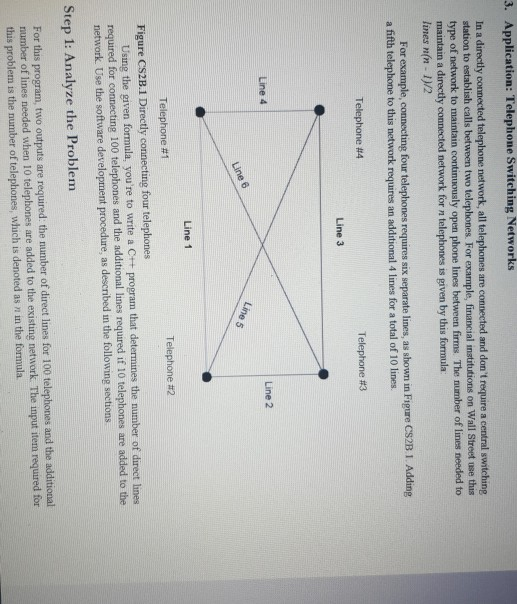
3. Application: Telephone Switching Networks In a directly connected telephone network, all telephones are connected and don't require a central switching station to establish calls between two telephones. For example, financial institutions on Wall Street use this type of network to maintain continuously open phone lines between firms. The number of lines needed to maintain a directly connected network for n telephones is given by this formula: lines n(n-1)/2 For example, connecting four telephones requires six separate lines, as shown in Figure CS2B. 1. Adding a fifth telephone to this network requires an additional 4 lines for a total of 10 lines. Telephone #4 Telephone #3 Line 3 Line 2 Line 1 Telephone #1 Telephone #2 Figure CS2B.1 Directly connecting four telephones Using the given formula, you're to write a C++ program that determines the number of direct lines required for connecting 100 telephones and the additional lines required if 10 telephones are added to the network Use the software development procedure, as described in the following sections Step 1: Analyze the Problem For this program, two outputs are required the number of direct lines for 100 telephones and the additional number of lines needed when 10 telephones are added to the existing network. The input item required for this problem is the number of telephones, which is denoted as n in the formula
Step by Step Solution
There are 3 Steps involved in it

Get step-by-step solutions from verified subject matter experts
 Study Help