







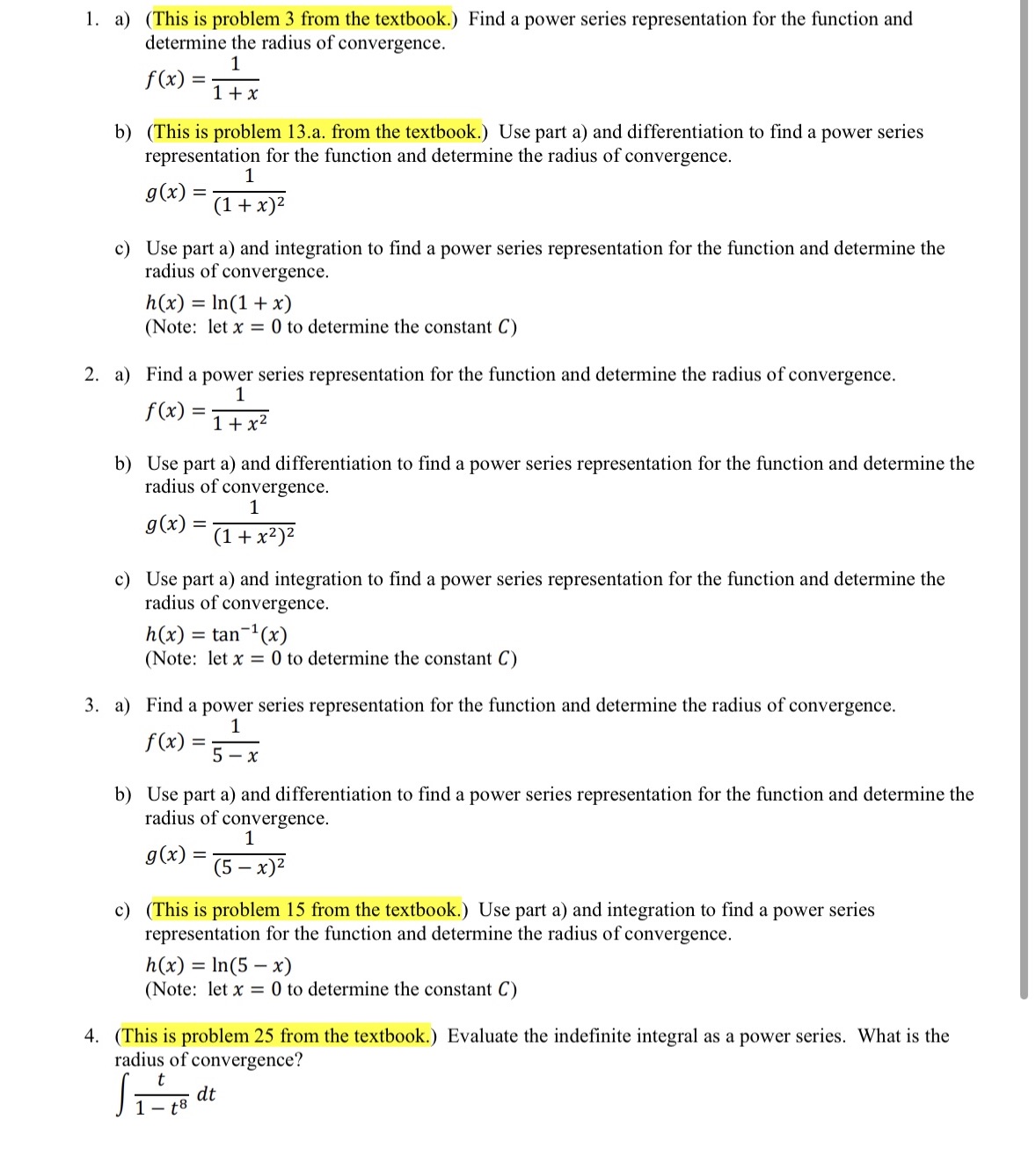
Question: Full solution 1. a) (This is problem 3 from the textbook.) Find a power series representation for the function and determine the radius of convergence.
Full solution
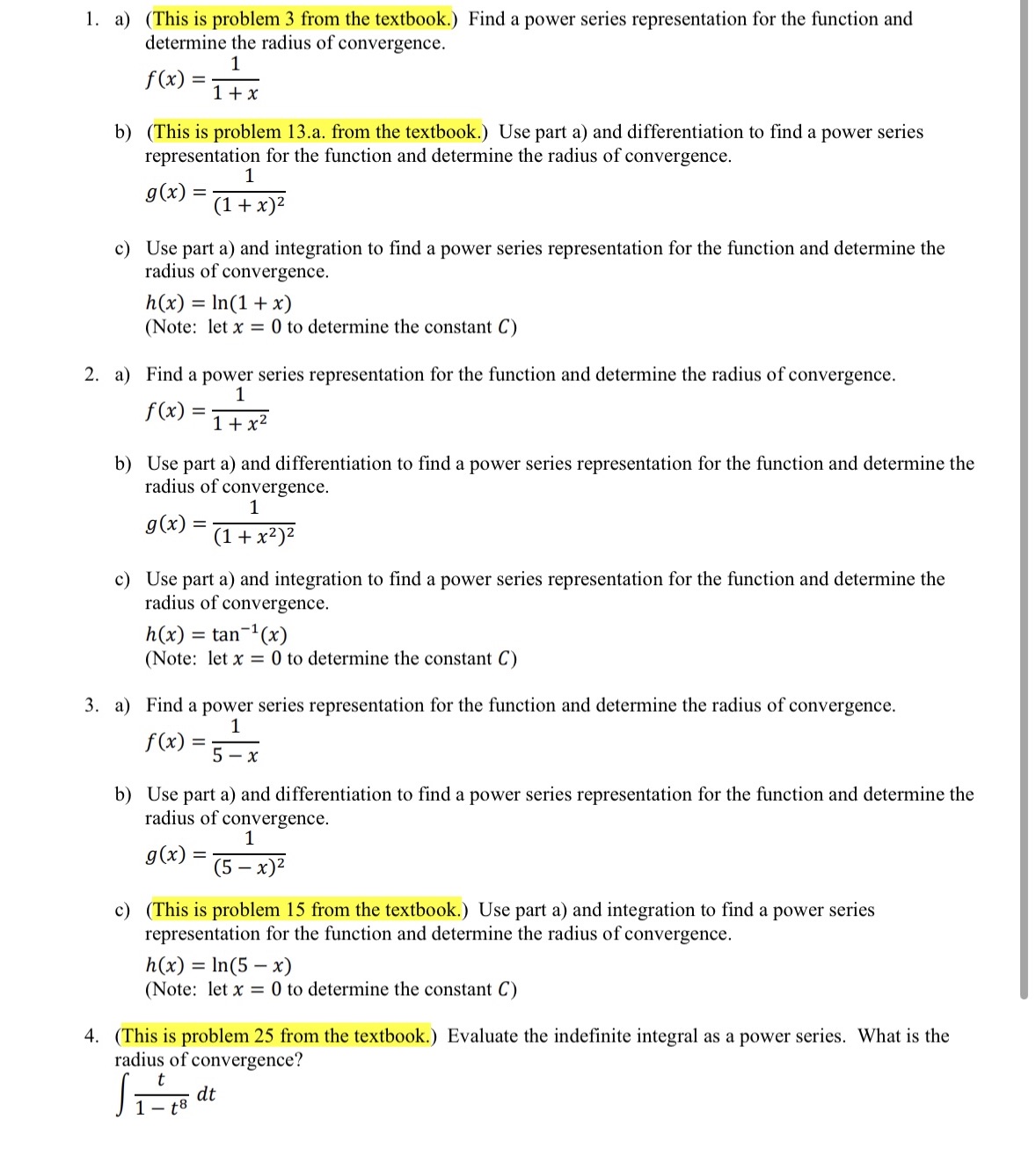
1. a) (This is problem 3 from the textbook.) Find a power series representation for the function and determine the radius of convergence. 1 f ( x) = = 1 + x b) (This is problem 13.a. from the textbook.) Use part a) and differentiation to find a power series representation for the function and determine the radius of convergence. 1 g (x ) = 7 (1 + x) 2 c) Use part a) and integration to find a power series representation for the function and determine the radius of convergence. h(x) = In(1 + x) (Note: let x = 0 to determine the constant C) 2. a) Find a power series representation for the function and determine the radius of convergence. f (x) = 7 1 + x2 b) Use part a) and differentiation to find a power series representation for the function and determine the radius of convergence. 1 g (x) = 7 (1 + x2)2 c) Use part a) and integration to find a power series representation for the function and determine the radius of convergence. h(x) = tan-(x) (Note: let x = 0 to determine the constant C) 3. a) Find a power series representation for the function and determine the radius of convergence. 1 f (x ) = - 5 - x b) Use part a) and differentiation to find a power series representation for the function and determine the radius of convergence. 1 g (x ) = T (5 - x) 2 c) (This is problem 15 from the textbook.) Use part a) and integration to find a power series representation for the function and determine the radius of convergence. h(x) = In(5 - x) (Note: let x = 0 to determine the constant C) 4. (This is problem 25 from the textbook.) Evaluate the indefinite integral as a power series. What is the radius of convergence? t 1- 18 dt
Step by Step Solution
There are 3 Steps involved in it

Get step-by-step solutions from verified subject matter experts
 Study Help