







Question: function: function: function y = hitTheSpot(v0,theta) Cd = 0.5; dxdt = @(t,x) [x(3:4);(-1/2*1*pi*(0.1^2)*Cd*norm(x(3:4))*x(3:4)-[0;9.81])]; if size(v0) == size(theta) [m,n] = size(v0); y = zeros(m,n); for i
function:
function:
function y = hitTheSpot(v0,theta) Cd = 0.5; dxdt = @(t,x) [x(3:4);(-1/2*1*pi*(0.1^2)*Cd*norm(x(3:4))*x(3:4)-[0;9.81])]; if size(v0) == size(theta) [m,n] = size(v0); y = zeros(m,n); for i = 1:m for j = 1:n [t,x] = ode45(dxdt,[0,2*v0(i,j)*sind(theta(i,j))/9.81],[0;0;v0(i,j)*cosd(theta(i,j));v0(i,j)*sind(theta(i,j))]); % figure % plot(x(:,1),x(:,2)) % hold on % plot(v0*cosd(theta)*t,v0*sind(theta)*t-1/2*9.81*t.^2) % set(gca,'ylim',[0,inf]) [~,b] = max(x(:,2)); y(i,j) = interp1(x(b:end,2),x(b:end,1),0,'pchip'); end end elseif size(v0) == [1,1] [m,n] = size(theta); y = zeros(m,n); for i = 1:m for j = 1:n [t,x] = ode45(dxdt,[0,2*v0*sind(theta(i,j))/9.81],[0;0;v0*cosd(theta(i,j));v0*sind(theta(i,j))]); % figure % plot(x(:,1),x(:,2)) % hold on % plot(v0*cosd(theta)*t,v0*sind(theta)*t-1/2*9.81*t.^2) % set(gca,'ylim',[0,inf]) [~,b] = max(x(:,2)); y(i,j) = interp1(x(b:end,2),x(b:end,1),0,'pchip'); end end elseif size(theta) == [1,1] [m,n] = size(v0); y = zeros(m,n); for i = 1:m for j = 1:n [t,x] = ode45(dxdt,[0,2*v0(i,j)*sind(theta)/9.81],[0;0;v0(i,j)*cosd(theta);v0(i,j)*sind(theta)]); % figure % plot(x(:,1),x(:,2)) % hold on % plot(v0*cosd(theta)*t,v0*sind(theta)*t-1/2*9.81*t.^2) % set(gca,'ylim',[0,inf]) [~,b] = max(x(:,2)); y(i,j) = interp1(x(b:end,2),x(b:end,1),0,'pchip'); end end end
Code in matlab
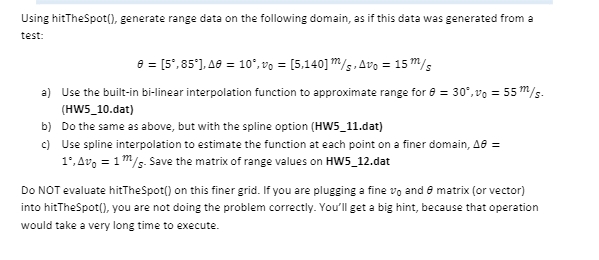
Using hitTheSpot(), generate range data on the following domain, as if this data was generated from a test: 8 = [5*,85'), 18 = 109,00 = [5,140) M/5, A10 = 15 m/s a) Use the built-in bi-linear interpolation function to approximate range for 8 = 30,vo = 55 m/s. (HW5_10.dat) b) Do the same as above, but with the spline option (HWS_11.dat) c) Use spline interpolation to estimate the function at each point on a finer domain, 18 = 1, Avo = 1 m/s. Save the matrix of range values on HW5_12.dat DO NOT evaluate hitTheSpot() on this finer grid. If you are plugging a fine vo and matrix (or vector) into hit Thespot(), you are not doing the problem correctly. You'll get a big hint, because that operation would take a very long time to execute. Using hitTheSpot(), generate range data on the following domain, as if this data was generated from a test: 8 = [5*,85'), 18 = 109,00 = [5,140) M/5, A10 = 15 m/s a) Use the built-in bi-linear interpolation function to approximate range for 8 = 30,vo = 55 m/s. (HW5_10.dat) b) Do the same as above, but with the spline option (HWS_11.dat) c) Use spline interpolation to estimate the function at each point on a finer domain, 18 = 1, Avo = 1 m/s. Save the matrix of range values on HW5_12.dat DO NOT evaluate hitTheSpot() on this finer grid. If you are plugging a fine vo and matrix (or vector) into hit Thespot(), you are not doing the problem correctly. You'll get a big hint, because that operation would take a very long time to execute
Step by Step Solution
There are 3 Steps involved in it

Get step-by-step solutions from verified subject matter experts
 Study Help