







Question: function N = Nmatrix1D(xt, xe, trialn) if trialn == 1 N(1) = (xt-xe(2))/(xe(1)-xe(2)); N(2) = (xt-xe(1))/(xe(2)-xe(1)); end end function B = Bmatrix1D(xt,xe, trialn) if trialn
function N = Nmatrix1D(xt, xe, trialn)
if trialn == 1
N(1) = (xt-xe(2))/(xe(1)-xe(2));
N(2) = (xt-xe(1))/(xe(2)-xe(1));
end
end
function B = Bmatrix1D(xt,xe, trialn)
if trialn == 1
B(1) = (1)/(xe(1)-xe(2));
B(2) = (1)/(xe(2)-xe(1));
end
end
function [w, gp] = gauss(ngp)
if ngp == 1
gp = 0;
w = 2;
elseif ngp == 2
gp = [-0.57735027, 0.57735027];
w = [1, 1];
elseif ngp == 3
gp = [-0.7745966692, 0.7745966692, 0.0];
w = [0.5555555555556, 0.55555555556, 0.8888888888889];
end
end
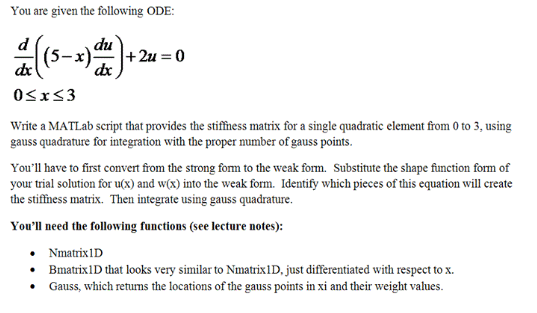
You are given the following ODE: du 0SxS3 Write a MATLab script that provides the stiffness matrix for a single quadratic element from 0 to 3, using gauss quadrature for integration with the proper number of gauss points. You'll have to first convert from the strong form to the weak form. Substitute the shape function form of your trial solution for ucx) and w(x) into the weak form Identify which pieces of this equation will create the stiffhess matrix. Then integrate using gauss quadrature. You'll need the following functions (see lecture notes): NmatrixlD Bmatrix1D that looks very similar to Nmatrix1D, just differentiated with respect to X. Gauss, which retums the locations of the gauss points in xi and their weight values. You are given the following ODE: du 0SxS3 Write a MATLab script that provides the stiffness matrix for a single quadratic element from 0 to 3, using gauss quadrature for integration with the proper number of gauss points. You'll have to first convert from the strong form to the weak form. Substitute the shape function form of your trial solution for ucx) and w(x) into the weak form Identify which pieces of this equation will create the stiffhess matrix. Then integrate using gauss quadrature. You'll need the following functions (see lecture notes): NmatrixlD Bmatrix1D that looks very similar to Nmatrix1D, just differentiated with respect to X. Gauss, which retums the locations of the gauss points in xi and their weight values
Step by Step Solution
There are 3 Steps involved in it

Get step-by-step solutions from verified subject matter experts
 Study Help