



Question: Furnaces are usually challenging, costly engineering projects. They need to be long-lasting, optimise energy usage and waste, and have minimal emission of pollutants and
![k Q 2 = (7.-). -T) where k is the thermal conductivity of the layer. a) [20 marks] Manipulate Fouriers law algebraically to](https://dsd5zvtm8ll6.cloudfront.net/si.experts.images/questions/2021/12/61b2f89798799_1639118997593.jpg)
![d) [30 marks] Write a matrix model that can predict the temperatures Tį and T2 in the schematic of Figure 2. Assume that k is](https://dsd5zvtm8ll6.cloudfront.net/si.experts.images/questions/2021/12/61b2f89675194_1639118997441.jpg)
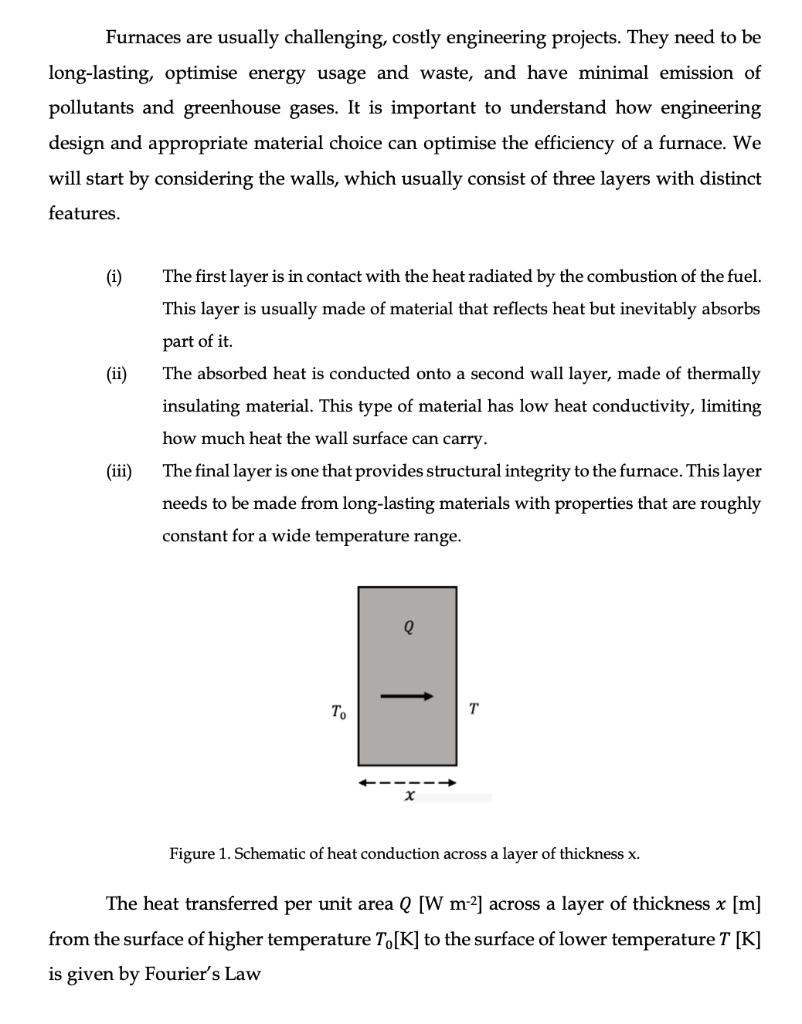
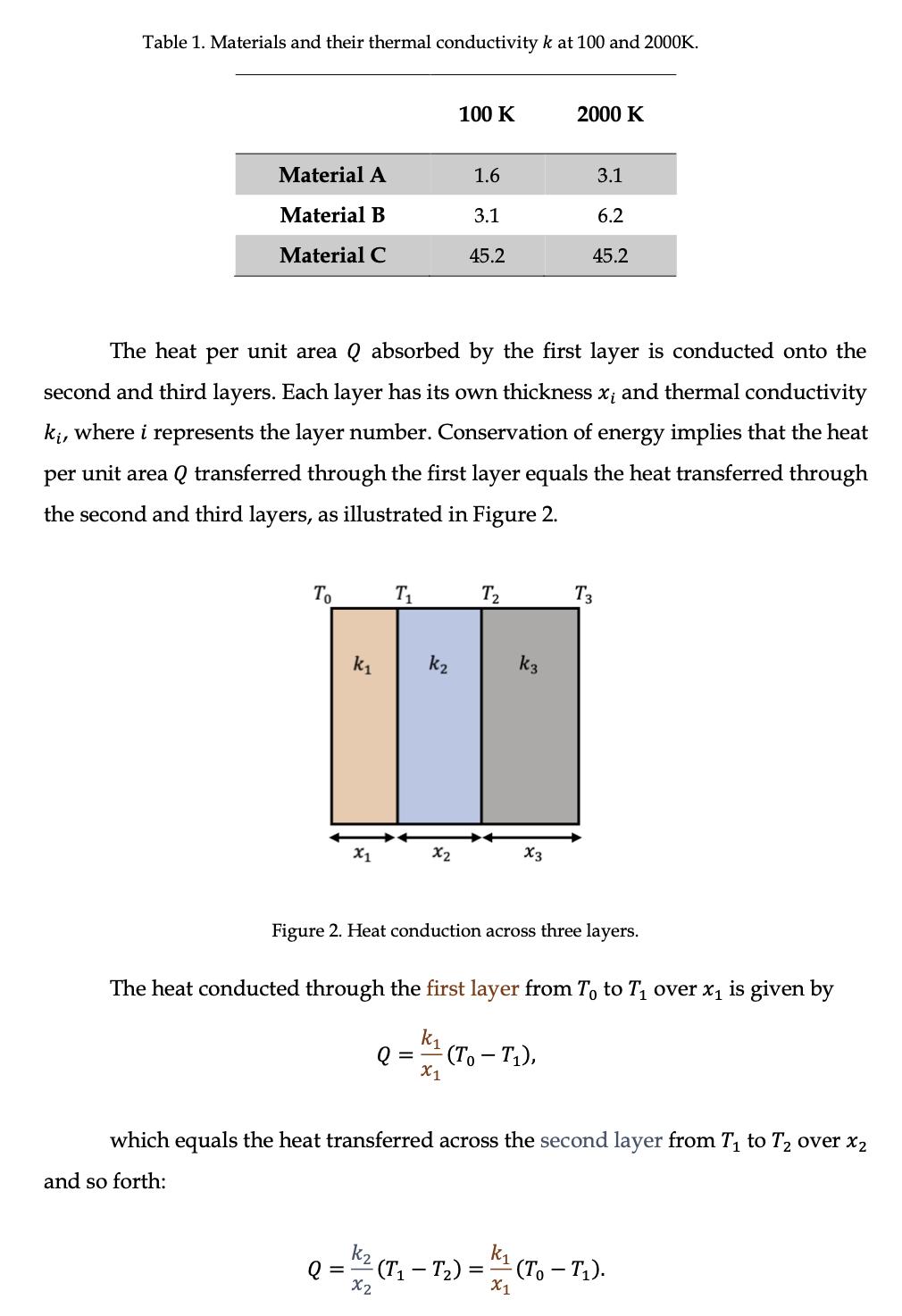
Furnaces are usually challenging, costly engineering projects. They need to be long-lasting, optimise energy usage and waste, and have minimal emission of pollutants and greenhouse gases. It is important to understand how engineering design and appropriate material choice can optimise the efficiency of a furnace. We will start by considering the walls, which usually consist of three layers with distinct features. (i) (ii) (iii) The first layer is in contact with the heat radiated by the combustion of the fuel. This layer is usually made of material that reflects heat but inevitably absorbs part of it. The absorbed heat is conducted onto a second wall layer, made of thermally insulating material. This type of material has low heat conductivity, limiting how much heat the wall surface can carry. The final layer is one that provides structural integrity to the furnace. This layer needs to be made from long-lasting materials with properties that are roughly constant for a wide temperature range. To Figure 1. Schematic of heat conduction across a layer of thickness x. The heat transferred per unit area Q [W m-] across a layer of thickness x [m] from the surface of higher temperature To[K] to the surface of lower temperature T [K] is given by Fourier's Law Q = (T-T), where k is the thermal conductivity of the layer. a) [20 marks] Manipulate Fourier's law algebraically to obtain a formula for the internal temperature of the layer at a distance d [0, x] from the left wall. If Q and k are constant, discuss the units of k and what it represents. Express Fourier's law in differential form, evaluate and discuss the meaning of the following integral: d 0 /dT dx. dx Differential form (hint): What would happen when x assumes infinitesimally small values? b) [10 marks] Discuss the effects of k on the temperature profile T(d). Support your answer by plotting T(d) for a wall thickness x = 0.3 m, with internal temperature To = 373 K and external temperature T = 273 K for three constant values of 0.1, 10 and 100 [W m-]. In more realistic scenarios k is not a constant and assumes different values at different temperatures. We then say that k is a function of the temperature k = k(T). This type of consideration can improve the accuracy of the model developed in question 1a. Table 1 shows the thermal conductivity of three materials at temperatures 100 and 2000 K. of the c) [10 marks] Choose one of the materials in Table 1 for the second laye furnace wall and justify your decision. Use the data in Table 1 and your knowledge in 2x2 linear systems of equations to find a linear approximation for k (T) in this layer for the temperature interval 100 - 2000 K. Table 1. Materials and their thermal conductivity k at 100 and 2000K. Material A Material B Material C To k The heat per unit area Q absorbed by the first layer is conducted onto the second and third layers. Each layer has its own thickness x; and thermal conductivity ki, where i represents the layer number. Conservation of energy implies that the heat per unit area Q transferred through the first layer equals the heat transferred through the second and third layers, as illustrated in Figure 2. = T k K Q x2 X2 100 K 1.6 3.1 45.2 X1 T K3 Figure 2. Heat conduction across three layers. X3 The heat conducted through the first layer from To to T over x is given by 2000 K 3.1 6.2 45.2 (To-T), T3 which equals the heat transferred across the second layer from T to T over x2 and so forth: (T-T) = - (To - T). X1 d) [30 marks] Write a matrix model that can predict the temperatures T and T in the schematic of Figure 2. Assume that k is independent of temperature and that To, T3, k1,k2, k3, x, x2 and x3 are known values. e) [30 marks] Use your matrix model developed in question 1d to choose which material from Table 1 should be used for the first, second and third layers with thickness x = 0.1, x = 0.7 and x3 = 0.6 m. Assume working temperatures To = 1700 K and T3 = 350 K. Assume that k is constant and temperature-independent, but justify your choice for its value.
Step by Step Solution
3.42 Rating (136 Votes )
There are 3 Steps involved in it
a Manipulating Fouriers law algebraically to obtain a formula for the internal temperature of the layer at a distance d 0 x from the left wall To obtain the internal temperature at a distance d from t... View full answer

Get step-by-step solutions from verified subject matter experts