







Question: g Revision questions.pdf - Adobe Reader File Edit View Window Help Open 1 4 IK + 100% Tools Fill & Sign Comment Sign In Export
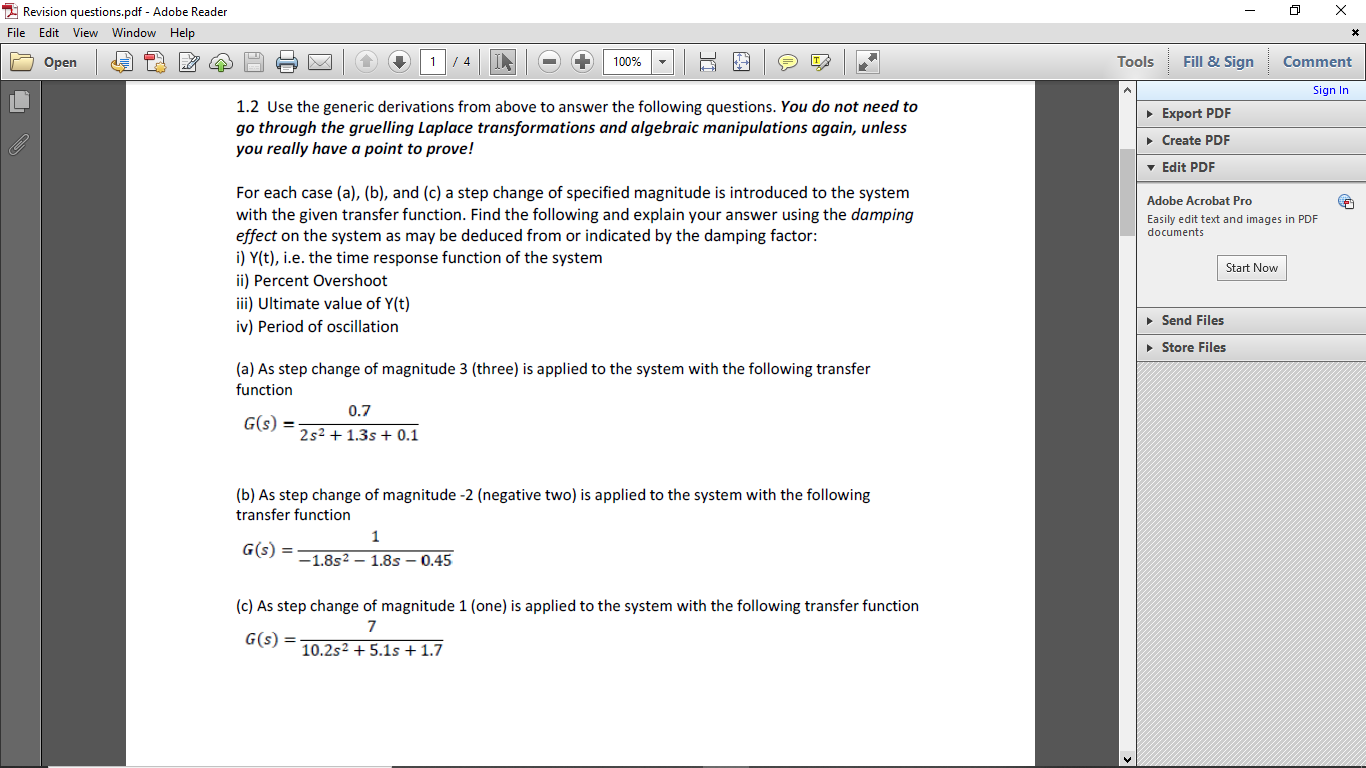
g Revision questions.pdf - Adobe Reader File Edit View Window Help Open 1 4 IK + 100% Tools Fill & Sign Comment Sign In Export PDF 1.2 Use the generic derivations from above to answer the following questions. You do not need to go through the gruelling Laplace transformations and algebraic manipulations again, unless you really have a point to prove! Create PDF Edit PDF Adobe Acrobat Pro Easily edit text and images in PDF documents For each case (a), (b), and (c) a step change of specified magnitude is introduced to the system with the given transfer function. Find the following and explain your answer using the damping effect on the system as may be deduced from or indicated by the damping factor: i) Y(t), i.e. the time response function of the system ii) Percent Overshoot iii) Ultimate value of y(t) iv) Period of oscillation Start Now Send Files Store Files (a) As step change of magnitude 3 (three) is applied to the system with the following transfer function 0.7 G(S) = 2 s2 + 1.3s + 0.1 (b) As step change of magnitude -2 (negative two) is applied to the system with the following transfer function 1 G(s) = -1.8s2 - 1.8 -0.45 (c) As step change of magnitude 1 (one) is applied to the system with the following transfer function 7 G(S) = 10.2s2 + 5.1s + 1.7
Step by Step Solution
There are 3 Steps involved in it

Get step-by-step solutions from verified subject matter experts
 Study Help