







Question: gA A 008SMB snd Simple Harmonic Motion A simple harmonic system (energy is conserved, no losses due to friction) consists of a mass attached
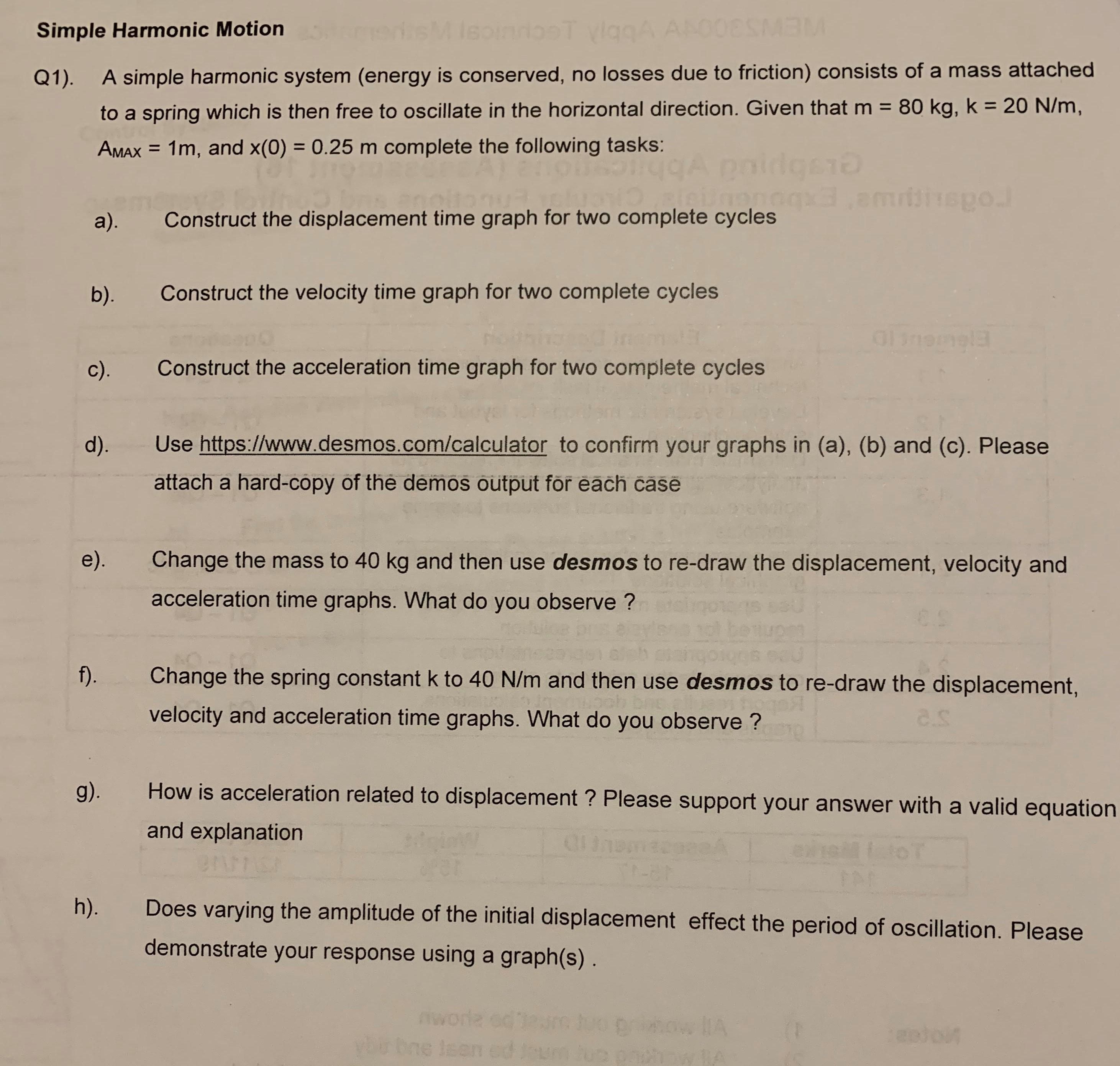
gA A 008SMB snd Simple Harmonic Motion A simple harmonic system (energy is conserved, no losses due to friction) consists of a mass attached 80 kg, k 20 N/m, Q1). 1 to a spring which is then free to oscillate in the horizontal direction. Given that m = AMAX = 1m, and x(0) = 0.25 m complete the following tasks: 9A paidge YOionq amsgol Construct the displacement time graph for two complete cycles a). Construct the velocity time graph for two complete cycles b). ELiuo gla Construct the acceleration time graph for two complete cycles c). Use https://www.desmos.com/calculator to confirm your graphs in (a), (b) and (c). Please d). attach a hard-copy of the demos output for each case Change the mass to 40 kg and then use desmos to re-draw the displacement, velocity and e). acceleration time graphs. What do you observe? f). Change the spring constant k to 40 N/m and then use desmos to re-draw the displacement, velocity and acceleration time graphs. What do you observe? How is acceleration related to displacement? Please support your answer with a valid equation g). and explanation enrrc Does varying the amplitude of the initial displacement effect the period of oscillation. Please h). demonstrate your response using a graph(s) 1 HA vbe bne Ison ed Jeum wtA
Step by Step Solution
3.33 Rating (153 Votes )
There are 3 Steps involved in it
To solve this simple harmonic motion problem lets break it down step by step Given Mass m 80 textkg Spring constant k 20 textNm Maximum displacement A... View full answer

Get step-by-step solutions from verified subject matter experts
 Study Help